


The case is free and open source. The STL and STEP files and the CadQuery code that makes them are on GitHub under the CERN-OHL-S v2 licence.
Get the files on GitHubThe Tang Nano 9K case is a two part 3D printable enclosure for the Sipeed Tang Nano 9K, a small FPGA board with a Gowin GW1NR-9 chip. The board outline, the two mounting holes and the pin header rows come from Sipeed’s own dimensional drawing, and the case is generated from Python code with CadQuery, so every size can be changed and the files built again with one command.
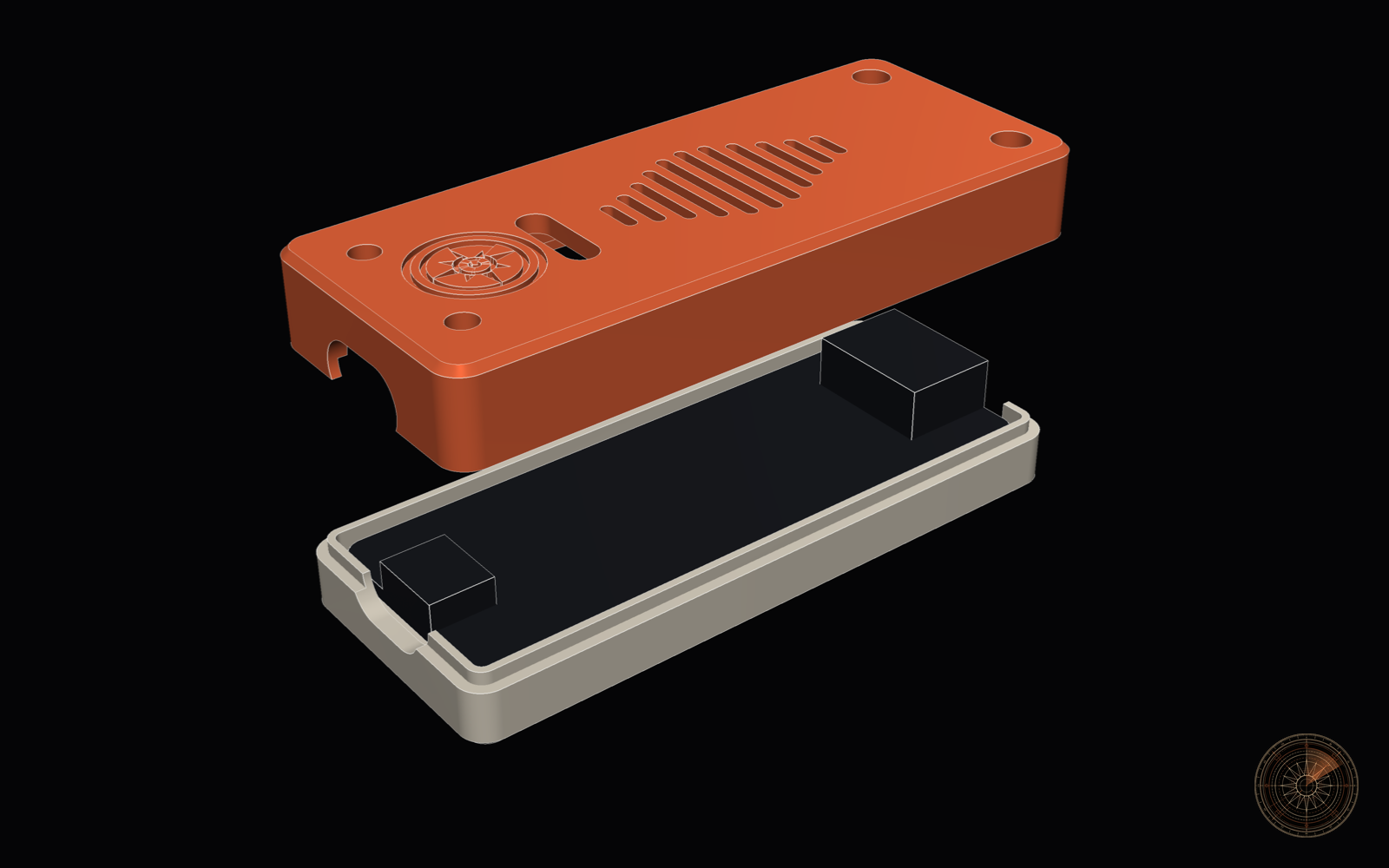
The case is not printed yet and not tested with a real board. The fit was checked in CAD only, against a simplified board model. Component heights are estimates, because the Sipeed drawing does not give them.
| Item | Value |
|---|---|
| Board | Sipeed Tang Nano 9K, 70.0 x 26.0 mm (Sipeed drawing) |
| Outer size | 74.8 x 30.8 x 16.6 mm |
| Parts | Base and lid, two M2 x 14 screws through the board holes |
| Openings | USB-C plug, HDMI plug, S1 and S2 button holes, window over the six user LEDs |
| Underside | Slots for soldered 2 x 24 pin headers |
| Vents | 11 slots whose lengths follow a Boltzmann distribution |
| Materials | Nylon PA12 (MJF or SLS), or PETG on an FDM printer |
| Files | STL and STEP for base and lid, two variants |
| Licence | CERN-OHL-S v2 |
| Check | Result |
|---|---|
| Board outline, holes, header rows | Taken from the Sipeed DXF drawing |
| Fit in CAD (base, lid and board model) | 0.000 mm3 overlap in all six checks, run again on every change |
| Printed | No |
| Fit tested with a real Tang Nano 9K | No |
| microSD card access | Not designed, the drawing does not show the slot |
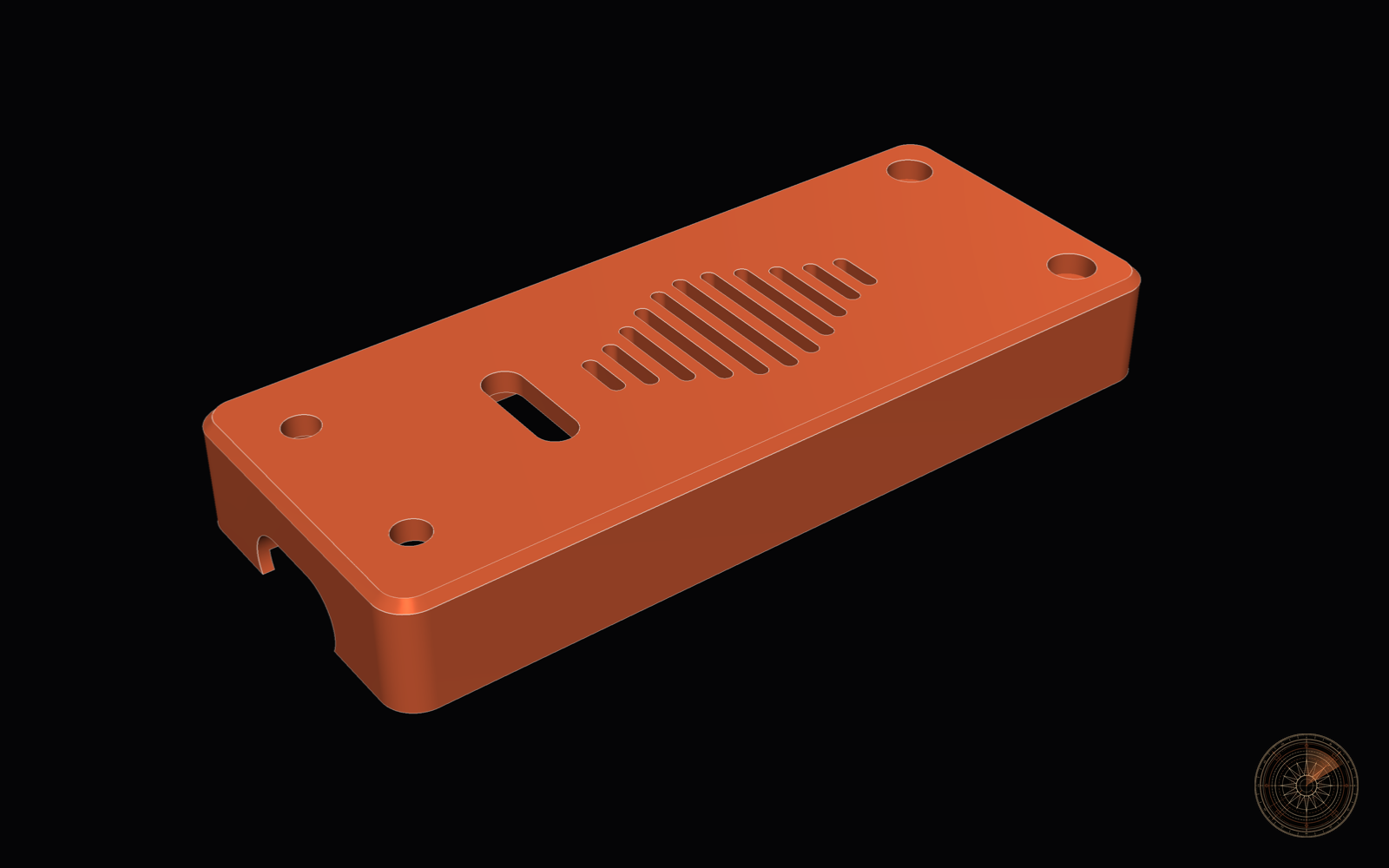
The plain variant carries only a part number and the licence name under the base. The branded variant adds a compass mark on the lid, a simplified engraving of the project logo, and the source address under the base. The branded variant is for personal prints only. Any print that is sold uses the plain variant. The shape is the same in both. Every design in the repository shares one shape language, the same edge radius, chamfer and Boltzmann vent row, so the parts read as one family without a logo.
The Tang Nano 9K is one of the boards on the thermodynamic computing hardware list, large enough for a small Ising lattice of p-bits updated by chromatic block Gibbs sampling. The open source thermospike library compares p-bit sampling with sampling by stochastic spiking neurons, and its planned FPGA reference design runs on this board. The case is the housing for that bench. A thermal noise true random number generator can feed the same samplers with physical noise in place of software noise.
The project behind this site treats consciousness as an emergent property that does not depend on one physical substrate. Measuring what the same sampling computation costs on different substrates, p-bits, spiking neurons, software noise or thermal noise, is one concrete way to test what a substrate changes and what it leaves the same.
python build.py.No printed case is for sale yet. A print service listing follows only after a real print has been tested with a board. If you want a printed case, the button counts it. When 10 different people ask, a printed version is planned.
Every kit for p-bits, spiking neurons, EEG recording and satellites, with sellers and prices, is on the hardware kits page. The thermodynamic computing section explains how p-bits sample a Boltzmann distribution, and the Kerem Camsari article on a one million p-bit FPGA computer shows the same method at a far larger scale.