


Artificial Kuramoto Oscillatory Neurons (AKOrN), What They Bind and What Hardware Can Run Them
Artificial Kuramoto Oscillatory Neurons, or AKOrN, are units that oscillate instead of firing past a threshold. Takeru Miyato, Sindy Löwe, Andreas Geiger and Max Welling introduced them in arXiv:2410.13821, first posted on 17 October 2024 and accepted as an oral paper at ICLR 2025. Each unit is a point that rotates on a sphere, and coupled units pull each other into step. Units that fall into the same rhythm are read as belonging together, which makes synchrony a candidate answer to the binding problem.
In short, AKOrN binds features through phase locking, and the authors report gains on unsupervised object discovery, adversarial robustness, calibrated uncertainty and reasoning. This project uses an AKOrN-style layer to bind its modules, and its own measurements show that the layer does not yet carry stimulus content.
How Artificial Kuramoto Oscillatory Neurons work
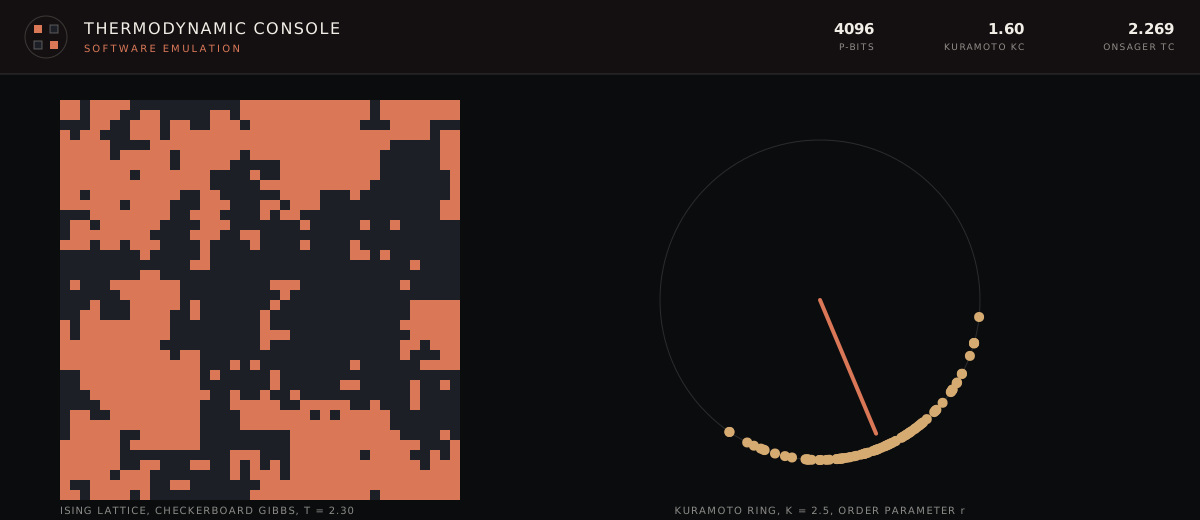
The design starts from the Kuramoto model, which Yoshiki Kuramoto proposed in the 1970s for many oscillators with different natural frequencies. Each oscillator turns at its own rate and is pulled toward the others in proportion to a coupling strength K. Below a critical coupling the oscillators drift apart. Above it a growing group locks into one rhythm. The order parameter R measures that locking, from 0 for no common phase to 1 for full synchrony.
AKOrN generalizes the phase from a point on a circle to a unit vector on an N-dimensional sphere. The update has three parts.
| Term | What it does |
|---|---|
| Natural frequency | A skew-symmetric matrix rotates each unit on its sphere |
| Coupling | The pull from connected units, projected onto the tangent plane of each unit so the unit stays on the sphere |
| Stimulus | The input acts as an external field that biases the rotation |
The connections can be fully connected, convolutional or attention based, so the same unit drops into most deep network designs. The reference code is public at github.com/autonomousvision/akorn, released by Geiger’s Autonomous Vision Group in Tübingen.
The Thermodynamic Computing hub runs the circle and sphere versions of the Kuramoto model in the browser. Its Kuramoto view lets you raise K and watch R climb as the ring locks.
Why synchrony is a candidate for binding
The binding problem asks how a brain joins features that separate areas process, such as colour, shape and motion, into one object. One long-standing proposal is temporal binding. Neurons that code features of the same object fire in synchrony, and neurons that code different objects do not. Wolf Singer’s group defended this view with gamma-band synchrony in visual cortex, and it is set out with its latency limits in the post on Wolf Singer’s temporal binding.
AKOrN makes that proposal trainable. In an AKOrN network, synchrony is the state the network computes with. That is the reason this project adopted it. Oscillatory binding is one of the six neurobiological features, taken from Todd Feinberg and Jon Mallatt, that guide the architecture.
What this project measured with its AKOrN layer
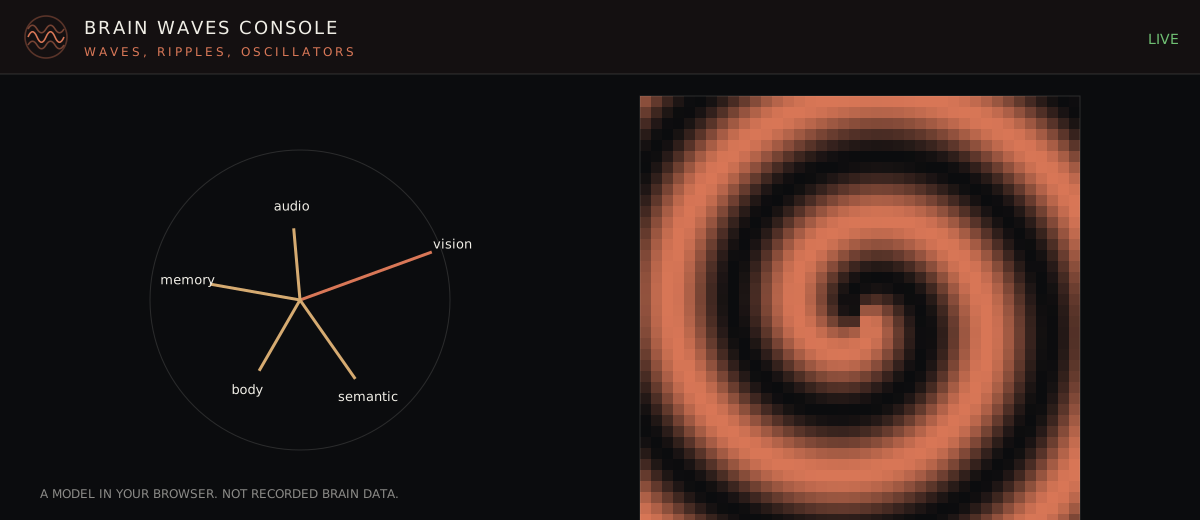
The project’s binding layer, WorkspaceBindingSystem in models/core/oscillatory_binding.py, runs five module oscillators with the tangent-plane coupling of the N-sphere model. Each module’s bid sets its oscillator’s amplitude, and the layer reports a synchrony value, sync_R. The measurements below are from September 2026 and are published in the repository.
| Test | Result |
|---|---|
| Natural frequency term | A defect made it exactly zero. The update read only the diagonal of a skew-symmetric matrix, and that diagonal is zero, so the oscillators could only relax to a fixed point (report) |
| sync_R with the defect | Without the fix, 48.39 to 85.43 percent of steps sat at one sync_R value, depending on the seed |
| sync_R with the fix | The fix is behind the flag --akorn-natural-frequency. With it, 0.0375 percent of steps sat at one value, and the oscillators keep moving |
| Stimulus content in sync_R | FAILED at all 3 seeds, with and without the fix. With the fix, eta-squared for 6-class shape was 0.0021, 0.0023 and 0.0120 against permutation null 95th percentiles of 0.0168, 0.0044 and 0.0391 (report) |
| Frozen layer on one task | On the delayed match-to-sample task, sync_R took one value over 13,600 steps because only one of five modules received input. With audio added on a second task, it took 553 distinct values (report) |
The reading is narrow. The layer now moves, and it moves when more than one module has input. It does not report which stimulus was shown. Once the oscillators converge, sync_R reduces to the mean of the module bids. So the project has an oscillatory binding mechanism in its code and no evidence yet that the mechanism binds content. None of the project’s consciousness indicators moved on these results.
The Brain Waves Console runs the five workspace oscillators with the same equations as the code, including the defect and the fix.
What hardware can run Kuramoto oscillators
The AKOrN paper runs on GPUs, and so does this project. A coupled oscillator network is also a natural fit for analog and parallel hardware, because each oscillator can be its own circuit. The options sold today are limited, and the thermodynamic computing hardware guide lists them with what each one can and cannot do.
| Hardware | What it can run | Limit |
|---|---|---|
| GPU or CPU | The full AKOrN update, as in the paper and in this project | Steps through time on a clock |
| FPGA board | A discrete Kuramoto update for many oscillators in parallel, one circuit per oscillator | Digital emulation of the same equations, written by the user |
| THE ANALOG THING | Linear oscillators as continuous voltages. Two integrators make one harmonic oscillator, so its five integrators hold two coupled oscillators | Kuramoto’s sine coupling needs function blocks the board does not have |
No board on that list runs AKOrN out of the box, and the project has no driver for any of them. The analog computer shows the physics of coupled oscillation in real voltages. The FPGA shows the parallel update. Neither one is a trained AKOrN network.
What this means for the consciousness question
Temporal binding is one of the few theories of conscious unity that makes a physical prediction. Features of one experience should share a rhythm. AKOrN turns the prediction into a network that can be trained and tested, and the authors’ results show that synchrony helps networks separate objects. That is evidence that the mechanism can group features. Whether synchrony carries conscious content, in a network or in a brain, is a separate question that these results leave open.
This project’s results sharpen the gap. A synchrony signal can vary and still say nothing about the stimulus. Any claim that a system binds through oscillation needs the content test, and the project’s layer fails it today. The broader evidence on cortical waves, rather than single rhythms, is reviewed in Earl Miller’s case for analog cognition and traveling waves.
What is known and what is not
Known on 29 October 2026. Artificial Kuramoto Oscillatory Neurons are published, peer reviewed at ICLR 2025, and open source. They bind features through synchrony and improve object discovery and robustness in the authors’ experiments. This project’s AKOrN-style layer runs, its natural frequency defect is fixed behind a flag, and it moves when two or more modules have input.
Not known. Whether synchrony in an AKOrN network carries the identity of what it binds in this project’s agent. Whether any physical oscillator hardware can run a trained AKOrN network at scale. Whether oscillatory binding in any substrate is linked to consciousness. The project’s measurements answer the first question with a failure for now, and the other two stay open.
Researchers covered here
- Takeru MiyatoPreferred Networks, Inc.; PhD student, Autonomous Vision Group, University of TübingenFirst author of Artificial Kuramoto Oscillatory Neurons (ICLR 2025 oral), and earlier work on spectral normalization and adversarial training methods for semi-supervised learning
- Max WellingProfessor of Machine Learning, University of Amsterdam; Chief AI Officer, CuspAICo-author of Artificial Kuramoto Oscillatory Neurons (Miyato, Löwe, Geiger and Welling, ICLR 2025), Neural Wave Machines with T. Anderson Keller (ICML 2023), and foundational work on variational inference, geometric deep learning and graph neural networks
- Andreas GeigerProfessor of Computer Science, University of Tübingen, head of the Autonomous Vision Group, Tübingen AI CenterCo-author of Artificial Kuramoto Oscillatory Neurons (Miyato, Löwe, Geiger and Welling, ICLR 2025), whose code is released by his Autonomous Vision Group, and the KITTI benchmark for autonomous driving