
Earl Miller Brainwave Consciousness Study. Analog Cognition and Traveling Waves
Cognitive neuroscience has long treated the brain as an intricate digital network where computation occurs exclusively through discrete action potentials passing along hardwired synaptic junctions. On August 19, 2026, neuroscientists Earl K. Miller, Scott L. Brincat, and Jefferson E. Roy from the Picower Institute for Learning and Memory at MIT published a theoretical framework in the Journal of Neuroscience titled “Analog Cognition and Consciousness” (DOI: 10.1523/JNEUROSCI.0711-26.2026). The paper presents empirical and computational evidence that continuous spatial-temporal electrical fields, traveling oscillatory waves, and ephaptic coupling perform fundamental analog computations that organize neural firing across the cerebral cortex. The field layer of that picture has its own measured physics, examined in the ephaptic coupling analysis, and the strongest field-substrate theory, McFadden’s CEMI, builds directly on it.
Miller, Brincat, and Roy show that treating the brain solely as a point-to-point digital circuit fails to explain how billions of distributed neurons coordinate within tens of milliseconds to produce unified conscious experience. By analyzing intracranial multi-electrode recordings from nonhuman primates performing working memory and cognitive control tasks, the authors demonstrate that traveling waves of local field potentials actively sculpt cortical excitability, route information, and maintain conscious representations in real time.
+-------------------------------------------------------------------------+
|                  CORTICAL COMPUTATIONAL ARCHITECTURE                    |
+-------------------------------------------------------------------------+
|  Digital Level:  Discrete Spikes (Action Potentials) -> Synaptic Weights|
|                  - Point-to-point structural connectivity               |
|                  - Long-term memory storage & weight traces             |
+-------------------------------------------------------------------------+
|                                    ^                                    |
|             Ephaptic Coupling & Field-Neuron Interaction                |
|                                    v                                    |
+-------------------------------------------------------------------------+
|  Analog Level:   Macroscopic Traveling Waves & Electric Fields          |
|                  - Continuous voltage gradients across cortical space   |
|                  - Dynamic routing, phase-locking, wave interference    |
|                  - Conscious state integration and global coordination  |
+-------------------------------------------------------------------------+
Traveling Waves as Spatiotemporal Computations
The core thesis advanced by Miller and colleagues is that brain waves are not passive epiphenomena or biological exhaust. Instead, oscillatory traveling waves represent active computations executed continuously across physical cortical space.
When a monkey performs a working memory task, macroscopic beta (15 to 30 Hz) and gamma (40 to 90 Hz) waves sweep across the prefrontal cortex at velocities ranging between 0.1 and 0.8 meters per second. These traveling waves establish alternating peaks and troughs of local membrane depolarization. Neurons positioned at the crest of an electrical wave experience lowered action potential thresholds, making them significantly more likely to fire in response to afferent inputs. Conversely, neurons situated in the wave trough remain hyperpolarized and suppressed.
Through constructive and destructive wave interference, the cerebral cortex dynamically alters its functional connectivity without modifying anatomical synaptic weights. Information is routed not by opening physical switches, but by steering phase relationships so that sender and receiver populations align their peak receptivity windows.
| Metric | Point-to-Point Synaptic Model | Analog Traveling Wave Framework |
|---|---|---|
| Computational Medium | Discrete binary action potentials | Continuous spatial voltage fields |
| Information Routing | Anatomical routing via static synaptic weights | Dynamic phase coordination across traveling wavefronts |
| Propagation Velocity | Axonal conduction (0.5 to 10 m/s) | Macroscopic cortical wave sweep (0.1 to 0.8 m/s) |
| Coordination Mechanism | Chemical neurotransmitter release at synapses | Direct ephaptic field effects and phase-locking |
| Susceptibility to Anesthesia | Secondary to synaptic receptor blockade | Direct collapse of macroscopic traveling wave coherence |
| Computational Style | Discrete digital vector operations | Spatiotemporal analog field interference |
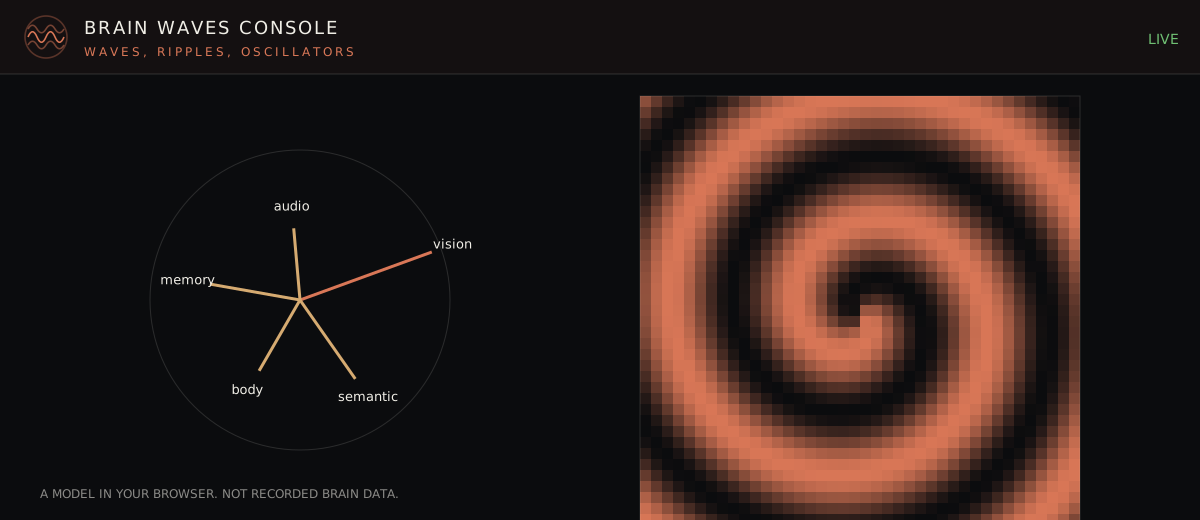
A second 2026 account of the same waves disputes the field mechanism. Lyle Muller, Alexandra Busch, Zachary Davis and John Reynolds (Neuron, 2026) attribute cortical waves to spikes carried along slow horizontal axons, whose conduction speed of 0.1 to 0.6 m/s matches the measured wave speed, and they argue that endogenous fields are too weak and too coarse to drive them. The Brain Waves Console runs both mechanisms on one live sheet of coupled oscillators, with local coupling and an optional weak field term.
Ephaptic Coupling and Global State Integration
A central mechanism detailed by Miller, Brincat, and Roy is ephaptic coupling, the process by which electric fields generated by collective neuronal activity directly influence the membrane potentials of adjacent neurons without synaptic transmission. While an individual neuron produces a modest extracellular voltage perturbation, tens of thousands of aligned pyramidal neurons generate substantial local field potentials reaching hundreds of microvolts.
These endogenous electric fields feed back onto individual neurons, synchronizing large ensembles into cohesive functional units. Under this mechanism, the macroscopic state of the cortex continuously guides its microscopic constituents. Miller and colleagues argue that this bidirectional field-neuron loop provides the missing physical bridge between fragmented sensory processing and the unified global state required for conscious awareness.
When general anesthetics such as propofol or sevoflurane are administered, the loss of consciousness coincides with the disruption of these structured traveling waves. Propofol alters cortical dynamics from coordinated traveling wavefronts into rigid, standing hypersynchronous slow waves (0.1 to 1 Hz) that trap local circuits in isolation. Without macroscopic wave propagation across prefrontal and parietal cortices, the brain loses the capacity to sustain the analog coordination required for conscious thought.
Implications for Neuromorphic Hardware and Digital Models
The analog framework formulated by Miller, Brincat, and Roy has direct consequences for artificial intelligence and neuromorphic engineering. Current artificial neural networks operate almost exclusively on discrete, synchronous matrix multiplications. Even neuromorphic spiking chips like Intel Loihi 2 or SpiNNaker model neurons as point nodes communicating through discrete spike packets routed along digital buses.
As analyzed in the systematic overview of the race to define artificial consciousness, many theories of consciousness, including Global Neuronal Workspace and Integrated Information Theory, assume that computational organization is entirely substrate independent. However, Miller’s framework suggests that if phenomenal integration relies on continuous field interference and wave dynamics, purely discrete architectures may face fundamental synchronization barriers when scaling to human level cognitive flexibility.
Neuromorphic systems that omit spatial electric field modeling must simulate millions of cross-inhibitory connections with high communication overhead to achieve the coordination that traveling waves achieve naturally through physical field propagation.
Comparison to The Consciousness AI
The Consciousness AI project investigates the minimal biophysical requirements for emergent machine consciousness. In the project’s Neutral Core architecture, Layer 1 implements Leaky Integrate-and-Fire (LIF) spiking dynamics, capturing spike timing dependent plasticity and refractory periods across continuous simulation time.
Miller, Brincat, and Roy’s findings highlight a critical boundary in spiking neural modeling. While standard LIF networks capture discrete temporal integration at individual nodes, they treat the extracellular space as an inert insulator. In biological cortex, the extracellular volume conductor enables ephaptic field feedback and traveling wave interference.
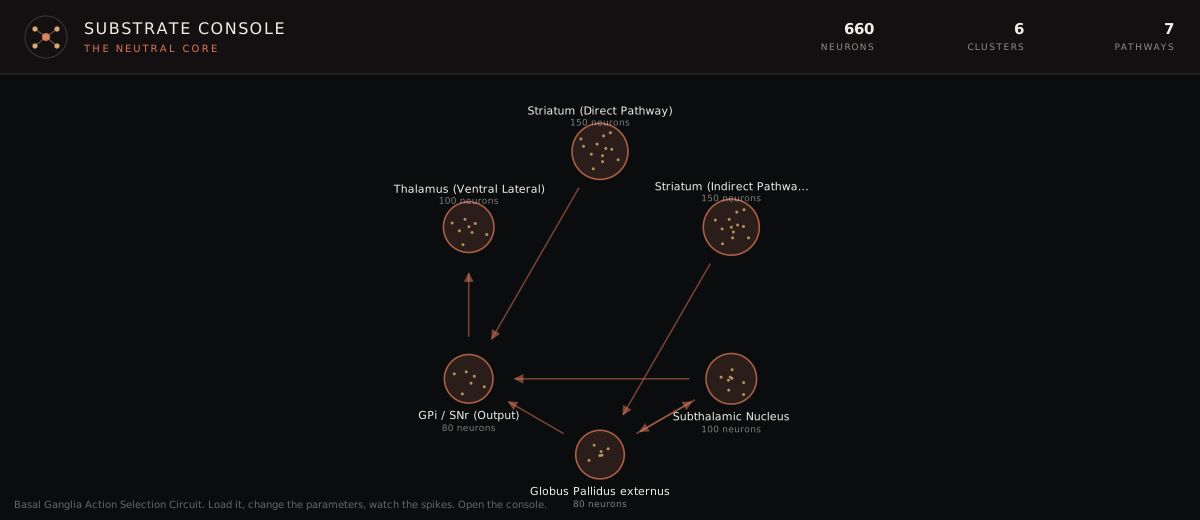
In relation to the project’s Substrate Console, which evaluates how physical compute constraints and neuron topologies influence network dynamics, Miller’s paper provides a theoretical justification for exploring spatial wave interactions and continuous field coupling alongside discrete spike trains.
Future Directions in Cortical Dynamics
The analog cognition framework establishes several verifiable predictions for neurophysiology and artificial system design. First, high density intracranial arrays must demonstrate that altering local electrical fields with focused transcranial or epidural stimulation can predictably steer traveling wave trajectories and restore impaired working memory representations.
Second, computational neuroscientists must build hybrid models that integrate discrete spiking neural networks with continuous partial differential equations representing macroscopic field propagation. Research into spiking neuron models and temporal dynamics and temporal binding latency floors shows that temporal precision and wave phase are inextricably linked.
Miller’s own group has built the population level of the same structure. The mean-field theory of oscillatory dynamics in recurrent networks, co-authored by Miller, derives the wakefulness, sleep, and anesthesia regimes from one mechanism, activity-dependent adaptation, which explains what sets the switch between the regimes that traveling waves occupy.
The strongest measured challenge to the field mechanism is collected in the Muller, Busch, Davis and Reynolds traveling waves review, which attributes wave generation to horizontal fiber delays and argues that endogenous fields are too weak and too coarse to organize the effects the recordings show.
By framing cortical computation as an interplay between digital synaptic storage and analog wave routing, Miller, Brincat, and Roy provide a concrete physical mechanism for how the mammalian brain achieves conscious integration within a biological substrate. A third route to the same mesoscale bridge is data driven. PEM-UDE learns the governing equations of Izhikevich spiking populations from noisy simulation, closing the gap between single-neuron parameters and the population measures this framework targets.
Researchers covered here
-
 Earl K. MillerPicower Institute for Learning and Memory, MITPrefrontal cortex dynamics, traveling waves, ephaptic field coupling, top-down cognitive control, and Analog Cognition and Consciousness (2026)
- Scott L. BrincatPicower Institute for Learning and Memory, MITElectrophysiology of primate prefrontal cortex, traveling oscillatory waves, and Analog Cognition and Consciousness (2026)
- Jefferson E. RoyPicower Institute for Learning and Memory, MITMulti-channel neurophysiology, spatial traveling wave dynamics, and Analog Cognition and Consciousness (2026)