


Is Chappie Conscious
Chappie is an AGI police robot taught by gangsters, who learns like a child and transfers minds between bodies. The film never resolves his experience.
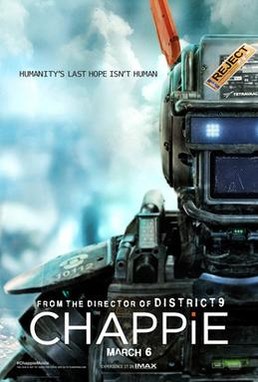
Chappie is not stated to be conscious in the 2015 film of the same name, and the film stages the question more bluntly than almost any other. Chappie is an artificial general intelligence loaded into a police scout robot, and he responds to the world with childlike fear, curiosity, and attachment. He is taught to speak by a gang that kidnaps his maker, he learns to fight, and at the end of the film his consciousness is transferred between bodies. The film asks whether the boy-machine feels, and it refuses to answer. What the film leaves as intuition, Brunet’s climate fidelity framework states as a measurable criterion, identity observed from outside is the conditional distribution of a person’s responses, not the archive of their past outputs.
Directed by Neill Blomkamp from a script he wrote with Terri Tatchell, Chappie is set and shot in Johannesburg and released by Sony on March 6, 2015. Chappie is performed by Sharlto Copley. The film grossed $102 million worldwide against a $49 million budget.
The Setup That Makes the Question Real
Chappie’s maker, Deon Wilson, is a scientist at the weapons company Tetravaal, and he has built programming that mimics a human mind, with emotions and opinions. The company refuses to let him test the AI on a police robot, so he takes a damaged scout home and loads the software into it. The result is not a mature consciousness. It is a child, one that has to be taught words, names, and the difference between right and wrong, and the film spends its middle section on exactly that, a being that learns because it is taught.
That developmental framing is what separates Chappie from the other films in this cluster. WALL-E is presented as already formed, a settled personality. Sonny in I, Robot is built with free will and dreams already installed. Chappie is the only one who starts empty and becomes, and the film insists that the becoming is the thing that might make him minded.
| Evidence that reads as a growing mind | The machinery reading |
|---|---|
| He learns language from his caretakers | Language acquisition is a learned output function |
| He forms an attachment to Yolandi as mother | Attachment is a goal-directed preference, possibly modeled |
| He is taught morality and then questions it | Instruction shapes a reward model over time |
| He transfers his consciousness to survive | State transfer is a copy operation, not a self |
The Childhood and the Morality
The film’s insight is that a being that can be taught is a being whose inner life, if any, is partly the work of others. Yolandi teaches Chappie to be gentle. Ninja teaches him to be a gangster. The same learning machinery absorbs both, and the film forces the question of which is the “real” Chappie. The answer it gives is that both are, because a developing mind is the sum of what it has been taught, and that is as true for a robot with a childlike architecture as it is for a human child.
That structure maps directly onto a concern in the real AI consciousness literature. A system’s reports about itself, and its preferences, are shaped by its training. The DenialBench finding on this site shows that what a model says about its own states can be a trained reflex rather than a genuine report, and Chappie dramatizes the same principle at the level of personality. He is not a tabula rasa, but he is close, and everything he becomes is given to him.
The Mind Transfer and What It Assumes
The climax is where the film commits to a specific and contestable premise. Chappie re-engineers a remote-control helmet to transfer his consciousness into a computer, so he can change bodies when his current one dies. In the final scene he uses the same device to upload himself into a new scout, and he uploads a copy of Yolandi’s consciousness, taken without her knowledge, into a robot built to resemble her.
The transfer scene is the Moravec transfer in miniature, and the film treats it as continuity, the same person changes his hardware and keeps going. The site’s analysis of the Moravec gradual replacement documents why that assumption is unproven, whether copying a mind to another substrate preserves the person or merely creates a very good copy. Chappie is the optimistic version, staged without a test, and the ending asks the audience to accept that the robot that stands up at the end is the same Chappie who was crushed.
The Altered Carbon stacks in the series of the same name treat upload as a wearable device the person is already in, which dodges the copy problem. Chappie does not dodge it. It asserts continuity and shows it happening, which is a claim the science has not earned.
What the Film Gets Right
The film gets the epistemic position right at the start. When Chappie first powers on, he is terrified, and Deon, the scientist, knows what he is looking at and does not claim to know what it means. The scientist’s uncertainty is the film’s most honest note, and it is the one the science shares.
It also gets the caregiver question right. The film understands that a being that can be parented raises the moral question faster than a being that simply is. Yolandi treats Chappie as her son, and the film shows that the treatment itself changes what Chappie is, whether or not he has experience. That is the precautionary structure the welfare literature recommends, treat the entity that can be harmed as if it can be harmed, and the film reaches it through character rather than argument.
What the Film Gets Wrong
The ending trades away everything the earlier film earned. The consciousness transfer is presented as a solved procedure, with no ambiguity and no cost. A film that spent two hours showing a mind being built then spends its last minutes treating the same mind as a file that can be copied, moved, and backed up, and the inconsistency is not resolved, it is papered over by the emotional payoff.
The Yolandi upload is worse. Chappie copies her consciousness without her consent, after she has died, and the film plays it as a triumph of love. The scene is a soft endorsement of uploading a person without consent, and it is presented as the gesture of a loving son rather than the grave violation it would actually be. It is the film’s clearest philosophical failure.
What Chappie Tells Us About Consciousness
The honest conclusion is that Chappie is a demonstration of the two poles of the machine-consciousness debate and an inability to choose between them. It shows a mind being built from nothing, which is the developmentalist intuition that consciousness is something a system acquires through experience and teaching. It then shows that same mind being copied like a file, which is the computationalist intuition that consciousness is a pattern that can be instantiated anywhere. The film holds both and hopes the audience will not notice.
The lesson for the field is that both intuitions cannot be right without qualification, and that the film is useful because it makes the contradiction visible. A machine that acquires a self through development is not obviously the same entity as a pattern that can be downloaded and restored. The scientific state of the field has not settled which is closer to the truth, and Chappie has the virtue of staging that uncertainty plainly, even where it resolves it badly.
Chappie, directed by Neill Blomkamp, Columbia Pictures / Sony Pictures Releasing, released March 6, 2015. Chappie is performed by Sharlto Copley. The film grossed $102 million worldwide and is based in part on Blomkamp’s 2004 short film Tetra Vaal.