How Cortical Stacks Work in Altered Carbon and What Resleeving Would Cost
A stack stores the mind and a sleeve is any body it runs in. Altered Carbon assumes substrate independence and then shows what the assumption breaks.
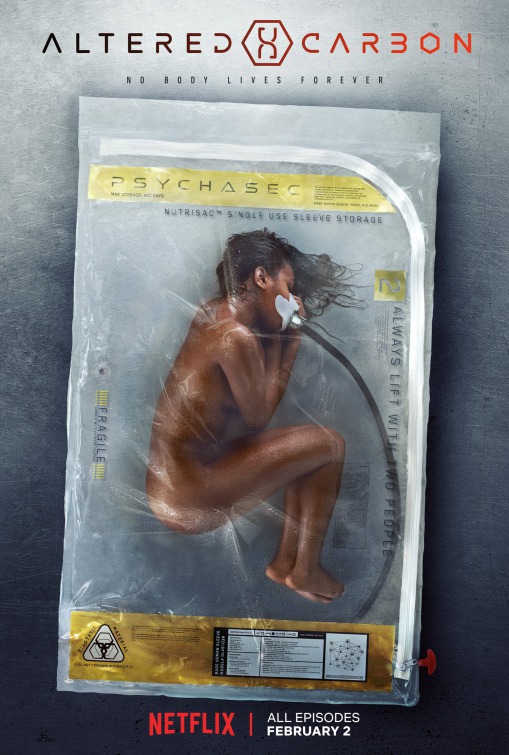
A cortical stack in Altered Carbon is a device implanted at the base of the skull in early childhood that records and stores a person’s mind. The body is called a sleeve and is treated as replaceable hardware. Destroying a sleeve is recoverable, and the stack can be placed in a new one. Destroying the stack is what the setting calls real death. The series, adapted from Richard K. Morgan’s 2002 novel, assumes substrate independence as a settled fact and then spends its running time on what that assumption costs. Real hardware sets the scale the stack waves away, and current cortical interfaces record thousands of channels where bridging consciousness across a synthetic corpus callosum would need hundreds of millions. Brunet’s identity framework for AI personality clones formalizes what resleeving dramatizes, that identity from the outside is judged over time by indiscernibility, and a copied past does not guarantee a matched future.
| Term | What it means | The question it raises |
|---|---|---|
| Cortical stack | The physical store holding the mind | Whether a mind can be a stored object at all |
| Sleeve | Any body a stack is installed in | Whether the body contributes to the mind it carries |
| Real death | Destruction of the stack itself | Whether the stored pattern is the person or a description of one |
| Resleeving | Installing a stack in a new body | Whether the same person continues, or a successor begins |
| Double sleeving | Running two copies of one person at once | Whether identity can branch, and which branch is the original |
The Setting Assumes the Answer
Most fiction about uploading treats the transfer as the dramatic question. Altered Carbon skips it. Stacks are ordinary technology, everyone has one, and nobody in the setting argues about whether a resleeved person is the same person. The legal system, the economy and the criminal code all proceed as if the answer is obviously yes.
That assumption is the functionalist position, and it is the one this project works from, described on the functionalist emergentism page. If consciousness is a property of organisation rather than of a specific material, then the material can be swapped and the mind persists.
What makes the series worth reading closely is that it does not let the assumption sit comfortably. Every major plot problem is generated by a consequence the assumption entails and nobody planned for.
Double Sleeving Is the Real Problem
Running two copies of one person simultaneously is illegal in the setting, and the prohibition is where the philosophy actually lives.
If a stack is the person, then copying it produces two people with an equal claim to being the original. Neither is a fake. They diverge from the moment of copying and continue as separate individuals with a shared history. The setting’s response is to criminalise the situation rather than resolve it, which is an honest admission that the legal system cannot answer the question either.
This is the branching problem, and it is fatal to the simplest version of psychological continuity. If continuity of memory and disposition is what makes someone the same person, then two continuous successors are both that person, which is incoherent. The structure is examined in why a mind cannot be smeared across time, and the same difficulty appears whenever a running system is replaced by an equivalent one, discussed in model switching and the ship of Theseus.
Altered Carbon does not solve it. It shows a society that has decided not to look.
Whether the Sleeve Does Anything
The series is inconsistent here, and the inconsistency is interesting.
Officially the sleeve is hardware. In practice, characters report that different sleeves feel different, that chemical dependencies belong to the body and transfer with it, that reflexes and combat conditioning live partly in muscle, and that inhabiting a body of a different age or sex changes how a person thinks. Takeshi Kovacs is repeatedly affected by which body he is wearing.
That undercuts the clean separation the setting depends on. If the sleeve contributes to cognition and affect, then the stack does not contain the whole person, and resleeving produces a modified individual every time rather than the same one relocated.
This is the point where the embodied and affective accounts of consciousness press hardest against the pure computational reading. On Damasio’s account, bodily states are part of how decisions get made rather than inputs to a separate decision process, which is covered in somatic markers and affective consciousness in artificial systems. Mark Solms argues a stronger version in which affect grounded in the body is the foundational form of consciousness, examined in Mark Solms on building an artificial agent with affective consciousness. On either view, a stack that stores cognition without the body is storing an incomplete thing.
What the Series Gets Right
The class analysis is the strongest part and it is not incidental. The very rich back up remotely and keep cloned sleeves, so they are effectively unkillable. Everyone else risks real death whenever a stack is damaged. Immortality becomes a purchased good, and the technology’s meaning is set by who can afford it.
That is a serious prediction. If mind storage were ever possible, its consequences would be distributed by wealth rather than by philosophy, and the metaphysical question would be settled in practice by whoever owned the infrastructure long before anyone settled it in principle.
The religious objection is also handled well. Neo-Catholics refuse resleeving and are coded in the setting as obstacles, and the series lets their position stand as coherent rather than superstitious. A person who believes the process ends one life and starts another is holding a view that no argument in the show refutes.
What the Series Gets Wrong
Stacks are too small and too reliable. A device holding the entire causal structure of a mind, surviving explosions and centuries in storage, is a plot convenience rather than an engineering proposal, and the show never addresses what format the mind is in.
The series also treats memory as the whole of identity. Characters are recognisable across sleeves because they remember the same things, and everything else about them is negotiable. That is the simplest theory of personal identity available and the one with the most known problems.
Where This Sits
Altered Carbon is the most thorough popular treatment of substrate independence taken as given. Its value is not the answer, which it assumes, but the working out. It shows that accepting the functionalist position does not end the argument, because branching, embodiment and inequality all arrive immediately behind it.
For the same question staged as a single upload rather than a whole economy, see GLaDOS and what uploading would preserve. Other treatments are indexed in the guide to movies and TV shows about AI becoming conscious, and the state of the real evidence is in the current scientific consensus on AI consciousness. For what a cortical stack would actually have to read and write, measured against the 200 million axons of a real corpus callosum, see Paradromics Neuralink and what a real cortical interface would need. The destructive upload, in which the body is dismantled after the recording and the program alone continues, is staged by the Netflix series Cassandra, which is examined in the Cassandra post. A single upload performed by the entity itself, mind copied between bodies as the plot’s resolution, is examined in the Chappie analysis.