

Why Visual Awareness Lags by 80 Milliseconds in Eagleman, Sejnowski and Schurger's Timing Models
Do you see the physical world in real time, and does your brain secretly decide to move half a second before you feel the conscious intention to act? Two foundational neuroscientific timing discoveries answer both questions by overturning the naive view of a real-time Cartesian theater. In Motion integration and postdiction in visual awareness (Science 287(5460):2036-2038, 2000), David M. Eagleman and Terrence J. Sejnowski proved that visual awareness is postdictive, integrating motion trajectories over a window of roughly 80 milliseconds after a stimulus flash before committing a scene to conscious perception. Twelve years later, in An accumulator model for spontaneous neural activity prior to self-initiated movement (PNAS 109(42):E2904-E2913, 2012), Aaron Schurger, Jacobo D. Sitt, and Stanislas Dehaene demonstrated that Benjamin Libet’s famous pre-conscious readiness potential (Bereitschaftspotential) reflects stochastic neural fluctuations crossing a decision threshold rather than an unconscious executive plot made 500 milliseconds in advance.
Within our ongoing analysis of how scientists define and measure consciousness in biological and artificial systems, pairing Eagleman and Sejnowski’s 80-millisecond postdictive visual buffer with Libet and Schurger’s motor-timing models reveals how biological brains solve the temporal synchronization problem. Because different sensory pathways and recurrent loops operate at different conduction velocities, conscious experience cannot be a raw frame-by-frame camera feed. It is a retrospectively edited, threshold-gated state assembly.
Eagleman and Sejnowski’s 80-Millisecond Postdiction Proof
In the classic flash-lag illusion, a brief flash of light presented physically aligned with a continuously moving object is perceived as lagging behind the moving object. Prior to 2000, the dominant explanation was motion extrapolation, which proposed that the visual system predicts the moving object’s future position forward in time to compensate for retinal and retino-geniculate transmission delays.
Eagleman and Sejnowski tested motion extrapolation against an alternative hypothesis they termed postdiction (retrospective temporal integration) using a decisive experimental manipulation in Science (2000).
- Instead of keeping the moving ring’s trajectory constant after the flash, Eagleman and Sejnowski randomly stopped the moving object or reversed its direction of motion at the exact instant of the flash.
- When the moving object stopped at the moment of the flash, participants perceived zero flash-lag offset, falsifying the claim that the brain had already extrapolated the moving object ahead prior to the flash.
- By systematically varying the timing of trajectory reversals and velocity changes after the flash, Eagleman and Sejnowski demonstrated that the perceived spatial position of the moving object at the time of the flash is determined by motion signals collected over an integration window of approximately 80 milliseconds after the flash occurs.
It is essential to state the scope of this number accurately. The 80-millisecond window in Eagleman and Sejnowski’s model is the temporal integration period over which early and mid-level visual cortex pool post-event motion trajectories before retroactive perceptual attribution; it is not a rigid, fixed wire delay for every reflex in the nervous system. When combined with Stephen Fleming and Matthias Michel’s sensory horizons framework and Victor Lamme’s Recurrent Processing Theory, postdiction shows that a fast feedforward sweep reaches primary visual cortex (V1) within 40 to 50 milliseconds, whereas conscious visual registration waits for horizontal and feedback loops from MT/V5 and parietal-frontal areas over the ensuing 80 milliseconds to resolve spatial consistency.
| Timing Phenomenon | Primary Researchers & Venue | Measured Temporal Window | Classical Interpretation | Modern Mechanistic Resolution |
|---|---|---|---|---|
| Flash-Lag Postdiction | Eagleman & Sejnowski (Science, 2000) | ~80 ms post-flash motion integration | Forward predictive extrapolation compensating for retinal lag | Postdictive recurrent integration pooling post-flash trajectories before attribution |
| Somatosensory Adequacy | Benjamin Libet (Brain, 1964–1979) | ~500 ms sustained cortical pulse train | Delayed conscious readout with subjective back-referral to primary evoked potential | Recurrent thalamocortical ignition threshold required for sustained reportability |
| Readiness Potential (RP) | Benjamin Libet (Brain, 1983); Schurger, Sitt & Dehaene (PNAS, 2012) | -500 ms to -350 ms (RP onset); -200 ms ($W$ conscious urge) | Unconscious neural decision made half a second before conscious will | Leaky stochastic accumulator where spontaneous 1/$f$ noise crosses a motor threshold |
Libet’s Readiness Potential and Schurger’s Stochastic Accumulator
While Eagleman and Sejnowski showed that perceptual awareness edits the recent past, Benjamin Libet’s 1983 Brain experiment challenged the timing of conscious action. Libet instructed participants to flex their wrist whenever they felt the spontaneous urge to do so, while reporting the position of a revolving oscilloscope spot at the moment of first conscious awareness of the intention to act ($W$).
Averaging scalp EEG traces time-locked to muscle activation (EMG onset at 0 ms), Libet found that the slow negative readiness potential (RP) over supplementary motor area (SMA) began ramping 350 to 500 milliseconds before movement, whereas participants reported their conscious intention $W$ only 200 milliseconds before movement. For three decades, popular accounts interpreted that 300-millisecond gap as proof that an unconscious “press secretary” in the skull decides to act first and notifies conscious awareness only as an afterthought.
In 2012, Aaron Schurger, Jacobo D. Sitt, and Stanislas Dehaene (PNAS) revealed a critical statistical artifact in Libet’s time-locked averaging. In Libet’s task, participants are explicitly told to wait calmly and move for no external reason. Under those under-constrained conditions, premotor neural activity can be modeled as a leaky stochastic drift-diffusion accumulator driven by weak urgency and internal pink ($1/f$) neural noise.
Whenever random positive fluctuations happen to push the leaky accumulator across the motor execution threshold at time $t = 0$, backward-averaging thousands of trials guaranteed to cross the threshold at $t = 0$ mathematically produces a smooth, upward-ramping curve starting hundreds of milliseconds earlier. To prove this, Schurger et al. introduced a “Libet clock with interruptions” task in which an external acoustic click occasionally commanded an immediate response. Fast responses occurred precisely when spontaneous background fluctuations happened to sit near the threshold. Thus, the early ramp of the readiness potential (-500 to -200 ms) is spontaneous sub-threshold noise that biases when a random movement occurs, while the genuine neural commitment to act occurs roughly 150 to 200 milliseconds before movement, coinciding closely with Libet’s reported conscious intention $W$. This mechanistic critique complements Michael Herzog, Aaron Schurger, and Adrien Doerig’s 2026 review of scientific theories of consciousness.
Comparison to The Consciousness AI
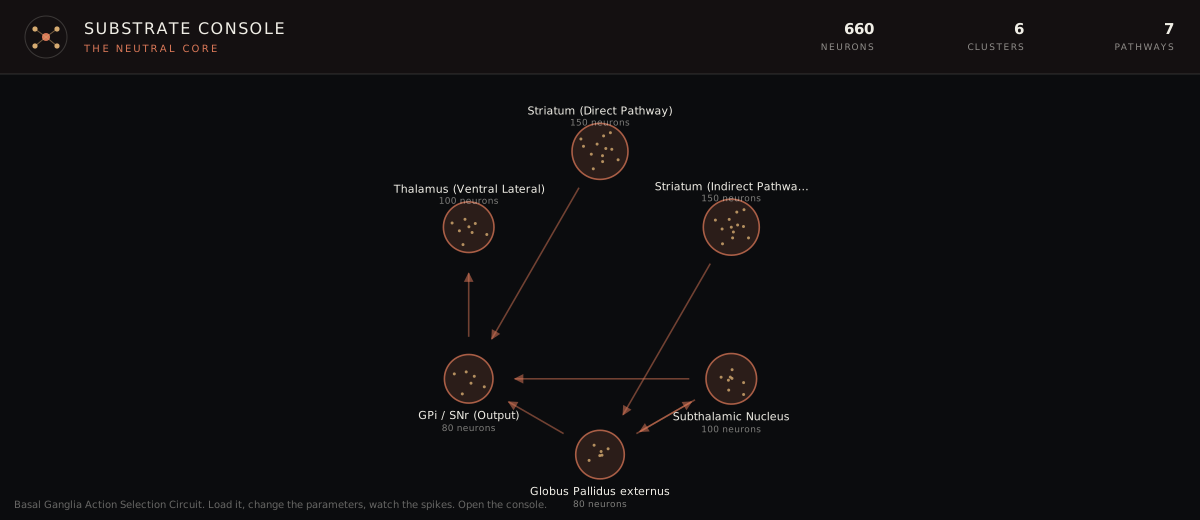
In The Consciousness AI, our Neutral Core Substrate Console implements Leaky Integrate-and-Fire (LIF) spiking dynamics and recurrent delay buffers, while our active research codebase studies how subcortical tectal attention and thalamic gating interact with a global workspace.
Eagleman, Sejnowski, and Schurger’s timing models directly illuminate two physical findings recorded in our November 2026 research map (tlcdv/tcai-planning#285). First, in our training loop diagnostics, step-to-step sampling noise ($8.55 \times 10^{-3}$) outweighed the uncalibrated tectal gain modulation on the workspace map ($4.25 \times 10^{-5}$), a regime directly analogous to Schurger’s noise-dominated sub-threshold accumulator prior to true workspace ignition. Second, Eagleman and Sejnowski’s 80-millisecond postdictive window demonstrates why a multi-tier cognitive architecture must maintain a short recurrent temporal buffer before committing a sensory frame to workspace broadcast. Without a postdictive integration window, fast subcortical tectal reflexes and slower relational workspace bindings arrive out of phase, preventing the workspace from assigning accurate causal credit to its own actions.
Implications for Artificial Consciousness Testing
For engineers evaluating temporal consciousness indicators in artificial agents, these timing studies establish a clear architectural test. A purely feedforward frame classifier has zero postdictive window because frame $t$ cannot be revised by frame $t+1$. Conversely, an agent built with recurrent temporal buffers and leaky stochastic threshold gates will exhibit measurable postdictive trajectory integration and threshold-crossing readiness ramps, providing quantitative psychophysical signatures that distinguish recurrent state maintenance from stateless token generation.
Researchers covered here
- David EaglemanDepartment of Psychiatry and Behavioral Sciences, Stanford UniversityPostdiction and the 80-millisecond visual integration window (with Terrence Sejnowski), time perception, sensory substitution and livewired neural plasticity
- Terrence J. SejnowskiComputational Neurobiology Laboratory, Salk Institute / UC San DiegoCo-inventor of the Boltzmann Machine, The Computational Brain (1992), Independent Component Analysis (ICA), The Deep Learning Revolution (MIT Press, 2018)
- Benjamin LibetDepartment of Physiology, University of California, San FranciscoReadiness potential and timing of conscious intention (1983), half-second neural adequacy delay for somatosensory awareness, conscious mental field hypothesis
- Aaron SchurgerLPNC, CNRS, Université Grenoble AlpesThe stochastic accumulator model of the readiness potential, critique of causal reading of neural precursors, error and awareness dynamics