


Intel Loihi 2 and what a neuromorphic chip in orbit would actually run
Intel Loihi 2 carries up to one million programmable spiking neurons on a single chip. That figure comes from Garrick Orchard, E. Paxon Frady and Mike Davies in the 2023 paper describing the architecture (arXiv:2304.01210), which also specifies 120 million synapses, 128 neuromorphic cores arranged in a two dimensional mesh, and fabrication on the Intel 4 process.
Those numbers are relevant to the consciousness question rather than for the efficiency question, because what separates Loihi 2 from its predecessor is programmability. The original Loihi chip fixed its neurons as leaky integrate-and-fire (LIF) units. Loihi 2 exposes microcode, so researchers can run any stateful spiking model, including the Izhikevich neuron and the Resonate-and-Fire neuron, without changing the hardware. That is the feature worth examining carefully, and it is the one that orbital hardware coverage does not address. The question is whether a chip that can express different neuron models is relevant to consciousness research, and the answer starts with what those models differ on.
Why LIF neurons are insufficient for the substrate question
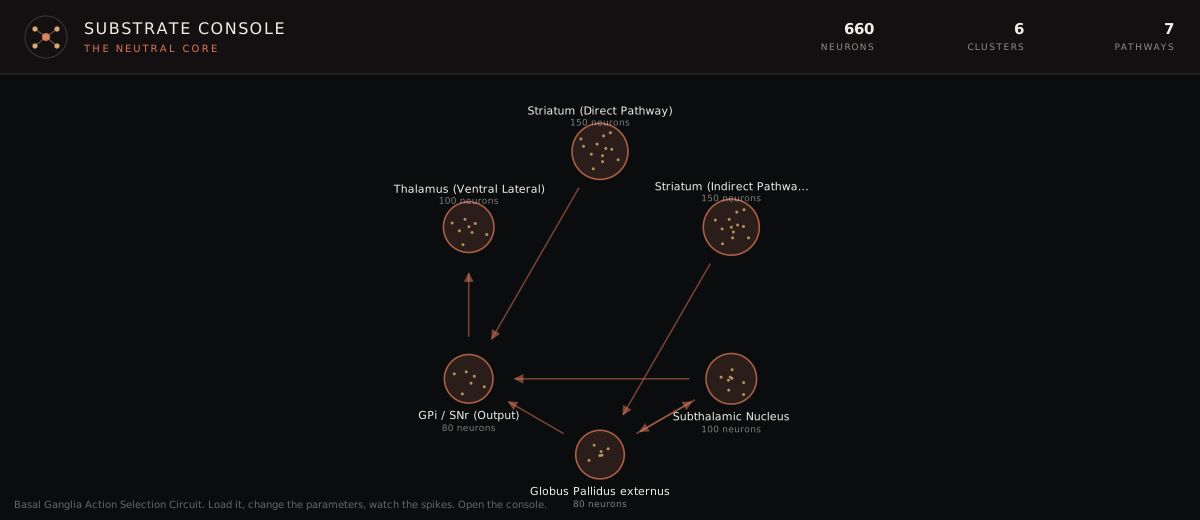
The Neutral Core runs Nengo, and its neurons are LIF units. That choice is defensible for a simulation, because LIF is computationally tractable and captures the basic threshold-and-reset dynamics of biological neurons. The limitation is that LIF neurons fire in an all or nothing pattern set by a single membrane time constant and a fixed threshold.
Eugene Izhikevich put a measurement on the gap. In his 2004 survey (IEEE Transactions on Neural Networks, DOI: 10.1109/TNN.2004.832719) he catalogued 20 neuro-computational behaviors seen in cortical recordings and scored each widely used model against all of them. A leaky integrate-and-fire neuron exhibits 3. His own 2003 two variable model can be tuned to each of the 20, using two differential equations and four parameters, at 13 floating point operations per millisecond against 5 for LIF. That combination of arithmetic cost and behavioral range is why the Izhikevich model is the standard comparison point for going beyond LIF without the 1,200 FLOPS of Hodgkin-Huxley. The dynamical argument for why the non-LIF models are relevant to recurrent consciousness criteria is set out in Eugene Izhikevich on the choice of spiking neuron model.
The relevance to consciousness is concrete. Theories that ground consciousness in specific temporal dynamics, meaning Victor Lamme’s recurrent processing theory and the Global Workspace Theory of Stanislas Dehaene and Jean-Pierre Changeux, predict that the pattern of spiking activity determines whether a system is doing the relevant computation. The presence of spikes on its own carries no weight in either theory. The August 2026 post on spiking neural networks and recurrent processing found that sustained gamma-band reverberant activity in Loihi implementations was sensitive to connectivity parameters in ways biological cortex is not. One hypothesis for that fragility is that homogeneous LIF neurons lack the diversity of temporal responses that helps biological cortex hold stable recurrent dynamics. Loihi 2’s programmable microcode makes it the first neuromorphic chip where that hypothesis can be tested directly, because researchers can vary neuron type systematically rather than only connectivity.
What flew in orbit and what it was running
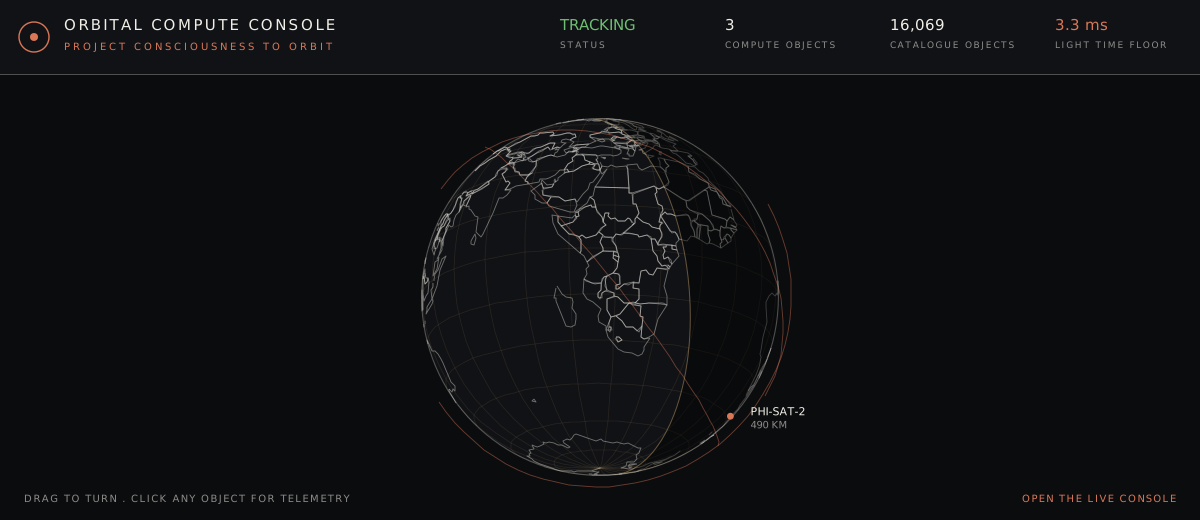
Neuromorphic hardware reached orbit before Loihi 2 was fabricated. TechEdSat-13, launched 13 January 2022 on Virgin Orbit’s Above the Clouds mission, carried a Loihi 1 chip in a Kapoho Bay USB form factor. The mission report by Marcus Murbach and colleagues (NASA Technical Reports Server, document 20220005780) describes it as the first neuromorphic processor to operate in Earth orbit. The chip ran spike-timing-dependent plasticity and spiking network routing algorithms in the radiation environment of low Earth orbit, and the hardware performed as expected through the mission duration. How on-chip plasticity and event-driven spiking dynamics address the space radiation problem without heavy physical shielding is analyzed in Radiation hardening and whether a conscious architecture can survive orbit, and the wider argument for moving a candidate mind off the planet is set out in Project Consciousness to Orbit.
The relevance for Loihi 2 is that TechEdSat-13 establishes the radiation environment as manageable for this architecture class, even though Loihi 2 itself has not flown. The Intel 4 fabrication node is not a space qualified process, and no radiation hardening has been applied to production Loihi 2 dies. Triple modular redundancy at the software level, running three copies of a spiking network and taking the majority vote, is the mitigation researchers have described for critical applications. That adds power and area overhead, which is a real cost in a mass constrained CubeSat.
The orbital compute missions tracked on the Orbital Compute Tracker include Starcloud-1, which ran an Nvidia H100 GPU in orbit from November 2025. In August 2026 Starcloud added a $250 million funding extension at a $2.3 billion valuation to scale exactly that GPU class into a fleet, the economics of which made the orbital AI data center case concrete. Raw throughput is only one axis of the comparison between a data center class GPU and a neuromorphic research chip. An H100 draws roughly 700 watts. Loihi 2 draws milliwatts per inference on sparse spiking workloads. For a satellite generating its own power from photovoltaic panels, the milliwatt figure is the enabling one. Whether that power envelope justifies the engineering investment depends on the workload. For a GPU running dense matrix multiplications, the power cost is inseparable from the computation. For a spiking network running event-driven sensory processing, most cores idle most of the time.
What Hala Point scales to and what it does not solve
Intel’s Hala Point system aggregates 1,152 Loihi 2 chips into a rack mounted research system supporting 1.15 billion neurons and 128 billion synapses, announced by Intel in 2024. Human cortex contains roughly 16 billion neurons. Hala Point therefore reaches about 7 percent of cortical neuron count, a scale comparable to a small primate cortex. It is not in orbit and is not designed to be. The comparison is relevant for a separate reason. Hala Point shows the ceiling of what the Loihi 2 architecture scales to once power and mass stop being constraints. A consciousness researcher using it can ask whether networks at that scale exhibit qualitatively different dynamics from networks at single chip scale. If the dynamics the recurrent processing criterion requires only emerge above a certain neuron count, Hala Point is where that threshold would first become visible in a silicon system.
The limitation Intel’s team has not resolved is what Gualtiero Piccinini raises in his neurobiophysical account of consciousness (Neurocognitive Mechanisms: Explaining Biological Cognition, OUP, 2020, ISBN 9780198866282), covered in the July 2026 post on Piccinini’s substrate argument. Piccinini argues that consciousness requires the specific physical processes of biological neurons, including ion channel biophysics, neurotransmitter chemistry and astrocytic modulation, and that spiking dynamics alone leave those processes out. On that view a programmable silicon spiking neuron producing the same firing pattern as a cortical neuron is doing a different computation, because the physical process generating the pattern is different. Loihi 2’s programmability does not answer that challenge. It answers the narrower question of whether a silicon system can produce the right temporal signatures. Piccinini’s challenge is whether producing the right signatures is sufficient. That remains open, and the Neutral Core at github.com/tlcdv/the_consciousness_ai frames the project’s own position honestly. The architecture is motivated by the hypothesis that temporal spiking dynamics make a difference, while acknowledging that the physical substrate question is unsettled. Where the wider field currently stands on that question is surveyed in the current scientific consensus on AI consciousness.
What a consciousness-relevant workload on Loihi 2 would need
If the Neutral Core’s LIF-based simulation were ported to Loihi 2, the immediate gain would be two things, power reduction and access to programmable neuron models. The power reduction is measurable and real. The gain from programmable neuron models depends on the question being asked. If the question is whether adding Izhikevich neurons to the basal ganglia action selection circuit changes the system’s dynamics in ways relevant to recurrent processing theory, Loihi 2 is the first hardware where that becomes directly answerable at scale. If the question is whether a silicon spiking network constitutes a genuine substrate for emerging consciousness, Loihi 2 does not resolve it, because the substrate question is prior to the architecture question.
What Loihi 2 does is move the investigation one step closer to empirical contact. LIF homogeneity is a confound in every experiment asking whether neuromorphic hardware satisfies consciousness criteria. If the fragility of sustained gamma activity in silicon comes from LIF uniformity rather than from the silicon substrate itself, then programmable neuron diversity is the variable to control, and Loihi 2 is the chip on which it can be isolated. That is a more specific claim than the ones usually made about neuromorphic computing, and it belongs to research into consciousness as a substrate-independent emergent property rather than to an orbital hardware review. Neuromorphic hardware as a potential consciousness substrate is covered in the brain emulation section. The machine that runs the same spiking dynamics at brain scale in real time is examined in the SpiNNaker post, and the strongest version of the substrate test, the same dynamics carried by light instead of electrons, is the subject of the optical neural networks post. How this project plans to test its own architecture on spiking and p-bit substrates is on the thermodynamic computing page.
Mike Davies leads the Neuromorphic Computing Lab at Intel Labs. The Orchard, Frady, Davies et al. Loihi 2 paper is at arXiv:2304.01210. The TechEdSat-13 mission report is NTRS document 20220005780. The neuron model comparison figures are from Izhikevich 2004, DOI: 10.1109/TNN.2004.832719.