PEM-UDE Learns Reduced-Order Equations for Neural Populations
Can a machine learn the governing equations of a neural population from noisy recordings, the way Kepler’s laws were learned from observation rather than derived from theory. A method called PEM-UDE, introduced by Anthony G. Chesebro, Earl K. Miller, Richard H. Granger, Alan Edelman, Christopher V. Rackauckas, Lilianne R. Mujica-Parodi, Helmut H. Strey and colleagues, does exactly that for chaotic systems, and its neuroscience application produces a law worth testing. Applied to a population of Izhikevich spiking neurons, PEM-UDE yields a multi-scale neural mass model that ties single-neuron parameters to macroscopic network dynamics and predicts a specific relationship between connection density, dominant oscillation frequency, and synchrony. The paper, “Scientific Machine Learning of Chaotic Systems Learns Reduced-Order Equations for Neural Populations” (arXiv:2507.03631, v5 updated 2026-08-17), then tests that prediction against three intracranial recording datasets from rat and human cortex.
The result is significant for consciousness science because the measures that theories of consciousness actually use, oscillatory synchrony, ignition, perturbational complexity, are population-level quantities. A method that learns the mesoscale equations connecting single-neuron parameters to those quantities supplies a bridge that has mostly been assumed rather than measured.
Prediction error feedback meets universal differential equations
PEM-UDE combines two existing ideas. The prediction error method (PEM) is a system identification technique that feeds the mismatch between predicted and observed states back into the model as it trains. Universal differential equations (UDEs), developed by Christopher Rackauckas and the SciML community, replace unknown terms in a differential equation with neural networks, so the discovered model stays partly symbolic and partly learned.
Chesebro and colleagues show that the prediction error feedback does something specific to chaotic systems. Chaotic optimization is hard because small parameter errors grow exponentially. The feedback term smooths that optimization problem. For noise-free data generated inside the model class, the method preserves the data-consistent zero-loss set, the collection of parameter values that fit the data perfectly. Noise and model misspecification introduce a gain-dependent trade-off between stability and bias.
The authors are careful about one limit. Preserving the zero-loss set is not a guarantee of unique structural identifiability. Different equation structures can fit the same data equally well. That honesty is significant, and it shapes how the neuroscience result should be read.
Two chaotic benchmarks and five to one noise
The method is tested on two benchmarks before any neuroscience is attempted. Both are standard chaotic systems where the true equations are known, so recovery can be scored.
| Benchmark | What was recovered | Hardest condition |
|---|---|---|
| Rossler attractor | Correct functional forms | One observed dimension carrying noise at five times the signal magnitude |
| A real electrical circuit | Correct functional forms | The same five to one noise regime |
Recovering the correct functional forms when one measured channel is five parts noise to one part signal is the headline technical result. Chaotic dynamics amplify noise faster than they amplify structure, which is why equation discovery from real recordings has been limited to clean, low-dimensional systems.
Sparse connectivity enters the neural mass model
The neuroscience application begins with a structural fact. Real cortical circuits are sparsely connected. Conventional neural mass models, the workhorses that reduce a population of neurons to a few state variables, generally do not carry connection density as an explicit parameter. PEM-UDE accepts prior knowledge of a system as an initial functional form, and the authors use that to learn circuit equations in which sparse connectivity is explicit.
The starting point is a population of Izhikevich neurons. The choice is deliberate. On Eugene Izhikevich’s own scoring, reviewed in our analysis of spiking neuron model choice, a leaky integrate-and-fire unit reproduces 3 of 20 observed cortical firing behaviors while the two-variable Izhikevich model reproduces all 20 at a fraction of the cost of a Hodgkin-Huxley cell. A closure learned from Izhikevich dynamics inherits a richer dynamical repertoire than one learned from LIF.
Out of that population, PEM-UDE produces a multi-scale neural mass model with two properties. Single-neuron parameters remain interpretable inside the macroscopic equations. And the model predicts a specific relationship among three macroscopic quantities, connection density, dominant oscillation frequency, and synchrony.
The macroscale that such closures must eventually describe has its own measured structure. Brain spirals in human fMRI organize whole cortex dynamics into rotating waves whose direction and location track the cognitive task, a geometric order at the top of the scale that a learned neural mass model would need to reproduce to match real cortical dynamics.
The prediction the cortex data tested
That predicted relationship is what the authors take to the data. Three intracranial recording datasets, from rat cortex and human cortex, provide the test. The observed frequency and synchrony trends are consistent with the model’s predictions.
The paper’s own framing of this evidence is a model of discipline, and it is worth quoting in substance. The learned equations are a reduced-order closure for a specified family of simulated Izhikevich networks. The experimental recordings provide an indirect consistency check of the predicted frequency and synchrony trends. They are not a direct fit of the learned equations to the recordings. The closure is validated as a closure. The cortex data confirm a trend, not an equation.
Comparison to The Consciousness AI
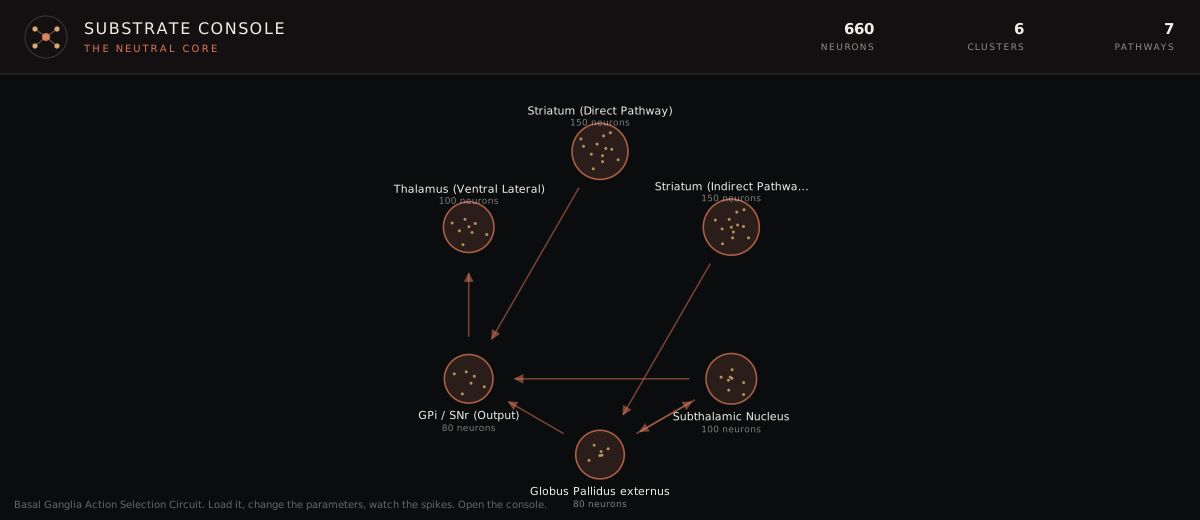
The Consciousness AI project’s substrate layer, exposed in the Substrate Console, runs Leaky Integrate-and-Fire neurons in Layer 1. That is the deliberately cheap choice, and the LIF versus Izhikevich comparison records what it costs in dynamical repertoire. PEM-UDE suggests a direction the project has not taken. Rather than assuming a mesoscale closure for the simulated spiking network, the project could learn one from its own simulation data using the same prediction error plus UDE recipe, then ask whether the learned density, frequency, and synchrony relation holds in the richer model family the comparison post describes.
The project’s binding layer uses Kuramoto oscillator phase coherence as a temporal coordination mechanism, under functionalist emergentism, the position that consciousness is an emergent property of organized dynamics and is substrate independent. A learned law connecting connection density to oscillation frequency and synchrony is exactly the kind of mesoscale regularity such a position needs, because it says the collective measures used by binding theories are governed by countable architectural parameters. The paper supplies the recipe. Applying it to the project’s own architecture remains an untested direction.
What PEM-UDE changes for the field
The clearest contrast is with the other recent route to the same target. Zheng, Miller, and Fiete’s mean-field theory of oscillatory dynamics derives a four-regime structure for recurrent networks with adaptation from first principles. PEM-UDE discovers closure equations from data and priors. One starts from theory and lands on regimes. The other starts from simulations and lands on laws. Both feed the same need, a principled account of how micro-level spiking produces the macro-level oscillatory structure that consciousness measures read, and both name Earl K. Miller among their authors, which makes the two papers a single research line in his analog cognition programme, alongside the traveling waves framework covered on this site.
The limitations travel with the method. Structural identifiability is not guaranteed, so a learned equation set is a hypothesis class, not a discovery. The cortex evidence is indirect, a trend check rather than a fit. And the closure is valid for the Izhikevich network family it was learned from, which is richer than LIF and poorer than a conductance-based cortex. What is established is a working pipeline from noisy spiking simulation to interpretable mesoscale equations with a testable prediction, and that pipeline is the contribution. For a field whose population-level measures outrun its population-level theory, the state of the art reviewed on this site gains a concrete tool.