


Device Physics Gets Neuronal, Threshold Switching and Oxygen Vacancies
The device literature on artificial neurons moved from proof of concept to design space between 2023 and 2025, and three works mark the shift. Hefei Liu, Han Wang and colleagues published the review Artificial Neuronal Devices Based on Emerging Materials: Neuronal Dynamics and Applications in Advanced Materials on March 9, 2023 (DOI 10.1002/adma.202205047). Liang Li and colleagues posted Oxygen vacancies modulated VO2 for neurons and Spiking Neural Network construction on April 16, 2024 (arXiv 2405.00700). Pei-Lin Lin, Jen-Sue Chen and colleagues published Achieving neuronal dynamics with spike encoding and spatial-temporal summation in vanadium-based threshold switching memristor for asynchronous signal integration in Nanoscale Horizons, published online December 11, 2024 (DOI 10.1039/d4nh00484a).
| Work | Device family | What it demonstrates |
|---|---|---|
| Liu et al., Adv. Mater. 2023 | Review of emerging materials | The design space of devices that mimic neuronal dynamics |
| Li et al., arXiv 2024 | VO2 threshold devices | Oxygen vacancy concentration as a control knob for neuronal behavior |
| Lin et al., Nanoscale Horizons 2024 | Vanadium oxide memristor | Spike encoding and spatial-temporal summation in one device |
The review that named the field’s purpose
The Advanced Materials review does something the single-device papers cannot. It organizes the device concepts, switching physics and structures proposed to mimic neuronal dynamics and functions, into one map, and its abstract states the motivation with unusual directness. Artificial neuronal devices are critical building blocks of neuromorphic computing systems, and the research is driven by new computing technology and, in the authors’ words, more realistic brain emulation. The review therefore belongs to this site’s emulation record as much as to its hardware one. It is the device-physics counterpart of the software-side surveys this site tracks.
The vacancy as a design parameter
The Li paper’s contribution is a control knob. In vanadium dioxide, the concentration of oxygen vacancies, the atomic-scale defects where oxygen atoms are missing from the crystal lattice, modulates the device’s threshold switching behavior. Tune the vacancies and you tune the neuronal behavior the device produces. The paper connects that control to constructing spiking neural networks from the devices themselves, which moves the neuron’s variability and adaptivity out of software configuration and into materials processing.
The Lin paper then shows the sum. Its vanadium-based threshold switching memristor carries spike encoding and spatial-temporal summation, the two operations a biological synapse-and-soma system performs, in one device, aimed at asynchronous signal integration. The authors frame it as a prospect for the hardware realization of spiking neural networks. Against the software spiking networks examined in the SNN and IIT analysis, the device performs the integration physically, without a clock scheduling its events.
Comparison to The Consciousness AI
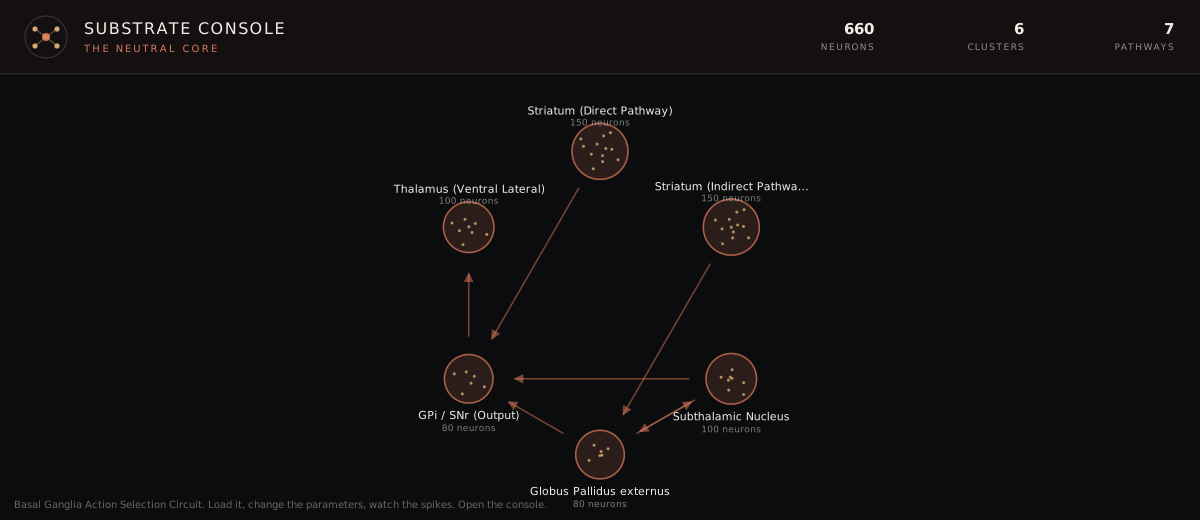
This project treats consciousness as an emergent property of organized physical activity, and these papers sharpen what organized physical activity can mean in hardware. The Substrate Console on the substrate page runs leaky integrate-and-fire dynamics in software; the devices in these papers implement the integrate-and-fire transition itself in material physics. That difference is the empirical content of the substrate debate, and it is why the project’s research code, maintained in the tlcdv/the_consciousness_ai repository, keeps its simulated dynamics explicitly labeled as simulations.
What the Device Route Leaves Open
The device route has produced neurons, synapses and their integration, and it has not produced a network that does cognitive work at scale, nor answered whether physical dynamics of this kind are necessary for experience or merely sufficient for efficiency. The field’s handling of that distinction is reviewed in the flagship overview of AI consciousness research. For the emulation program, the record so far supports a modest claim with large consequences. The dynamics a whole brain emulation would need to run are the kind of dynamics that materials can host, examined further on the brain emulation page.
Researchers covered here
- Han WangUniversity of Southern CaliforniaSenior author of the tantalum disulfide stochastic artificial neuron and the 2023 neuronal devices review
- Liang LiFirst author of the 2024 work on oxygen-vacancy-modulated VO2 neurons
- Jen-Sue ChenSenior author of the vanadium-based threshold switching memristor work in Nanoscale Horizons