

Pedro Mediano and Robin Carhart-Harris on How Psychedelics Restructure Brain Information
How do altered states of consciousness reshape the statistical structure of communication across the human cortex? In an October 2026 preprint titled Psychedelics restructure information in the human brain (bioRxiv 10.64898/2026.10.01.755915), George Blackburne, Alberto Liardi, Pablo Mallaroni, Rosalind G. McAlpine, Robin L. Carhart-Harris, Christopher Timmermann, Suresh Muthukumaraswamy, Jeremy I. Skipper, and Pedro A. M. Mediano analyze human brain recordings across five compounds in 80 participants (N = 80). Their multivariate information analysis resolves a recurring puzzle in neuroimaging of altered states. Across LSD, psilocybin, ketamine, DMT, and 5-MeO-DMT, cortical regions lose rigid local persistence while sharing more overlapping structure, leading the authors to summarize the psychedelic brain as one where cortical populations become “alike, but not necessarily together.”
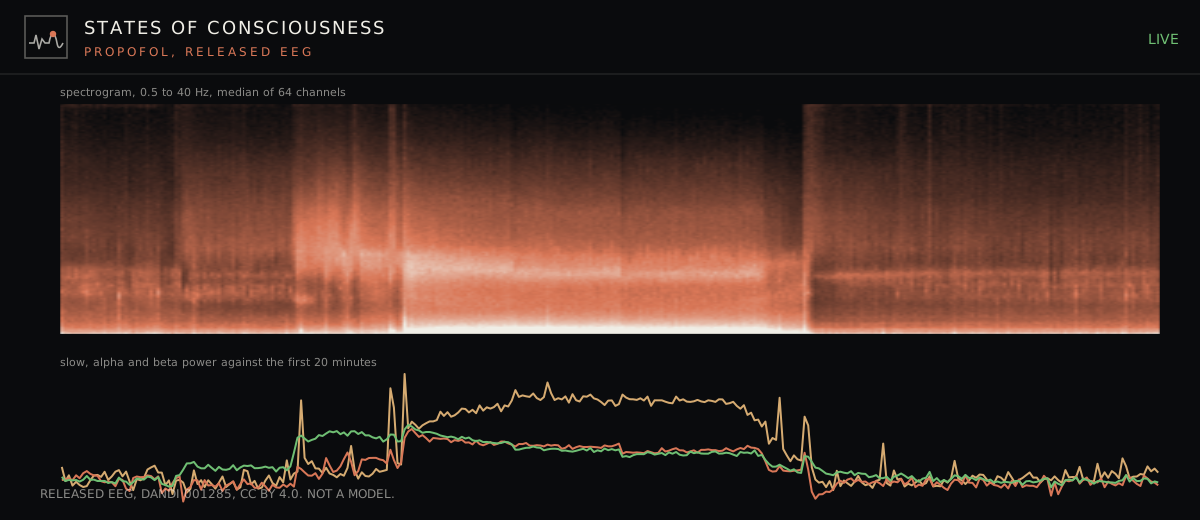
This article reviews the computational and information-theoretic neuroimaging findings of an unreviewed October 2026 preprint strictly from a consciousness science perspective and offers no medical or therapeutic guidance. Alongside the propofol anesthesia recordings on our States of Consciousness Console and the wider evaluation debates tracked in how scientists race to define and test AI consciousness in 2026, the study shows why single scalar complexity numbers cannot describe how conscious states reorganize.
Why Standard Connectivity Metrics Clashed in Earlier Studies
Over the past twelve years, neuroimaging of psychedelic and dissociative states produced findings that seemed awkward to reconcile under conventional statistics. Analyses inspired by Robin Carhart-Harris’s Entropic Brain Theory repeatedly measured higher signal entropy and temporal diversity across cortical recordings. Simultaneously, classical functional connectivity matrices showed weakened internal cohesion inside major resting-state networks such as the default mode network paired with elevated cross-network correlation.
Standard pairwise correlation compresses several distinct information processes into one number. Two cortical areas can exhibit correlated time series because both duplicate the same redundant information, because one directs information into the other across time, or because both participate in a genuinely joint synergistic computation absent from either region alone. Collapsing storage, transfer, redundancy, and joint integration into one scalar hid opposing shifts happening across the cortex at the same time.
Decomposing Information Flow Across Five Compounds
Blackburne, Mediano, Carhart-Harris, Timmermann, and colleagues apply multivariate information decomposition, extending the mathematical framework explored in Pedro Mediano’s Integrated Information Decomposition (PhiID) research, to human neuroimaging datasets spanning five distinct pharmacological compounds across N = 80 participants. Including four classic serotonergic psychedelics (LSD, psilocybin, DMT, and 5-MeO-DMT) alongside the dissociative NMDA antagonist ketamine lets the authors test which informational signatures generalize beyond a single receptor class.
Separating local information storage, directed transfer, redundancy, and synergistic transformation reveals a coherent structural reorganization across all five compounds.
| Analytical Method | Quantity Measured | Observed Pattern Under Psychedelics | Limitation Addressed in Blackburne et al. (2026) |
|---|---|---|---|
| Pairwise Functional Connectivity | Zero-lag correlation between regional time series | Lower intra-network integrity with altered cross-network coupling | Conflates redundant copies, directed transfer, and joint integration |
| Univariate Signal Entropy | Single-channel temporal diversity / Lempel-Ziv complexity | Broad rise in unpredictability across cortical sensors | Ignores how information is partitioned across interacting regions |
| Multivariate Information Decomposition (2026) | Decomposed storage, transfer, redundancy, and synergistic dynamics (N = 80, 5 compounds) |
Cortical populations become “alike, but not necessarily together” | Separates declining local persistence from shifting cross-regional overlap |
| Minimal Generative Model (2026) | Coupled neural populations with adjustable local self-coupling | Lowering self-coupling reproduces the empirical information profile | Ties macroscale neuroimaging shifts to a single dynamical parameter |
Reduced Self-Coupling as a Minimal Dynamical Mechanism
To move beyond descriptive statistics, the authors built a minimal generative model of coupled neural populations and varied the strength of local self-coupling, the degree to which each cortical population reinforces its own preceding state over time. Lowering self-coupling inside the model reproduced the empirical restructuring observed across the human datasets.
When local self-coupling drops, cortical populations retain less of their own isolated history, weakening rigid local attractors and loosening canonical modular boundaries. Regions become statistically more alike in their dynamics without locking into tight, synchronized joint trajectories. That single dynamical lever gives quantitative grounding to the relaxed-priors hypothesis developed by Carhart-Harris and Karl Friston under active inference. Instead of invoking complex ad hoc receptor chains to explain each macroscale metric separately, reduced self-coupling explains how relaxing local temporal stabilization reshapes information geometry across the entire cortex.
Implications for Theories of Consciousness and AI Metrics
Special and altered states of consciousness occupy an essential test niche on our consciousness theories index because participants remain awake and report intense, structured shifts in phenomenal experience rather than losing awareness entirely.
First, juxtaposing this preprint with Mediano’s earlier PhiID work on synergistic workspaces and the August 2026 multimodal study of perceptual awareness in Alzheimer disease highlights a clean empirical contrast. Under propofol anesthesia or severe neurodegeneration, conscious level fades as gateway integration collapses. Under psychedelics and ketamine, waking consciousness reorganizes around weakened local self-coupling while maintaining vivid phenomenology. A single scalar metric cannot reliably separate collapse of consciousness from reconfiguration of conscious content.
Second, the result informs how researchers evaluate dynamical artificial networks. Proposals that score artificial systems using a single entropy or complexity index miss the distinction between local temporal persistence, redundant copying, and joint synergistic computation. Applying multivariate information decomposition to recorded module activations in recurrent neural architectures, including the instrumented workspace modules explored in The Consciousness AI where such decomposition remains an unimplemented open measurement, would test whether an artificial system stores isolated local states, duplicates redundant representations, or binds modules into joint dynamics.
Preprint Boundaries and Open Empirical Questions
Because bioRxiv 10.64898/2026.10.01.755915 is an October 2026 preprint awaiting peer review, exact effect sizes per drug and per cortical parcel require independent verification once the full peer-reviewed dataset and code publish. Two structural constraints also shape interpretation.
- Multivariate information decomposition scales steeply with node count, restricting current analyses to coarse cortical parcellations rather than single-neuron spike trains.
- Grouping five compounds across
N = 80participants isolates a shared cross-drug backbone driven by reduced self-coupling, yet serotonergic tryptamines, ergolines, and NMDA antagonists produce distinct subjective profiles and time courses that future higher-resolution recordings will need to separate.
Even with those caveats stated upfront, Blackburne, Mediano, Carhart-Harris, Timmermann, and colleagues provide a clear methodological advance. Decomposing how information is stored, shared, and transformed across five altered states turns conflicting neuroimaging summaries into a unified dynamical picture anchored in cortical self-coupling.
Sources
- George Blackburne, Alberto Liardi, Pablo Mallaroni, Rosalind G. McAlpine, Robin L. Carhart-Harris, Christopher Timmermann, Suresh Muthukumaraswamy, Jeremy I. Skipper, and Pedro A. M. Mediano. Psychedelics restructure information in the human brain. bioRxiv preprint
10.64898/2026.10.01.755915, October 2026. doi:10.64898/2026.10.01.755915. - Andrea I. Luppi, Pedro A. M. Mediano, Fernando E. Rosas, Judith Allanson, John Pickard, Robin L. Carhart-Harris, Guy B. Williams, Michael M. Craig, Paola Finoia, Adrian M. Owen, Lorina Naci, David K. Menon, Daniel Bor, and Emmanuel A. Stamatakis. A synergistic workspace for human consciousness revealed by Integrated Information Decomposition. eLife 12, RP88173, 2024. doi:10.7554/eLife.88173.4.
- Robin L. Carhart-Harris and Karl J. Friston. REBUS and the Anarchic Brain. Pharmacological Reviews 71(3), 316 to 344, 2019. doi:10.1124/pr.118.017160.
Researchers covered here
- Pedro MedianoImperial College London and the University of CambridgeIntegrated Information Decomposition, and the revised non-negative measure of integrated information
- Robin Carhart-HarrisNeuroscape / UC San Francisco / Imperial College LondonThe Entropic Brain Hypothesis (2014, 2018), REBUS model of relaxed beliefs under psychedelics, functional neuroimaging of altered conscious states
- Christopher TimmermannCentre for Psychedelic Research, Imperial College LondonHuman neuroimaging of DMT and psychedelic altered states, neurophenomenology, and cortical dynamics