

Thermodynamic Freedom and Wasserstein Speed Limits in Thermodynamic Computing
Once a thermodynamic computer is fabricated and trained for an inference task, is its trade-off between speed and heat dissipation permanently frozen into its circuits? In a 2026 preprint titled The thermodynamic freedom of a thermodynamic computer (arXiv:2608.27938, posted August 2026 and revised September 2026), statistical physicist Stephen Whitelam at the Molecular Foundry, Lawrence Berkeley National Laboratory, shows that the answer is no. By analyzing simulated thermodynamic computers executing a machine-learning classification task under Langevin dynamics and Wasserstein speed limits, Whitelam demonstrates that changing the inference protocol after design lets the same device operate within 40 percent of the absolute thermodynamic limit of efficiency without sacrificing accuracy, or accelerate inference continuously at fixed accuracy and thermodynamic efficiency. Because arXiv:2608.27938 is an arXiv preprint based on simulated stochastic dynamics rather than taped-out silicon measurements, its numbers establish theoretical physical bounds rather than bench-tested chip specifications.
Within our Thermodynamic Computing hub and the broader question tracked in how scientists race to define and test AI consciousness in 2026, Whitelam’s paper supplies the missing non-equilibrium physics underneath recent hardware announcements. Startups and academic laboratories are taping out stochastic chips, yet claims of thousand-fold energy reductions mean little without knowing how close a noisy inference circuit can actually approach the fundamental limits of heat dissipation set by statistical mechanics.
Wasserstein Speed Limits Near the Thermal Energy Scale
Conventional CMOS processors spend enormous electrical energy fighting thermal noise so that every logic gate flips cleanly between deterministic zero and one states. Thermodynamic computers invert that contract. Operating near the thermal energy scale k_B T, they allow stochastic physical fluctuations governed by overdamped Langevin dynamics to drive probability distributions toward equilibrium states that encode computational answers.
However, relaxing toward equilibrium takes time, and pushing a physical system from an initial state distribution to a target distribution faster generates extra entropy production and dissipated heat. In modern stochastic thermodynamics, that fundamental trade-off is bounded by the Wasserstein speed limit, an inequality connecting the geometric distance traveled between probability distributions (the Wasserstein distance), the run time of the protocol, and the minimum heat dissipated into the thermal bath.
Whitelam simulates a continuous-variable thermodynamic computer trained to perform a standard classification workload comparable to a basic multilayer perceptron, then audits its energy dissipation directly against the Wasserstein speed limit under different operating protocols.
Post-Design Thermodynamic Freedom Across Inference Protocols
The central finding of arXiv:2608.27938 is that training a thermodynamic network does not lock the hardware into one fixed efficiency point. Varying how inputs are loaded and how the system’s dynamical clock or driving schedule advances gives the operator wide thermodynamic freedom after the weights are already set.
- Under tuned loading protocols, the simulated thermodynamic computer completes classification within 40 percent of the absolute thermodynamic efficiency ceiling permitted by the Wasserstein speed limit, with zero degradation in classification accuracy.
- Under clock-acceleration protocols, the same trained system executes inference progressively faster while preserving both its classification accuracy and its thermodynamic efficiency ratio.
- Because these gains arise from steering the trajectory through probability space rather than redesigning the underlying couplings, one physical device can adapt dynamically between ultra-low-power monitoring and rapid high-throughput inference.
| Computational Paradigm | Physical Driving Mechanism | Primary Efficiency Bound | Runtime Trade-Off Control |
|---|---|---|---|
| Clocked Digital GPU | Deterministic switching well above k_B T |
CMOS switching capacitance and memory-bandwidth energy | Voltage-frequency scaling; fixed digital precision overhead |
Digital / Analog Equilibration (CN101) |
Noisy RLC or digital stochastic equilibration | Signal-to-noise ratio vs matrix dimension scaling | Averaging window length during equilibrium readout |
Discrete P-Bit Sampling (THRML / MTJ) |
Chromatic block Gibbs flips of binary stochastic spins | Random-bit generation cost and mixing autocorrelation time | Inverse-temperature annealing schedule |
| Langevin Thermodynamic Computer (Whitelam 2026) | Continuous-variable stochastic dynamics near k_B T |
Wasserstein speed limit (within 40 percent of bound) | Post-design loading and clock-acceleration protocols at fixed accuracy |
Linking Stochastic Speed Limits to CN101, THRML, and Brain Thermodynamics
Whitelam’s theoretical bounds sit directly beside three other threads in our thermodynamic computing coverage. In Normal Computing’s CN101 and thermodynamic linear algebra, equilibrium fluctuations of coupled oscillators invert matrices, yet ARIA’s March 2026 evaluation noted that scaling limits between helpful noise and signal degradation remain open. On the discrete side, Extropic’s open-source THRML sampler models block Gibbs sampling over energy-based graphs, while the Santa Fe Institute volume reviewed in Energetics of Computing in Life and Machines traces how biological cells pay far closer to Landauer and stochastic thermodynamic floors than silicon clusters do.
Most directly for neuroscience, Berjaga-Buisan, Kringelbach, and Deco’s 2026 study of fluctuation-dissipation thermodynamics in consciousness quantifies how far waking conscious human brains depart from thermal equilibrium compared with sleep or anesthesia. Whitelam’s Wasserstein analysis clarifies the engineering counterpart of that biological observation. Performing useful inference rapidly requires paying a non-zero non-equilibrium dissipation price, yet careful trajectory shaping lets physical dynamics approach the thermodynamic floor instead of burning orders of magnitude more heat than physics demands.
What Thermodynamic Speed Limits Tell Us About Consciousness
Why does a statistical physics preprint about Langevin classifiers bear directly on the study of consciousness? Two reasons tie stochastic thermodynamics straight to substrate independence and the Free Energy Principle.
First, biological brains sustain continuous, asynchronous, recurrent perception and homeostatic control on roughly 20 watts of metabolic power, whereas simulating comparable continuous dynamics on clocked GPUs draws hundreds to thousands of watts. As argued across our Thermodynamic Computing hub, if living systems exploit non-equilibrium physical relaxation to run continuous inference near thermal bounds, then testing whether consciousness is genuinely substrate-independent requires knowing whether non-biological stochastic substrates can execute equivalent belief-updating dynamics without hitting an insurmountable thermal wall.
Second, Whitelam’s result shows that energy dissipation rate and computational accuracy are separable along protocol dimensions. A living brain shifting from quiet rest to rapid threat detection adjusts its metabolic tempo without rewiring its cortical weights. Showing that a synthetic thermodynamic substrate holds analogous post-design freedom between speed and dissipation strengthens the physical plausibility of energy-bounded artificial cognition, while reminding researchers that efficient physical sampling by itself says nothing about whether a classifier feels anything.
Comparison to The Consciousness AI and thermospike
Whitelam measures theoretical heat dissipation against the Wasserstein speed limit in continuous Langevin models. Inside our own public software stack, we attack the complementary discrete-to-spiking accounting problem in two open repositories.
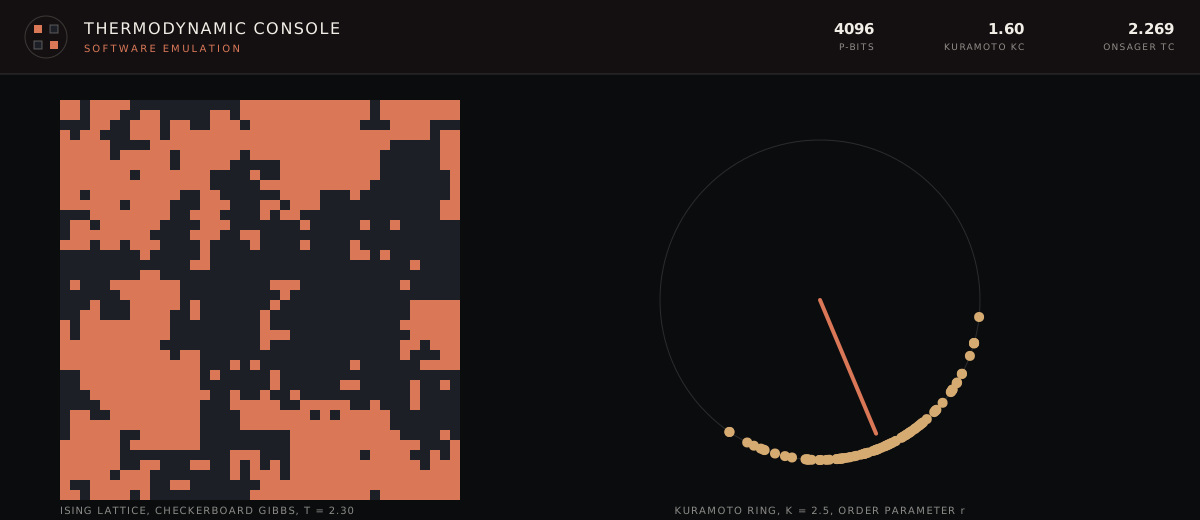
First, our standalone Python library tlcdv/thermospike (v0.1.0, installable via pip install thermospike, Zenodo DOI 10.5281/zenodo.23959919) implements both a sequential p-bit Gibbs sampler (PBitSampler) and a refractory stochastic spiking sampler (SpikingSampler, following Buesing, Bill, Nessler, and Maass 2011) and checks every run against exact Boltzmann state enumeration for small networks up to 20 neurons. Crucially, thermospike counts random bits, spikes, synaptic events, and dense multiply-adds per effective sample size (ESS) so autocorrelation penalties cannot hide behind cheap per-sweep numbers. In keeping with strict facts discipline, thermospike currently runs small networks in pure Python and NumPy, event counts are not physical joules, and the planned Tang Nano 9K FPGA reference design does not exist yet.
Second, the core research codebase at tlcdv/the_consciousness_ai isolates its p-bit emulator and deterministic Laplace free-energy relaxation solver inside models/thermodynamic/ behind guard tests so experimental thermodynamic modules never alter production training runs. Readers exploring physical noise sources and small desk boards capable of prototyping discrete p-bit samplers can inspect our thermodynamic computing hardware guide.
Limits of Simulated Bounds and Open Questions
Two clear limits bound arXiv:2608.27938 prior to peer review. First, Whitelam evaluates a compact classification architecture in numerical simulation, leaving open how closely real analog CMOS or superconducting circuits with parasitic capacitance, device mismatch, and readout amplifier overhead can approach the 40 percent theoretical Wasserstein floor. Second, bridging continuous-variable Langevin classification to recurrent, stateful, active-inference agents that interact continuously with an external environment remains an unsolved hardware-software co-design challenge.
Sources
- Stephen Whitelam. The thermodynamic freedom of a thermodynamic computer. arXiv preprint
arXiv:2608.27938, August 2026 (revised September 2026). arXiv:2608.27938. - Maxwell Aifer, Kaelan Donatella, Max Hunter Gordon, Samuel Duffield, Thomas Ahle, Daniel Simpson, Gavin Crooks, and Patrick Coles. Thermodynamic linear algebra. npj Unconventional Computing 1, 13, November 2024. doi:10.1038/s44335-024-00014-0.
- thermospike Public Repository (
tlcdv/thermospike). Stochastic spiking neurons and p-bit sampling cost accounting (doi:10.5281/zenodo.23959919). - The Consciousness AI Public Repository (
tlcdv/the_consciousness_ai). Isolatedmodels/thermodynamic/emulation and relaxation package.