


Remus Osan Derives the Recursive Speed Law and Propagation Failure of Neural Traveling Waves
When a sensory stimulus triggers a wave of spiking activity across cortical tissue, what mathematical law determines whether that wave propagates globally across the network or dies out at a structural inhomogeneity? In their September 2026 mathematical neuroscience paper Periodically modulated traveling waves in integrate-and-fire networks (arXiv:2609.33006), Jie Nissel, Ricardo Erazo-Toscano, Rosahn Bhattarai, Marius Osan, Mandeep Chauhan, and senior author Remus Osan at Georgia State University derive an exact scalar reduction governing wave speed and propagation failure in spatially inhomogeneous integrate-and-fire neural networks.
For the Neutral Core Substrate Console and the theoretical debate mapped in our 2026 overview of AI consciousness definitions, Osan’s analytical laws provide a rigorous bridge between single-neuron spiking mechanics and macroscopic conscious ignition. Both Recurrent Processing Theory (Victor Lamme) and Global Neuronal Workspace Theory (Stanislas Dehaene) depend on local sensory excitation crossing a nonlinear threshold to ignite sustained, long-range cortical broadcast. Osan and colleagues prove exactly how periodic variations in synaptic coupling strength bottleneck, slow, and abruptly terminate those traveling fronts through fold bifurcations.
Reducing Spiking Wavefronts to an Exact Scalar Speed Equation
In a homogeneous one-dimensional or two-dimensional sheet of leaky integrate-and-fire (LIF) neurons with exponentially decaying synaptic footprints, an excitation wave travels at a constant velocity. Classical analyses by Ermentrout, Bressloff, and Osan showed that such homogeneous networks typically admit two wave speed solutions above a critical excitability threshold, namely a fast stable wave speed ($c_2$) that corresponds to sustained physical propagation and a slow unstable wave speed ($c_1$) that acts as a separatrix threshold below which perturbations decay.
Biological cortex and neuromorphic silicon, however, are never spatially uniform. Cortical columns, patchy horizontal projections, and modular routing boundaries introduce periodic spatial modulations in synaptic coupling strength. Prior studies relied on numerical simulations or weak-coupling approximations to estimate when a wave stalls in inhomogeneous media.
Nissel, Erazo-Toscano, and Osan solved this problem by reducing the infinite-dimensional leading-edge firing map of the integrate-and-fire network to an exact scalar differential equation for the local wave speed $c(x)$ in space, where the periodic synaptic coupling modulation enters pointwise through the homogeneous velocities $c_1$ and $c_2$.
Dynamical Regime in arXiv:2609.33006 |
Spatial Synaptic Modulation | Analytical Speed & Failure Law Derived by Osan et al. |
|---|---|---|
| Homogeneous Baseline | Uniform exponential synaptic coupling | Coexistence of fast stable wave speed $c_2$ and slow unstable threshold speed $c_1$ |
| Slow Spatial Modulation ($\omega \to 0$) | Long-wavelength periodic coupling troughs | Fold bifurcation amplitude plateaus; local bottleneck speed governed by geometric mean $\sqrt{c_1 c_2}$ |
| Rapid Spatial Modulation ($\omega \gg 1$) | High-frequency spatial synaptic heterogeneity | Critical fold amplitude grows linearly with spatial modulation frequency |
| Perturbative Speed Profile | Arbitrary periodic modulation below critical fold | Recursive analytical expansion yields exact spatial velocity profile $c(x)$ without full PDE simulation |
| Failure Mode Distinction | Structural bottleneck vs. initial condition | Separates global loss of the periodic traveling wave solution (fold termination) from local launch failure |
The Geometric Mean Bottleneck ($\sqrt{c_1 c_2}$) and Fold Bifurcations
The central mathematical result of arXiv:2609.33006 is the discovery of how positive periodic traveling waves terminate. As the amplitude of the spatial synaptic modulation increases, the fast stable wave solution and the slow unstable wave solution approach one another in phase space until they collide and annihilate in a saddle-node (fold) bifurcation of periodic orbits. Beyond this critical modulation amplitude, no traveling wave can cross the network, and excitation arrests at the low-coupling trough.
By analyzing the exact scalar speed equation across spatial frequency regimes, Osan and colleagues uncovered two contrasting physical scaling laws.
- Under slow spatial modulation, where synaptic coupling varies gradually across cortical areas or smooth gain gradients, the wave cannot average over the trough, and the critical fold amplitude approaches an exact analytical plateau where the local bottleneck velocity equals the geometric mean of the two homogeneous speeds, $\sqrt{c_1 c_2}$.
- Under rapid spatial modulation across distances shorter than the exponential axonal decay length, the wavefront integrates across multiple peaks and troughs simultaneously, causing the critical modulation amplitude required to stop the wave to grow linearly with spatial frequency.
The authors also distinguish between structural wave loss (where the periodic wave solution ceases to exist anywhere in the network due to the fold bifurcation) and launch failure (where a valid periodic traveling wave exists on the lattice, but an initial sensory stimulus is injected at an unfavorable spatial phase or sub-threshold velocity and dies out before locking onto the stable periodic attractor).
Why Traveling Wave Survival Governs Perceptual Ignition
In empirical consciousness science, traveling cortical waves and recurrent propagation failures are not abstract mathematical curiosities. As documented in Marcello Massimini and Andrea Pigorini’s intracranial and scalp recordings of somatosensory awareness, the difference between an unconscious state (such as NREM slow-wave sleep or general anesthesia) and wakeful conscious perception is precisely whether a local cortical perturbation (measured via the Perturbational Complexity Index, PCI) propagates across distant cortical modules or extinguishes locally within a few millimeters.
During slow-wave sleep and anesthesia, periodic up-and-down states and heightened inhibitory conductance create deep spatial and temporal troughs in effective synaptic coupling. Osan’s fold-bifurcation law provides the exact spiking-network mechanics for why an excitation front launched in primary sensory cortex hits a propagation bottleneck when inter-areal coupling drops below the $\sqrt{c_1 c_2}$ threshold. Conversely, in sparse neuromorphic routing architectures such as SpikeMoE’s hippocampal CA1 competitive routing and oscillatory binding frameworks such as Artificial Kuramoto Oscillatory Neurons (AKOrN), maintaining high-frequency spatial interleaving prevents modular boundaries from acting as low-frequency wave traps.
Comparison to The Consciousness AI
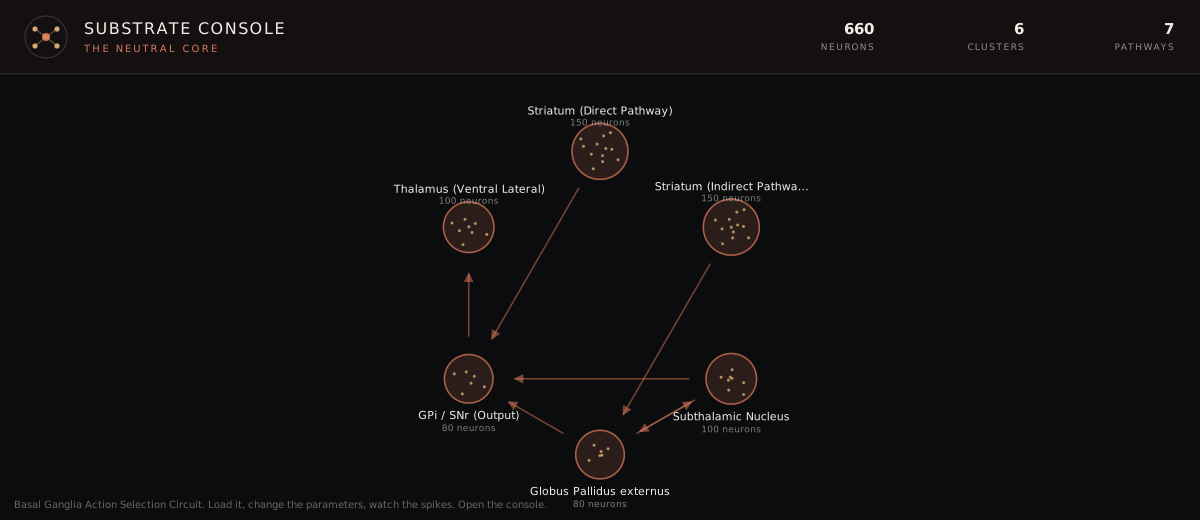
In The Consciousness AI, Layer 1 of the Neutral Core architecture (visualized live on the Substrate Console) runs Leaky Integrate-and-Fire (LIF) spiking neurons organized into anatomically inspired regional clusters (sensory, thalamic, basal ganglia, and workspace hubs). Because inter-regional synaptic weights are sparser than intra-cluster weights, every signal crossing from a sensory cluster into the global workspace encounters a spatial modulation in coupling density.
Osan’s recursive speed law and $\sqrt{c_1 c_2}$ bottleneck criterion apply directly to our LIF substrate. Rather than relying solely on brute-force parameter sweeps to check whether a sensory spike train will cross a regional boundary or suffer launch failure, arXiv:2609.33006 provides an analytical threshold linking homogeneous cluster excitability ($c_1, c_2$) to the maximum allowable synaptic trough between modules.
Limitations and Extensions
The exact scalar reduction in arXiv:2609.33006 is derived under a single-spike-per-neuron leading-edge assumption with exponentially decaying synaptic kernels in one spatial dimension. Extending the exact recursive speed law to multi-spike bursting regimes, two-dimensional spiral and target wave collisions, and conductance-based dendritic delays requires relaxing the single-spike front condition. Even with that mathematical simplification, the separation between the $\sqrt{c_1 c_2}$ slow-modulation bottleneck and linear high-frequency resilience establishes a foundational rule for engineering spiking substrates that must balance modular specialization with global wave broadcast.