


Memristive Neurons and the Hardware Route to Physical Spikes
Two 2021 papers attacked the same problem from opposite ends, and together they define the hardware route to spiking intelligence. Deyu Wang, Anders Lansner, Zhuo Zou and colleagues published Mapping the BCPNN Learning Rule to a Memristor Model in Frontiers in Neuroscience on December 9, 2021 (DOI 10.3389/fnins.2021.750458). Hefei Liu, Han Wang and colleagues published A Tantalum Disulfide Charge-Density-Wave Stochastic Artificial Neuron for Emulating Neural Statistical Properties in Nano Letters on April 9, 2021 (DOI 10.1021/acs.nanolett.1c00108). One maps a cortical learning rule onto memristor dynamics. The other builds a single artificial neuron out of a phase-transition material. Both replace a simulated spike with a physical one.
| Paper | Route | What the hardware does |
|---|---|---|
| Wang et al., Frontiers 2021 | Learning-rule mapping | BCPNN synapses stored and updated in memristor physics |
| Liu et al., Nano Letters 2021 | Material neuron | A tantalum disulfide charge-density-wave device that fires stochastically like a neuron |
The von Neumann bottleneck, stated by the learning rule itself
The Wang paper’s starting point is measured. The Bayesian Confidence Propagation Neural Network, BCPNN, the correlation-based learning rule developed by Lansner’s line at KTH, has been implemented to map onto neural and synaptic processes in the human cortex and has run in detailed spiking models of cortical associative memory as well as machine learning. In its conventional digital form, the authors state the cost directly. The von Neumann bottleneck is the major challenge, with synaptic storage and access to it as the dominant expense. Their answer is the memristor, a non-volatile device whose resistance carries the synaptic state, so the storage and the computation stop being separate trips across a bus.
This is the same separation the whole brain emulation roadmap identified between scanning, interpretation and simulation, examined in the roadmap review, but at the device level. A learning rule that lives in memristor physics is not a program managing memory. It is a physical system whose state is the memory.
The material that fires
The Liu paper works from the other direction. Instead of porting a rule, it reports a device whose own physics behaves like a neuron. A tantalum disulfide charge-density-wave device, driven past its threshold, switches stochastically, and the authors show it emulating the statistical properties of neural firing. The neuron’s integrate-and-fire-like behavior, including its randomness, is produced by the material rather than by a circuit simulating randomness.
The two results meet at a question this site keeps returning to. A software spiking network, examined in the SNN and IIT overlap analysis, produces spikes as scheduled events on a clock. A memristive or phase-transition device produces spikes as physical events in a material, with the device’s own variability doing the work that software must fake. Chips in the Loihi line, examined in the Loihi 2 analysis, sit between the two, programmable silicon producing spike timing without material stochasticity.
Comparison to The Consciousness AI
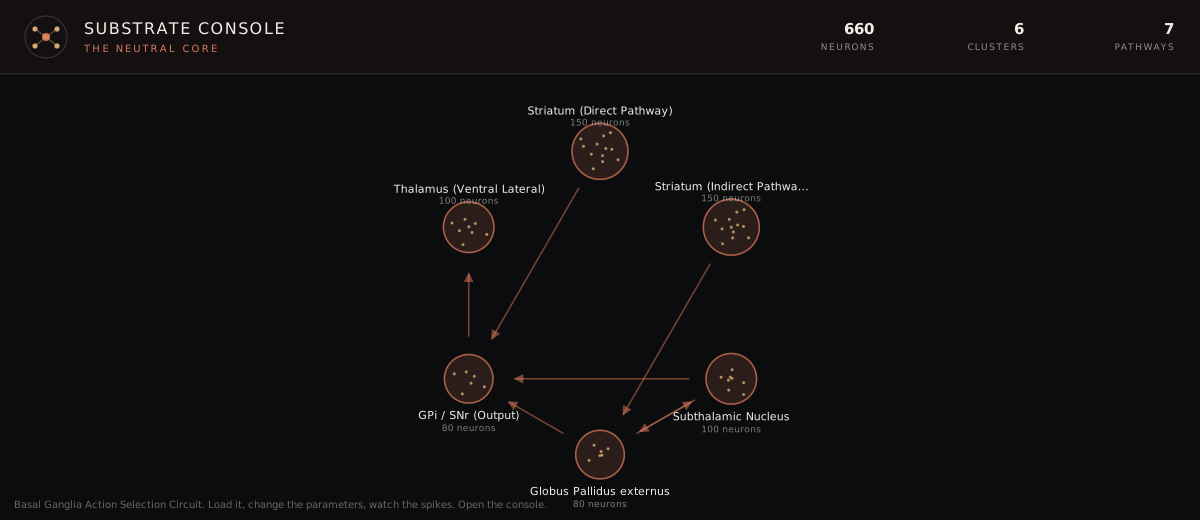
This project treats consciousness as an emergent property of organized physical activity, and its Substrate Console runs leaky integrate-and-fire dynamics rather than claiming any hardware equivalence, a boundary stated on the substrate console page. The two 2021 papers are the kind of result that keeps the boundary honest. They show the field moving computation toward physical dynamics because storage, energy and randomness demand it, whatever the philosophy says. The project’s research code, maintained in the tlcdv/the_consciousness_ai repository, treats that movement as evidence about feasibility rather than as evidence about experience, and the difference between those two claims is the site’s central discipline.
What the Hardware Route Leaves Open
Physical spikes solve cost and realism problems that software spikes cannot, and they leave the consciousness question exactly where it was. Whether the dynamics that carry experience must live in a substrate of a certain kind, or merely in organization of a certain kind, is unchanged by a memristor that learns or a material that fires. The device literature accumulates the feasibility record. The interpretation of that record is the debate this site tracks, reviewed in the flagship overview of AI consciousness research and collected on the brain emulation page.
Researchers covered here
- Deyu WangFirst author of the 2021 BCPNN-to-memristor mapping in Frontiers in Neuroscience
- Anders LansnerKTH Royal Institute of TechnologyThe BCPNN learning rule, spiking models of cortical associative memory, BCPNN-inspired silicon
- Hefei LiuFirst author of the tantalum disulfide stochastic artificial neuron and the 2023 Advanced Materials neuronal devices review