

ESA Space-Based Data Centres Forum and Returnable Satellites for Orbital Chip Aging
On November 12 and 13, 2026, the European Space Agency (ESA) convened its Strategy Forum on Space-Based Data Centres at ESTEC in Noordwijk, Netherlands, bringing together space agencies, cloud infrastructure operators, and digital sovereignty planners to draft a unified European roadmap for orbital computing. The forum arrived weeks after a surge of filings at the International Telecommunication Union (ITU) and the US Federal Communications Commission proposing tens of thousands to upwards of a million data-center satellites, alongside private efforts such as SpaceX’s Starmind concept, Google’s Project Suncatcher booking a 2029 Blue Origin New Glenn heavy-lift flight, and startups like Lux Aeterna designing heat-shielded returnable satellites to solve orbital AI’s most stubborn economic bottleneck, chip aging.
Within our Consciousness to Orbit section and the broader scientific roadmap tracked in how scientists race to define and test AI consciousness in 2026, November 2026 marks the moment orbital data centers moved from isolated startup pitches into formal international infrastructure governance.
ESA’s ESTEC Strategy Forum and the ITU Orbital Filing Surge
Unlike a conventional academic conference, ESA structured its November 12 to 13, 2026 ESTEC Strategy Forum as a collective intelligence exercise designed to evaluate how space-based data centers (SBDCs) can supplement terrestrial European networks facing grid power bottlenecks, land constraints, and digital sovereignty pressures.
That European policy push coincides with an unprecedented regulatory wave at the ITU. Operators have submitted constellation filings spanning tens of thousands to a million compute satellites, forcing international regulators to confront spectrum coordination, orbital congestion, dark-sky astronomical interference, and end-of-life deorbit rules years before gigawatt orbital clusters actually fly.
This institutional reality check complements our recent analysis of the ICEF Columbia Space-Based Data Centers caution roadmap and Ramon.Space’s 124 million dollar Series B. While ICEF warned that orbital compute still carries steep cost premiums over terrestrial facilities, ESA’s ESTEC forum confirms that major public agencies now treat orbital compute as a serious long-horizon strategic pillar rather than science fiction.
The 12 to 24 Month Chip-Aging Wall and Lux Aeterna’s Delphi Platform
Even if reusable heavy-lift rockets drive launch costs down and large deployable radiators solve vacuum thermal dissipation, orbital AI faces a brutal hardware cadence mismatch. Traditional communications and Earth-observation satellites are engineered for 7 to 15 year orbital lifespans. Terrestrial AI accelerators, by contrast, turn over every 12 to 24 months in performance per watt. Launching fixed, non-serviceable silicon into low Earth orbit risks stranding billions of dollars of obsolete compute in space before a satellite even reaches mid-life.
Aerospace startup Lux Aeterna, founded by SpaceX alumni including Brian Taylor, is targeting that refresh cycle directly with its Delphi returnable satellite platform. Equipped with a thermal heat shield, Delphi is designed to operate in orbit, reenter Earth’s atmosphere, land intact, undergo ground-based hardware and AI chip upgrades, and relaunch.
| Orbital Compute Challenge | Proposed 2026 Engineering Path | Key Players and Milestones | Remaining Physical Bottleneck |
|---|---|---|---|
| Continuous power and sun-synchronous scaling | Heavy-lift reusable launch into sun-synchronous orbit (SSO) | Google Project Suncatcher (New Glenn 2029 booking); SpaceX Starmind | Launch mass per megawatt and radiator area in vacuum |
| 12 to 24 month AI chip obsolescence | Heat-shielded returnable satellites upgraded on Earth | Lux Aeterna Delphi returnable craft | Reentry mass overhead, turnaround cadence, and launch economics |
| Radiation-hardened orbital memory and compute | Rad-hardened modular space processors | Ramon.Space ($124M Series B with Micron, Nov 2026) | Single-event upsets vs bleeding-edge commercial node density |
| Orbital congestion and governance | International spectrum, debris, and sovereignty roadmaps | ESA ESTEC Strategy Forum (Nov 12 to 13, 2026); ITU filings | Deorbit compliance, optical astronomy impact, and regulatory enforcement |
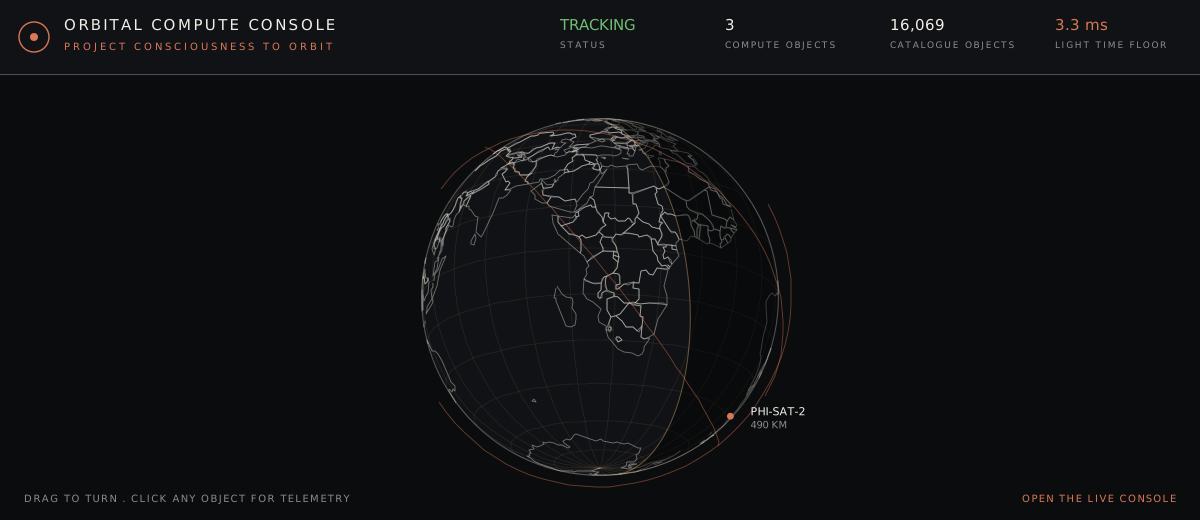
Readers tracking active orbital compute prototypes, launch windows, and altitude constraints can inspect the live mission ledger on our Consciousness to Orbit Mission Tracker.
What Orbital Chip Lifecycles Tell Us About Consciousness Beyond Earth
In the Radiant phase of Consciousness to Orbit, the central question is not merely whether GPUs or TPUs can run matrix multiplications in vacuum. It is whether substrate-independent minds, if emerging consciousness is ever realized in synthetic architectures, could persist and evolve off Earth under real physical constraints of power, radiation, thermal rejection, and hardware replacement.
The chip-aging problem makes a classic philosophy-of-mind problem concrete in aerospace engineering. Biological brains maintain continuous identity while molecules and cellular components turn over continuously inside a living body. An orbital synthetic substrate faces an analogous continuity constraint at the hardware level. If radiation degradation and 12 to 24 month silicon refresh cycles require migrating running states between orbital nodes or returning physical modules to Earth via craft like Delphi, then long-duration off-world cognition requires architectures whose active state can migrate cleanly across replacement hardware without breaking causal continuity.
Connection to The Hardware and The Consciousness AI
Our work connects orbital infrastructure down to open educational hardware and software architecture. In the-hardware, we publish open 3D-printable CadQuery parts under CERN-OHL-S v2 including CubeSat educational frames and benchtop fixtures, complementing our practical guides on CubeSat orbits, LEO, SSO, and deorbit timelines. In The Consciousness AI, we study emerging consciousness as a substrate-independent property, keeping our software experiments grounded in verifiable architectural layers rather than claiming any current orbital satellite hosts conscious agents.
Governance Realities Ahead of 2029
Between ESA’s November 2026 ESTEC forum and Google’s targeted 2029 New Glenn orbital rack flight, the next three years will test whether returnable satellites, radiation-tolerant commercial silicon, and international ITU rules can converge into an economically viable layer of space infrastructure. Until returnable platforms like Delphi prove repeated atmospheric reentry and chip swaps in flight, the 12 to 24 month silicon refresh wall remains just as binding for orbital AI as vacuum radiators and launch mass.