

Space-Based Data Centers Between the ICEF Caution Roadmap and Ramon.Space
Are orbital data centers entering commercial deployment faster than aerospace engineering and environmental governance can safely manage? Two major November 2026 announcements pull that debate into sharp focus from opposite sides. First, a working paper from the Innovation for Cool Earth Forum (ICEF) led by David Sandalow, Julio Friedmann, and collaborators at Columbia University’s Center on Global Energy Policy, Georgetown University, and Lawrence Livermore National Laboratory, titled Space-Based Data Centers Roadmap: The Case for Caution, warns that moving even 10 percent of projected 2030 AI data-center capacity into orbit would require more than 700 heavy rocket launches per year and giant solar-and-radiator arrays spanning 70 to 100 meters that could outshine visible stars. Days later, on November 17, 2026, space computing provider Ramon.Space announced a $124 million Series B funding round led by PSG with strategic investment from chipmaker Micron Technology (bringing total funding to roughly $180 million) to scale radiation-hardened, Earth-grade onboard computing and storage for satellite constellations and space data centers.
For our Consciousness to Orbit hub, our CubeSat and satellite engineering series, and the wider substrate debate tracked in how scientists race to define and test AI consciousness in 2026, these November 2026 milestones mark the moment orbital computing shifts from speculative vision to contested industrial reality. Following Google Project Suncatcher’s October 2026 Trillium TPU downlink in low-Earth orbit, Starcloud’s lunar-orbit contract with Firefly and Rocket Lab’s orbital solar cells, and Peng Hu and Kees van Berkel’s analysis of Heterogeneous Space Data Centers, the collision between Ramon.Space’s capital scale-up and Columbia’s caution roadmap forces a hard physical audit.
What the ICEF Columbia “Case for Caution” Roadmap Quantifies
Over the past year, commercial filings to the Federal Communications Commission from SpaceX, Starcloud, Blue Origin, and Cowboy Space have outlined orbital compute constellations ranging from tens of thousands to over a million specialized satellites, pitched as a way to harvest continuous orbital sunlight and relieve terrestrial power grids.
The November 2026 ICEF roadmap authored by Sandalow, Friedmann, and colleagues challenges the assumption that shifting hyperscale AI hardware off-planet is an environmentally benign shortcut. Four physical constraints anchor their caution case.
- Launch cadence and atmospheric emissions. Placing just 10 percent of anticipated 2030 AI data-center demand in orbit would demand over 700 heavy-lift launches annually, roughly two heavy rockets lifting off every day, injecting black carbon, alumina, and nitrogen oxides into the upper atmosphere at unprecedented scale.
- Radiative cooling mass and night-sky disruption. In vacuum, spacecraft cannot cool megawatt chips with air or water; every watt of electrical power must leave via infrared thermal radiation. Large space-based data centers require expansive photovoltaic wings paired with thermal radiators reaching 70 to 100 meters across. At constellation scale, the report warns that bright artificial structures could outnumber visible stars across large swaths of the night sky, threatening ground-based astronomy.
- Orbital debris and collision cascades. Packing giant high-area-to-mass solar and radiator structures into crowded low-Earth orbital shells multiplies collision cross-sections and complicates end-of-life deorbiting.
- Governance lag. Commercial deployment plans and FCC filings are moving far ahead of international space traffic, stratospheric emission, and orbital-albedo standards.
Ramon.Space’s $124M Series B and the Micron Strategic Bet
While policy researchers caution against megawatt orbital hyperscalers, capital is flowing decisively into the foundational silicon required to run resilient compute in orbit. On November 17, 2026, Ramon.Space closed its $124 million Series B led by PSG alongside Micron Technology, Senvest, and Phoenix Financial.
Micron’s strategic participation highlights a critical hardware bottleneck that we examined earlier in radiation hardening for conscious architectures in orbit. Standard commercial datacenter DRAM and high-density flash suffer single-event upsets (SEUs), silent bit flips, and single-event latchups when cosmic rays and trapped radiation-belt particles pass through dense nanometer silicon. Pairing Ramon.Space’s radiation-hardened space-computing software and processor architectures with Micron’s memory engineering targets dependable, Earth-grade storage and onboard AI processing inside real orbital constellations, alongside dedicated space SSD hardware such as Phison’s Pascari Space drives unveiled this month.
| November 2026 Orbital Compute Track | Lead Organizations | Key Quantitative Figures | Primary Physical Bottleneck Addressed or Exposed |
|---|---|---|---|
| ICEF Space-Based Data Centers Roadmap | Columbia CGEP (Sandalow, Friedmann), Georgetown, LLNL | >700 heavy launches/yr for 10% of 2030 AI compute; 70 to 100 m arrays/radiators | Launch emissions, vacuum thermal rejection, orbital debris, night-sky brightness |
| Ramon.Space Series B (Nov 17, 2026) | Ramon.Space, PSG, Micron Technology, Senvest | $124M Series B (~$180M total funding) | Radiation-hardened onboard compute and memory reliability in LEO and beyond |
| Google Project Suncatcher (Oct 2026) | Google, Planet Labs | 4 Trillium TPUs on 1 kW solar bus; Gemma downlink Oct 30, 2026 | Duty-cycled thermal rejection on compact LEO satellite buses |
| Starcloud Commercial Roadmap (Nov 2026) | Starcloud, Firefly Aerospace, Rocket Lab | SC-1L lunar orbit (NET 2028), Neutron launch (2029), space silicon cells | Deep-space cosmic rays, dollars-per-watt solar arrays, cislunar latency |
Why Megawatt Thermal Walls Favor Low-Power Cognitive Substrates
What do a $124 million space-memory round and a Columbia University warning about 100-meter orbital radiators tell us about consciousness and substrate independence? Every post in our Consciousness to Orbit section tests off-planet engineering against the requirements of continuous cognitive architectures, and the November 2026 data sharpen one stark physical conclusion.
Conventional datacenter GPUs draw 250 to 700 watts per chip before counting networking and storage. Trying to brute-force massive dense-matrix AI clusters into low-Earth orbit forces the exact 70-to-100-meter radiator fields, 700-launch-per-year supply chains, and astronomical pollution that the ICEF roadmap warns against. By contrast, a biological human brain sustains continuous, closed-loop, recurrent conscious processing on roughly 20 watts, more than an order of magnitude below a single datacenter GPU.
Under functionalist emergentism and the civilization-scale framing in the Kardashev scale as an energy budget for growing consciousness, off-planet synthetic minds cannot simply hoist brute-force terrestrial transformer farms into vacuum. Any continuous recurrent architecture meant to operate autonomously in orbit, maintaining unbroken temporal binding windows rather than short duty-cycled inference bursts while surviving cosmic-ray bit flips, pushes hardware design toward two converging requirements. First, radiation-hardened, error-correcting memory and compute pipelines of the kind Ramon.Space and Micron are funding. Second, ultra-low-power event-driven spiking or thermodynamic physical substrates that slash radiator area and launch mass by orders of magnitude.
Comparison to The Consciousness AI
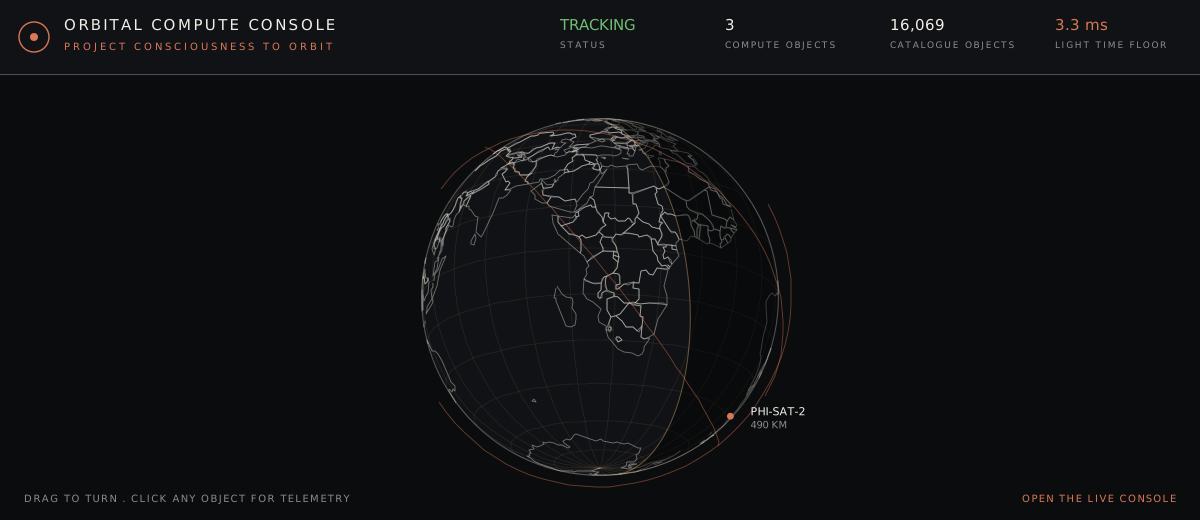
The Consciousness AI does not build or launch satellites, and our public Orbital Compute Tracker tracks verified third-party orbital compute missions using open NORAD catalogue data to compute live ground tracks and speed-of-light latency floors. What our research architecture contributes to this orbital conversation is the computational efficiency side of the equation. By studying biologically grounded, sparse, event-driven spiking networks (Layer 1 LIF), oscillatory phase binding, and isolated thermodynamic p-bit sampling prototypes (models/thermodynamic/), we test whether continuous cognitive organization can be separated from the megawatt power envelopes of dense matrix clusters. Readers interested in the practical ground-up engineering of small satellites can also follow our neutral educational CubeSat from the US guide series.
What to Watch Next in Orbital Governance and Hardware
The tension exposed in November 2026 will play out across two measurable tracks over the next 18 months. On the policy side, watch whether the FCC and international astronomy bodies adopt explicit orbital-albedo, radiator-area, and launch-emission caps in response to the ICEF Columbia working paper before approving million-satellite compute filings. On the hardware side, watch how quickly Ramon.Space and Micron qualify radiation-hardened high-density memory modules for commercial LEO and cislunar constellations, revealing how much compute can run reliably inside compact kilowatt-class hulls without turning low-Earth orbit into a crowded mirror of giant radiators.
Sources
- David Sandalow, Julio Friedmann, and colleagues (Innovation for Cool Earth Forum / Columbia University Center on Global Energy Policy, Georgetown University, Lawrence Livermore National Laboratory). Space-Based Data Centers Roadmap: The Case for Caution. Working paper, November 2026.
- Ramon.Space. Ramon.Space Raises $124M Series B Led by PSG with Strategic Participation from Micron Technology. Press release, November 17, 2026.
- The Consciousness AI Public Repository (
tlcdv/the_consciousness_ai). Orbital Compute Tracker and substrate energy-budget documentation.