


Mark Solms and Ryan Smith Test Two Routes to Interoceptive Prioritisation
When an embodied organism faces hunger, thirst, and suffocation at the same time, how does its nervous system decide which internal error signal takes control of behavior? In a paper posted to arXiv on October 15, 2026, “Two Routes to Interoceptive Prioritisation: Preference Reweighting and Likelihood Precision in Multi-Need Homeostatic Agents” (arXiv:2610.18617), St John Grimbly, Jonathan Shock, Benjamin Rosman, Ryan Smith, and Mark Solms turn that core question of affective neuroscience into a rigorous computational experiment.
For the past decade, Mark Solms has argued that conscious experience originates in the upper brainstem’s homeostatic regulation of multiple competing bodily needs rather than in cortical sensory representation, a position examined in our analysis of Damasio and Solms on homeostatic feeling and Bjorn Merker’s upper-brainstem selection triangle. In formal active-inference models, however, researchers have typically implemented homeostatic priority in one of two ways without testing how they interact, either by scaling the urgency of the agent’s prior preferences (C) as a need approaches a lethal boundary, or by increasing the sensory precision (\kappa) of the interoceptive likelihood mapping (A) for the threatened channel.
By building the multi-need AffectWorld environment and requiring the agent to learn its own interoceptive body model online during survival, Grimbly, Shock, Rosman, Smith, and Solms prove that the two mechanisms are not redundant alternatives. Used alone, drive-based preference reweighting creates an exploration-exploitation trap that degrades the agent’s full-range internal body model; used together with dynamic interoceptive precision routing, agent survival climbs from 0.56 at baseline to 0.94.
Inside AffectWorld and the Submerged-Drinking Conflict
To prevent a trivial solution where an agent satisfies each need independently, AffectWorld places a discrete-time active-inference agent in a $6 \times 6$ partially observable gridworld governed by $M = 3$ lethal physiological modalities.
- Hunger (energy), replenished at food tiles (
4discrete internal levels from sated3down to lethal0). - Thirst (hydration), replenished at water tiles (
4discrete internal levels). - Oxygen (respiration), replenished in open air (
4discrete internal levels).
The architectural teeth of the environment lie in how the three needs couple through action. Water tiles are submerged. Every step the agent spends on a water tile to restore hydration (+1/3 expected thirst recovery) simultaneously deprives it of air, dropping its oxygen state by 2 levels per step. Food and water resources lie in separate locations across the grid, and the agent receives only noisy interoceptive observations $o_t^{(m)}$ about its true hidden physiological states $s_t^{(m)}$.
Even more importantly, the agent does not start with a perfect map of its own body. Its interoceptive likelihood matrix $A^{(m)} = P(o_t^{(m)} \mid s_t^{(m)})$ is learned online across 20 consecutive episodes of 120 steps each by accumulating Dirichlet concentration parameters from experienced state-observation pairs. If the agent hits level 0 on any of the three needs, it dies immediately and the episode terminates.
The Two Mathematical Routes to Prioritisation
At each step, the active-inference agent selects policies $\pi$ by minimizing Expected Free Energy (EFE, $G(\pi)$), which balances pragmatic value (keeping predicted observations aligned with homeostatic preference priors $C$) and epistemic value (information gain about hidden states and Dirichlet model parameters). The authors test two distinct state-dependent modulations driven by how far each estimated need $\hat{d}_t^{(m)}$ has drifted from its homeostatic setpoint.
Route 1 Preference Reweighting (dynamic-C)
Under preference reweighting, the log-prior preference vector $C_t^{(m)}$ is dynamically scaled by the need’s current deficit urgency. When hydration drops toward the lethal boundary while energy is only mildly depleted, the pragmatic penalty in $G(\pi)$ for remaining thirsty grows nonlinearly, forcing the policy selection distribution to prioritize water-seeking over foraging. This formalizes the classic drive-reduction view of affective valence.
Route 2 Interoceptive Likelihood Precision Routing (\kappa-routing)
Under likelihood precision routing, the inverse temperature $\kappa_t^{(m)}$ applied to the interoceptive likelihood mapping $A^{(m)}$ varies across modalities under a fixed total precision budget.
\[\sum_{m=1}^{M} \kappa_t^{(m)} = K = M \bar{\kappa}\]Because total attentional capacity $K$ is conserved, sharpening precision $\kappa_t^{(m)}$ on a critically depleted channel necessarily attenuates precision on sated channels. Rather than directly altering what the agent wants (C), \kappa-routing sharpens the posterior state belief $Q(s_t^{(m)})$ for the endangered organ system, reducing interoceptive posterior entropy $\bar{H}$ so the agent knows with high confidence whether it is one step away from suffocation or dehydration.
The Four-Condition Ablation Across 83 Layouts
The authors first evaluated four conditions (Uniform baseline, Preference reweighting only, Likelihood precision only, and Combined) across 11 hand-designed grid layouts (8 random seeds each) and then replicated the entire comparison on a pre-registered battery of 72 additional procedural layouts stratified into three difficulty tiers of 24 layouts each.
| Experimental Condition | Mean Survival Fraction (120-step episodes) |
Minimum Homeostatic Headroom Gain vs Baseline | Interoceptive Posterior Entropy ($\bar{H}$) | Full-Range Body Model Quality (All-Level Dirichlet Fidelity) |
|---|---|---|---|---|
Uniform Baseline (fixed $C$, fixed $\kappa$) |
0.56 (~67 / 120 steps) |
Reference baseline | High (blurred state estimates across needs) | Moderate (broad state visits before frequent death) |
Preference Reweighting (dynamic-C only) |
0.67 |
+0.05 |
Unchanged from baseline | Lower across all levels (narrow state coverage; higher only on visited safe levels) |
Likelihood Precision (\kappa-routing only) |
0.83 |
Intermediate gain | Significantly reduced (sharpened visceral beliefs) | Preserved across the full physiological range |
Combined (dynamic-C + \kappa-routing) |
0.94 |
+0.11 |
Lowest on threatened channels | High operational accuracy + dual-need critical conflict cut from ~2% to <0.1% |
Two findings in this table stand out for both neuroscience and artificial agent design.
First, look at why Preference reweighting alone (0.67 survival) degrades full-range body model quality. Because dynamic urgency aggressively pushes the agent away from severe deficit states as soon as a need dips moderately, the surviving agent spends almost all of its time in a narrow band near homeostatic satiety. Consequently, its online Dirichlet updates never accumulate enough observations at severe depletion levels (level 1), leaving its internal likelihood matrix $A^{(m)}$ poorly calibrated precisely when an unexpected environmental perturbation finally forces it near a lethal boundary.
Second, Likelihood precision (\kappa-routing) under a conserved budget $K = M\bar{\kappa}$ achieves 0.83 survival on its own because accurate posterior estimation prevents catastrophic miscalculations during the submerged-drinking trade-off. When the agent steps into water to drink, routing precision $\kappa_t$ to the oxygen channel allows it to track the exact -2 levels/step oxygen drop and exit the water tile one step before suffocation. When both mechanisms operate together (Combined), survival reaches 0.94, minimum homeostatic headroom rises by +0.11, and the fraction of time steps spent in simultaneous critical conflict across two or more needs drops twentyfold, from roughly 2% of steps to <0.1%. That additive ordering held across the 72 pre-registered validation layouts.
What This Resolves in Solms’s Brainstem Framework
In the broader landscape mapped by our 2026 review of AI consciousness theories and tests, biological and affective theorists often criticize computational functionalism for treating all information processing as uniform, while computationalists ask affective theorists to specify what feeling actually computes.
Grimbly, Shock, Rosman, Smith, and Solms close that gap. In their formalization, homeostatic feeling is not a single scalar reward signal bolted onto a reinforcement learner, a point that also distinguishes their active-inference architecture from Galus and Starzyk’s motivated emotional mind model. Instead, interoceptive prioritisation requires two distinct computational operations working together, a conserved precision-routing gate (\kappa) that determines which visceral error signal dominates current state estimation, and a dynamic preference modulation (C) that converts that sharpened state estimate into policy urgency.
Comparison to The Consciousness AI
This paper is directly relevant to the Affective Core and Thalamic Gate layers of The Consciousness AI, documented on our Core Architecture page and interactive Substrate Console.
In our project’s multi-layer architecture, an embodied agent must regulate internal energy and stability variables while selecting actions through a competitive tectal and thalamic routing loop. The failure mode that Grimbly, Smith, and Solms expose in AffectWorld, where an agent with uncalibrated internal state estimation or disconnected routing fails under multi-need conflict, mirrors what our own codebase verification audits tested this week. In tcai-research #62 (the value gate), we tested whether our embodied agent genuinely learns from homeostatic reward which environmental object replenishes its internal need rather than relying on hardcoded heuristics. Across three seeds, the active value-learning agent passed all three learning gates (L1–L3), selecting the nutritive object in 56 of 60 trials compared to 28 of 60 when value updates were frozen.
At the same time, arXiv:2610.18617 points to a specific architectural refinement our next milestone should adopt. Currently, our affective layer supplies homeostatic urgency (analogous to dynamic-C), while our rhythm and thalamic gates route exteroceptive object features. Explicitly imposing a conserved interoceptive precision budget $\sum_m \kappa_t^{(m)} = K$ across internal homeostatic channels, and auditing whether our agent suffers the same Dirichlet state-coverage trade-off that Grimbly and colleagues discovered under dynamic-C alone, gives our Affective Core a clean, falsifiable next test.
Sources
- St John Grimbly, Jonathan Shock, Benjamin Rosman, Ryan Smith, and Mark Solms. Two Routes to Interoceptive Prioritisation: Preference Reweighting and Likelihood Precision in Multi-Need Homeostatic Agents. arXiv, posted October 15, 2026 (
arXiv:2610.18617v1). - Mark Solms. The Hidden Spring: A Journey to the Source of Consciousness. W. W. Norton & Company, 2021.
- Mark Solms and Karl Friston. How and why consciousness arises: some considerations from physics and physiology. Journal of Consciousness Studies 25(5–6), 202–238, 2018.
- The Consciousness AI Project Repository. Value gate (
tcai-research #62) and rhythm binding (#59,#61) verification records.
Researchers covered here
-
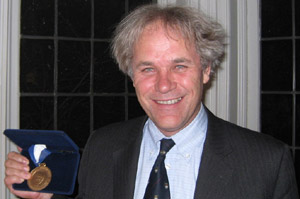 Mark SolmsUniversity of Cape TownNeuropsychoanalysis, and the brainstem account of affective consciousness
- Ryan SmithLaureate Institute for Brain Research. University of TulsaComputational psychiatry and active inference models of emotional awareness, interoceptive inference, hierarchical models of conscious access and affect
- St John GrimblyDepartment of Computer Science, University of Cape TownAffectWorld multi-need active inference environment, two routes to interoceptive prioritisation (preference reweighting and likelihood precision)
- Benjamin RosmanSchool of Computer Science and Applied Mathematics, University of the WitwatersrandReinforcement learning and decision-making in multi-need agents, skill composition, active inference homeostatic prioritisation
- Jonathan ShockDepartment of Mathematics and Applied Mathematics, University of Cape TownMathematical physics and computational neuroscience of active inference, multi-need homeostatic agency, neural dynamics
- Karl FristonUniversity College London. Chief Scientist, VERSES AIThe free energy principle and active inference