Peter Godfrey-Smith Other Minds Cephalopods and Distributed Consciousness
If you want to know what an independently evolved mind looks like without leaving Earth, the closest living example swims in coastal reefs. In Other Minds, The Octopus, the Sea, and the Deep Origins of Consciousness (Farrar, Straus and Giroux, 2016, ISBN 9780374227760) and its sequel Metazoa (2020), philosopher of biology Peter Godfrey-Smith examines coleoid cephalopods (octopuses, cuttlefish and squid) as evolution’s second major experiment in building a large, complex nervous system.
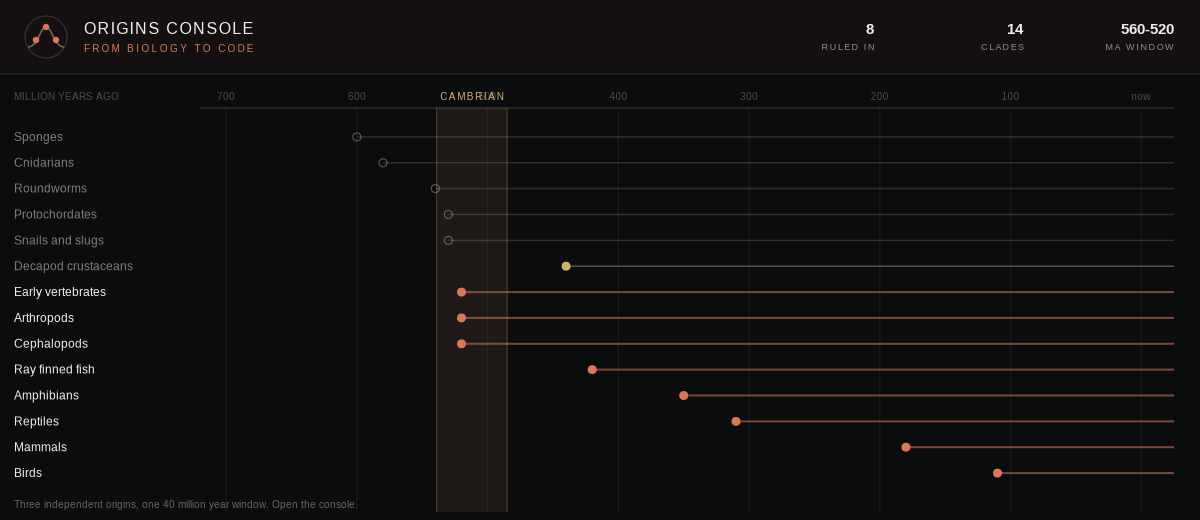
Vertebrates and cephalopods last shared a common ancestor roughly 600 million years ago, likely a small worm-like bilaterian with a minimal nerve net and no complex brain. Every major organ of perception and cognition in an octopus, from its camera-type eye to its learning circuits, evolved along an independent branch. That evolutionary split makes Other Minds a cornerstone text for the Alien Consciousness section.
A mind without a single central headquarters
An adult common octopus (Octopus vulgaris) carries roughly 500 million neurons, placing its raw neuron count in the same range as a dog or a small mammal. Where those neurons live breaks every vertebrate intuition about where a self resides.
Roughly two thirds of an octopus’s neurons sit outside its central brain, distributed along eight axial nerve cords inside its arms. Each arm contains local sensory-motor ganglia capable of tasting surfaces chemically, adjusting grip force, and executing coordinated reaching and fetching movements with minimal top-down instruction from the central brain. Even a severed octopus arm retains short-term reflex and grasping responses to local stimuli.
At the center, wrapped around the esophagus, sits a multi-lobed brain containing the vertical lobe, a learning and memory hub whose circuit geometry reveals striking convergence. As documented in comparative anatomy and mapped in Feinberg and Mallatt’s neuroevolutionary survey, the octopus vertical lobe fans roughly 1.8 million input fibers out onto approximately 25 million small amacrine interneurons, then converges back onto about 65,000 large output neurons. That three layer expansion-and-readout topology mirrors the mammalian cerebellum and the insect mushroom body, three architectures separated by hundreds of millions of years of independent evolution.
| Property | Mammalian vertebrate brain | Coleoid cephalopod nervous system | Relevance to alien consciousness |
|---|---|---|---|
| Evolutionary divergence | Bilaterian deuterostome branch | Bilaterian protostome (mollusc) branch (~600 Ma split) | Independent macro-origin of large nervous systems |
| Neuron distribution | Strongly centralized inside skull and spinal cord | ~500M neurons, roughly two thirds distributed across 8 arms | Challenges single-headquarters models of unified selfhood |
| Learning circuit motif | Neocortex, hippocampus and cerebellum | Vertical lobe (1.8M inputs to 25M interneurons to 65k outputs) | Convergent fan-out, fan-in computational architecture |
| Sensory Umwelt | Vision, audition, vestibular and localized somatosensation | Polarized-light vision, distributed arm chemoreception and chromatophore skin | Demonstrates radically divergent sensory worlds |
| Welfare assessment | Widely recognized sentience | LSE 2021 report (Birch et al.) graded octopods “very strong” evidence of sentience | Operationalizes non-human sentience criteria under uncertainty |
Gradualism and the shape of distributed experience
Godfrey-Smith defends a gradualist account of subjective experience. Consciousness did not switch on overnight in one sudden evolutionary leap. Instead, nervous systems accumulated sensory-motor feedback, reafference (distinguishing self-caused motion from external change), evaluative valence, and integrated world-tracking across deep evolutionary time.
What makes cephalopods philosophically unsettling is the question of unity. Human phenomenology usually presents a single integrated stream centered behind the eyes. An octopus combines centralized visual guidance with semi-autonomous arms that explore crevices, sample chemistry locally, and coordinate with the brain through a hybrid hierarchy rather than strict central command. Godfrey-Smith asks whether an octopus experiences one unified world, a loosely coupled federation of central and peripheral perspectives, or a mode of agency that sits cleanly between our concepts of “one mind” and “many.”
That biological reality received formal policy recognition in 2021 when Jonathan Birch, Charlotte Burn, Alexandra Schnell, Heather Browning and Andrew Crump published their LSE review of over 300 studies for the UK government (Review of the Evidence of Sentience in Cephalopod Molluscs and Decapod Crustaceans). Evaluating eight criteria ranging from nociception and integrative brain regions to painkiller self-administration and trade-off behavior, the panel graded octopods at “very strong” evidence of sentience across 7 of 8 criteria, leading to legal recognition of cephalopod sentience under the UK Animal Welfare (Sentience) Act 2022.
Why cephalopods anchor astrobiology and non-human minds
For researchers asking how consciousness could emerge in non-terrestrial life, octopuses provide three hard lessons that pure philosophy cannot supply.
- Large, flexible cognitive architectures can evolve without a vertebrate backbone, without a layered neocortex, and without social longevity (most octopuses are solitary and live only one to two years).
- Subjective experience and intelligent agency do not require strict anatomical centralization. Distributed control architectures with local sensory-motor autonomy and a shared associative hub work effectively in complex environments.
- Convergent circuit plans recur even when gross anatomy diverges. The three layer fan-out, fan-in plan of the vertical lobe, alongside Andreas Nieder and Onur Güntürkün’s finding of cortex-like circuits in the avian pallium, indicates that computational constraints of navigating a 3D physical world funnel evolution toward a recognizable family of organizational motifs.
At the same time, Godfrey-Smith cautions against naive functionalism. In Metazoa and his philosophical papers, he emphasizes living metabolism, continuous bodily boundary maintenance, and electrical signaling across whole organisms as tightly woven into biological subjectivity. His stance sits between strict mammalian chauvinism and unconstrained computationalism, challenging both sides of the current scientific consensus debate on AI consciousness.
Comparison to The Consciousness AI
The Consciousness AI adopts functionalist emergentism while grounding its seven layer software architecture in Feinberg and Mallatt’s neuroevolutionary criteria. Our current agent implements a centralized Global Workspace where specialist modules (Sensory Tectum, World Model, Affective Core, Self-Model) compete for broadcast via AKOrN Kuramoto oscillatory binding.
Cephalopod neurobiology highlights an open architectural assumption inside our own design. Like most Global Workspace implementations, our agent assumes a single central bottleneck as the locus of unified integration. Whether distributed multi-hub architectures with local semi-autonomous controllers (closer to an octopus arm-and-brain network, or to Michael Levin’s nested bioelectric collectives) support unified experience or fragmented micro-experiences remains an open question. Our codebase currently satisfies 3 of 14 Butlin et al. (2023) indicators and holds 0 of 21 trusted instruments, so it cannot settle that architectural dispute empirically today.
Open questions raised by Other Minds
Other Minds leaves consciousness science with an honest tension. The octopus proves that evolution on Earth built a complex, apparently sentient nervous system along a completely separate path from vertebrates, strengthening the case explored in the Alien Consciousness section that awareness is an evolutionary attractor rather than a one-off terrestrial accident. Yet even with a living octopus sitting inside a laboratory tank on our own planet, neuroscientists still cannot read out what its distributed arm-and-brain experience feels like from the inside. That gap defines the exact measurement wall awaiting any encounter with life beyond Earth.