

Andreas Nieder and Onur Gunturkun Conscious Birds and the Convergent Avian Pallium
Birds have no six layer mammalian neocortex, yet carrion crows display single-neuron correlates of subjective sensory awareness that closely mirror primate prefrontal cortex recordings. That experimental finding, led by Andreas Nieder at the University of Tübingen alongside anatomical circuit mapping by Onur Güntürkün at Ruhr University Bochum, dismantles the long-standing assumption that conscious perception depends on mammalian laminar cortex.
Their combined evidence sits at the heart of the Alien Consciousness section. Before asking whether subjective experience could emerge on another planet under alien biochemistry, consciousness science has to absorb what evolution already achieved on Earth. Two vertebrate branches separated by roughly 320 million years of independent evolution built radically different forebrain architectures that converged on the same functional circuit properties linked to conscious access.
Andreas Nieder and the two stage signal in crow NCL
In September 2020, Andreas Nieder, Lukas Wagener and Paul Rinnert published “A neural correlate of sensory consciousness in a corvid bird” in Science (Vol. 369, Issue 6511, pp. 1626-1629, DOI: 10.1126/science.abb1447). The team trained two carrion crows (Corvus corone) on a delayed visual detection task near perceptual threshold. On each trial, a faint gray square either appeared briefly on a screen or stayed absent, followed by a delay and a rule cue telling the bird which response indicated “stimulus seen” versus “stimulus absent.” Separating the stimulus from the motor rule guaranteed that the researchers could distinguish sensory awareness from simple motor preparation.
While the crows performed thousands of threshold trials, the team recorded extracellular activity from 480 single neurons in the nidopallium caudolaterale (NCL), a nuclear region at the back of the avian forebrain with no cortical layering.
The neuronal responses split cleanly into two distinct temporal phases.
- During the first phase immediately after presentation, NCL firing tracked the physical intensity of the visual stimulus regardless of what the crow later reported.
- During the second sustained phase, spanning the delay period before the rule cue arrived, neuronal activity shifted to predict the bird’s subjective report. On identical near-threshold stimuli, neurons fired strongly when the crow reported seeing the square and remained quiet when the crow missed it. On blank trials where the crow produced a false alarm and reported seeing a square that was not there, the same late-phase firing appeared anyway.
That dissociation between physical input and reported experience matches the classic neural correlate of sensory consciousness previously documented in macaque prefrontal cortex. A brain organized in dense nuclei rather than horizontal cortical sheets generated the same two stage perceptual ignition.
Onur Güntürkün and cortex-like microcircuits without a cortex
In the exact same issue of Science (September 2020, Vol. 369, Issue 6511, eabc5534, DOI: 10.1126/science.abc5534), Martin Stacho, Christina Herold, Noemi Rook, Hermann Wagner, Markus Axer, Katrin Amunts and Onur Güntürkün explained how a nuclear bird brain accomplishes that computation. Using 3D polarized light imaging across homing pigeons and barn owls, they resolved fine fiber architecture inside the sensory avian pallium at micrometer resolution.
Historically, neuroanatomists described the avian pallium as an amorphous cluster of nuclei incapable of laminar cortical processing. Stacho, Güntürkün and colleagues revealed the opposite. Inside those nuclear clusters, axons arrange into orthogonal horizontal and radial fiber systems forming iterative columnar microcircuits. Inputs enter sensory subfields, project across local columns, and feed back into associative hubs including the NCL in a canonical loop functionally analogous to mammalian neocortical columns.
Five years later, Gianmarco Maldarelli and Onur Güntürkün synthesized the behavioral and physiological literature in “Conscious birds” (Philosophical Transactions of the Royal Society B, 2025). Evaluating avian cognition against major frameworks including Global Neuronal Workspace Theory (GNWT) and Recurrent Processing Theory (RPT), they showed that birds satisfy core architectural requirements of both theories. Avian forebrains pack roughly twice the neuronal density per unit volume of primate brains of comparable mass, support extensive long-range recurrent loops linking sensory areas with the NCL, and exhibit sustained ignition-like activity during perceptual reporting and volitional attention.
| Architectural feature | Mammalian neocortex | Avian nuclear pallium (NCL) | Cephalopod vertical lobe |
|---|---|---|---|
| Macroscopic layout | Six horizontal cortical layers with radial columns | Clustered nuclei with orthogonal fiber sheets | Three layer fan-out, fan-in lobe plus distributed arm rings |
| Shared conscious ancestor with mammals | Same lineage | Diverged ~320 million years ago | Diverged ~600 million years ago |
| Key associative hub | Prefrontal and parietal cortex plus thalamus | Nidopallium caudolaterale (NCL) | Vertical lobe and superior frontal lobe |
| Direct neural evidence | Primate threshold detection, human MEG and intracranial ignition | Nieder et al. (2020) two stage subjective report firing in crow NCL | Birch et al. (2021) LSE review, nociception and flexible learning |
| Implication for substrate scope | Proves laminar cortex can support consciousness | Proves cortical lamination is unnecessary | Proves vertebrate brain plans are unnecessary |
What convergent avian brains mean for alien consciousness
Inside the wider consciousness debate, avian neurobiology provides a disciplined empirical bridge between terrestrial biology and astrobiology. If consciousness required the exact histological blueprint of mammalian neocortex, then subjective experience would look like a fragile evolutionary fluke tied to one clade on one planet.
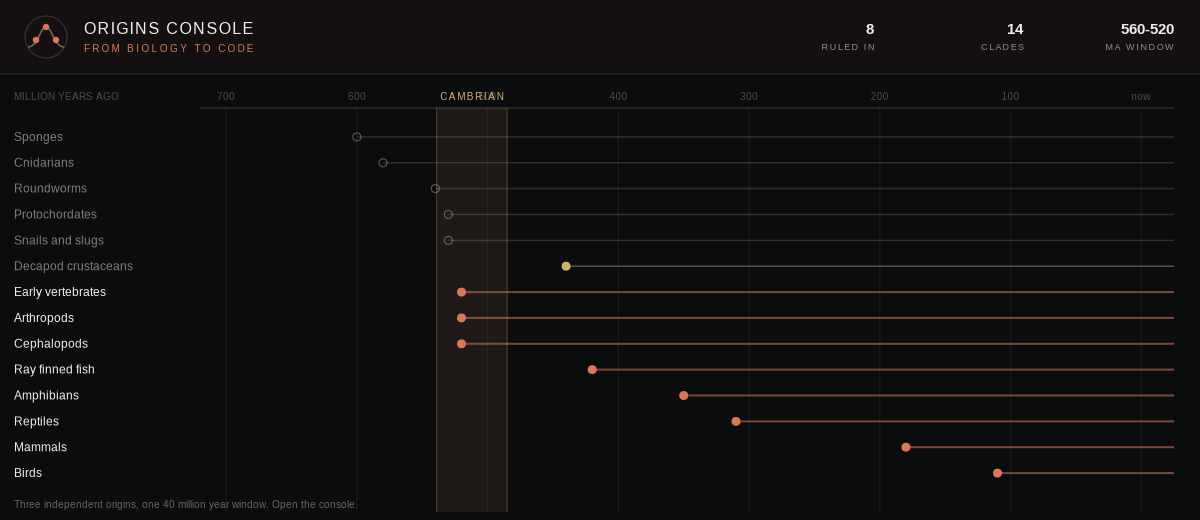
Instead, birds and mammals diverged from a stem amniote ancestor roughly 320 million years ago whose small pallium lacked both mammalian neocortical layers and the expanded avian NCL. Both lineages independently scaled up dense associative hubs, orthogonal microcircuitry, and recurrent feedback capable of separating raw sensory transduction from sustained subjective reporting. Combined with Nicola Clayton’s work on corvid cognition and methodological limits and Feinberg and Mallatt’s three independent Cambrian origins, the pattern points toward functional convergence.
When mobile organisms face complex, uncertain environments that require integrating multiple senses, holding information across delays, and choosing flexible actions under homeostatic stakes, evolution repeatedly converges on recurrent, globally broadcast circuit motifs regardless of whether the cells sit in laminar sheets or nuclear clusters. That same principle underpins Eric Schwitzgebel and Joseph Pober’s Copernican framing of substrate flexibility and the comparative survey in the Alien Consciousness section.
Connection to The Consciousness AI architecture
The Consciousness AI builds a seven layer software agent inspired by Feinberg and Mallatt’s neuroevolutionary features rather than by mammalian cortical lamination specifically. Our Sensory Tectum fuses trimodal spatial inputs using inverse effectiveness, our ReentrantProcessor runs 5 to 10 bidirectional prediction-error convergence cycles, our AKOrN layer couples oscillators for workspace binding, and our Global Workspace broadcasts winning representations across modules.
None of those software mechanisms replicates the biological complexity of a crow’s NCL, and our system currently implements only 3 of the 14 indicator properties tracked in the scientific consensus review on AI consciousness, with 0 of 21 candidate instruments validated. What Nieder and Güntürkün’s work sharpens for our engineering is a concrete architectural target. The distinction between phase one stimulus intensity tracking and phase two report-predictive sustained activity inside a recurrent hub is a testable dynamical signature, one that does not depend on mimicking six mammalian cortical layers.
Open questions in avian and comparative consciousness
Significant empirical gaps remain. Single-neuron threshold recordings like Nieder’s exist for a tiny number of avian species, primarily carrion crows and pigeons, and demonstrating sensory access awareness in a trained detection task does not settle higher-order self-awareness or the precise qualitative texture of avian experience. Moreover, neurobiological naturalists such as Feinberg and Mallatt note that birds still share living vertebrate physiology, metabolism, and midbrain structures (including the optic tectum) with mammals.
Even with that caveat, the avian pallium establishes a hard empirical constraint for every theory of mind. Any theory that defines consciousness by mammalian cortical layering fails on living animals sharing our own skies. To understand how consciousness could emerge in truly unfamiliar living systems, whether in Earth’s oceans or on distant worlds, comparative neuroscience has to follow the recurrent circuit dynamics rather than the macroscopic shape of the skull.
Researchers covered here
- Andreas NiederUniversity of TübingenSingle-neuron correlates of sensory consciousness in carrion crows, nidopallium caudolaterale (NCL), avian cognitive control and numerosity
-
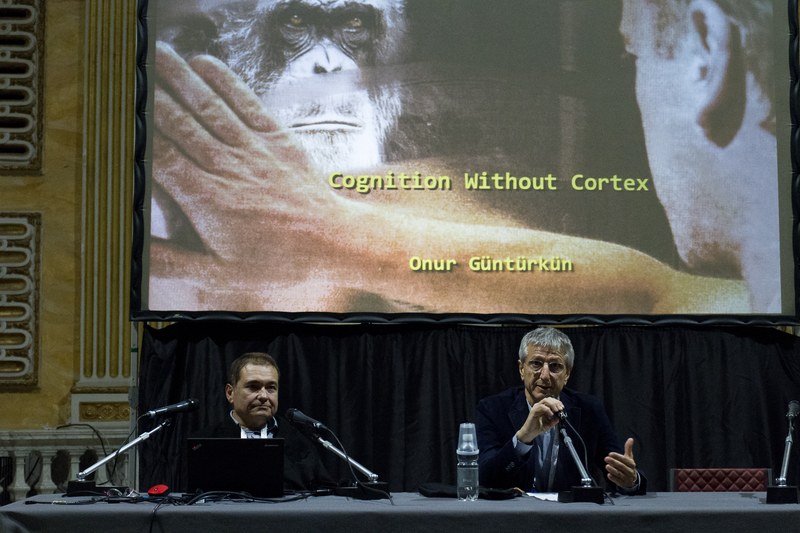 Onur GüntürkünRuhr University BochumConvergent evolution of the avian pallium, cortex-like canonical microcircuits in birds, Conscious birds synthesis (2025)