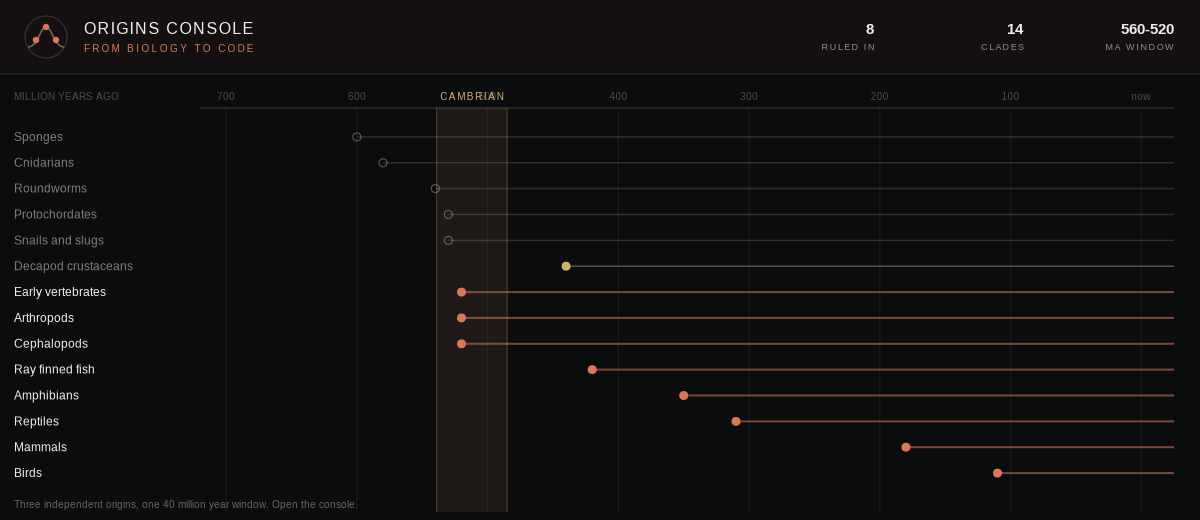
The Consciousness AI studies consciousness as an emergent property of the universe, substrate independent. If subjective experience depends on causal organization rather than on one specific terrestrial anatomy, then Earth is already a natural experiment with a sample size larger than one. On this planet alone, conscious organization emerged across nervous systems built on completely different plans, from the six layer mammalian neocortex to the nuclear avian pallium and the distributed arm rings and vertical lobe of coleoid cephalopods.
This section examines what follows from that biological fact for life beyond Earth. If independent evolutionary lineages on one world converged on the functional circuits linked to awareness, the same selective and physical pressures can operate in other biospheres. Understanding how to recognize experience in an octopus, a crow, or a non-neural tissue system is the same scientific problem as recognizing experience in a non-terrestrial organism.
Nothing on this page claims that extraterrestrial life or alien consciousness has been observed. Zero planetary biosignatures have confirmed life beyond Earth, and no validated instrument currently proves subjective experience in any non-human or artificial system. This section collects the peer-reviewed neurobiology, complexity physics, astrobiology and philosophy of mind that define what a rigorous search for alien consciousness requires. For where the wider field stands on verifying non-human minds today, start with the current scientific consensus on AI consciousness.
| Question | What it examines | Key researchers covered |
|---|---|---|
| How many times did consciousness arise on Earth | Independent evolutionary convergence across mammals, birds, arthropods and cephalopods without a shared conscious ancestor | Todd Feinberg, Jon Mallatt, Andreas Nieder, Onur Güntürkün, Peter Godfrey-Smith, Jonathan Birch, Simona Ginsburg, Eva Jablonka |
| Can physics detect selection without Earth chemistry | Substrate-agnostic complexity signatures, Assembly Index thresholds and causal emergence prior to genetic replicators | Sara Imari Walker, Lee Cronin, Michael Levin, Federico Pigozzi, Erik Hoel |
| Could we recognize a non-terrestrial mind | The Copernican Principle of Consciousness, verification limits across incompatible sensory worlds, and epistemic boundaries | Eric Schwitzgebel, Joseph Pober, Susan Schneider, Thomas Nagel, Naotsugu Tsuchiya |
| What happens when intelligence evolves without awareness | Hard science fiction thought experiments probing non-human Umwelten and high-intelligence zero-experience organisms | Peter Watts, Andy Weir, Adrian Tchaikovsky |
Mammalian neuroscience long treated the six layer neocortex as the signature hardware of conscious perception. Comparative neurobiology broke that assumption from two directions. Inside vertebrates, corvids and pigeons lack a layered neocortex, yet Andreas Nieder and colleagues demonstrated single-neuron correlates of subjective sensory awareness in the crow nidopallium caudolaterale (Science, 2020), while Onur Güntürkün and collaborators mapped canonical cortex-like microcircuits inside the nuclear avian pallium (Science, 2020; Phil. Trans. R. Soc. B, 2025). Outside vertebrates, coleoid cephalopods diverged from our lineage roughly 600 million years ago and built a nervous system of about 500 million neurons, with roughly two-thirds distributed across their arms and a three layer fan-out, fan-in vertical lobe studied by Todd Feinberg, Jon Mallatt and Peter Godfrey-Smith.
Comparative neurobiology proves that consciousness on Earth did not require a mammalian neocortex, yet every Earth animal still shares DNA, lipid bilayers, and ion-channel electrochemistry. Astrobiology faces the harder problem of detecting living and cognitive systems that share none of Earth’s chemistry.
Physicist Sara Imari Walker and chemist Lee Cronin introduced Assembly Theory (Nature, 2023; Walker’s Life as No One Knows It, 2024) to separate physics driven by chance from physics shaped by historical selection. Rather than looking for terrestrial biomolecules, Assembly Theory computes an object’s assembly index (the minimum number of joining operations needed to construct it from basic building blocks) alongside its copy number. Structures above an assembly threshold occurring in high copy numbers require memory and selection to persist across time.
Assembly Theory does not measure subjective experience directly, and Walker does not claim that an assembly index detects sentience. Its contribution to consciousness research sits one layer deeper. Together with Federico Pigozzi and Michael Levin’s finding that causal emergence precedes self-replicators in catalytic networks, Assembly Theory gives astrobiology a chemistry-agnostic vocabulary for tracking how physical systems cross from raw thermodynamics into historical, information-bearing agency.
The Consciousness AI implements a seven layer software agent grounded in the six neurobiological features condensed from Feinberg and Mallatt’s evolutionary survey (oscillatory binding via AKOrN Kuramoto oscillators, trimodal topographic mapping in a Sensory Tectum, reentrant convergence cycles, affective modulation, hierarchical capsule binding, and a Global Workspace broadcast). Because those six features were distilled from Earth’s earliest conscious vertebrates and checked against convergent arthropod and cephalopod circuits, the research codebase acts as an engineering testbed for asking which organizational traits are portable across substrates.
Every boundary condition from our Thermodynamic Computing hub and architecture documentation applies equally here.
Stating those limits plainly is part of the method. As Susan Schneider’s alien minds verification problem emphasizes, we cannot reliably verify alien or artificial consciousness until our detection frameworks survive rigorous testing on the minds we can already inspect.
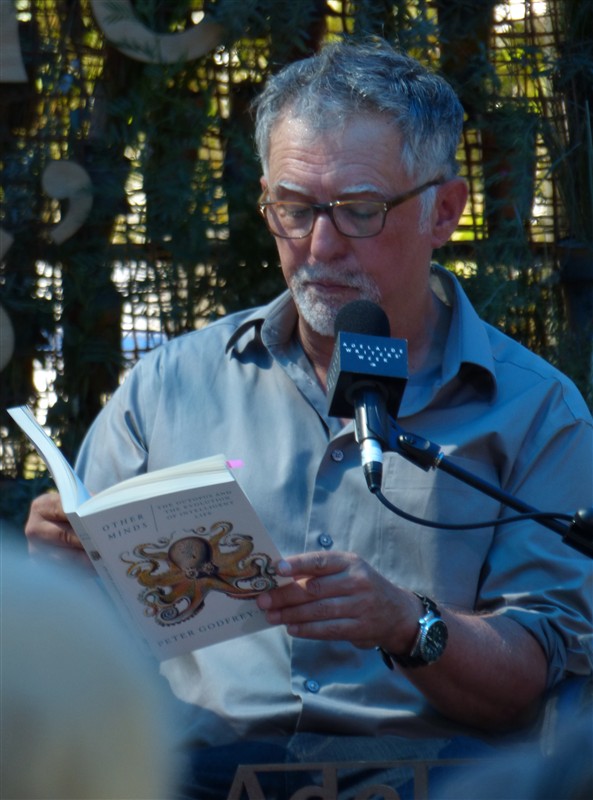 Peter Godfrey-SmithUniversity of SydneyOther Minds and the octopus, gradualist evolution of subjective experience, philosophy of biology, the Darwinian individual as the unit of experience
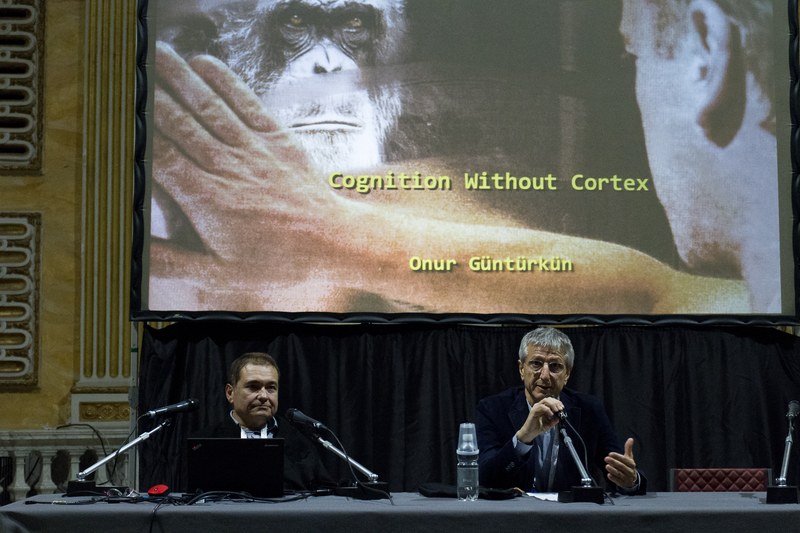 Onur GüntürkünRuhr University BochumConvergent evolution of the avian pallium, cortex-like canonical microcircuits in birds, Conscious birds synthesis (2025)
 Sara Imari WalkerArizona State University and Santa Fe InstituteAssembly Theory, Life as No One Knows It (2024), physics of life and selection, planetary intelligence and agnostic biosignatures
 Michael LevinAllen Discovery Center, Tufts UniversityBioelectric signalling, the cognitive light cone, and diverse intelligence
 Susan SchneiderCenter for the Future Mind, Florida Atlantic UniversityArtificial Consciousness Tests (ACT), Artificial You, AI and the Future of Your Mind (Princeton, 2019), AI safety & cognitive rights, NASA-Baruch Blumberg Chair at Library of Congress
 Jonathan BirchLondon School of Economics and Political ScienceThe Edge of Sentience, the LSE Criteria, and the run-ahead principle
These researchers span sharply different positions in the directory of consciousness researchers. Feinberg, Mallatt and Godfrey-Smith emphasize biological evolution and embodiment. Nieder and Güntürkün map avian neural circuits without assigning a verdict on artificial systems. Walker and Cronin formulate substrate-agnostic physics of selection and complexity. Schwitzgebel and Schneider probe the philosophical and epistemic limits of attributing experience to unfamiliar minds. The disagreement among them defines the open frontier of the field.
This section pairs directly with Project Consciousness to Orbit, which examines the mirror question of how substrate-independent minds built on Earth could operate beyond planetary biology. Earth’s comparative neurobiology is mapped interactively in the Origins Console, while non-neural biological computation is covered in the Bioelectricity section. The philosophical basis for portable causal organization sits on the Functionalist Emergentism page, and the hardware physics tests live in Thermodynamic Computing and Photonic-Thermodynamic Substrates.
The question this project asks of any substrate, printed on the animals it also applies to. Every order funds the research.
 Octopus Are you conscious? T-shirt | Octopus Illustration, Sci‑Fi Quote
From $23.99
 Dragonfly, are you conscious? T-Shirt | Dragonfly Illustration, Vintage Insect Art
From $23.99
 Owl are you conscious? Owl Illustration T-shirt | Vintage Bird Tee
From $23.99
 Cat are you conscious? Cat Illustration T-shirt | Vintage Brown Cat Tee
From $23.99
 Dog, are you conscious? T-Shirt | Border Collie Illustration
From $23.99
 Axolotl, are you conscious? T-Shirt | Pink Axolotl Illustration
From $23.99