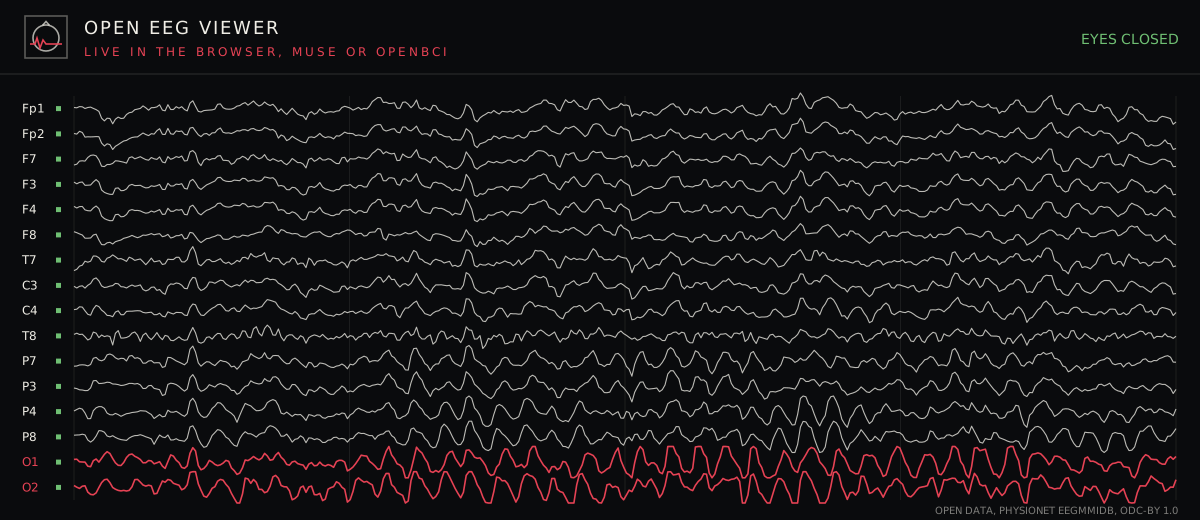
The band is free and open source. The STL and STEP files and the CadQuery code that makes them are on GitHub under the CERN-OHL-S v2 licence.
Get the files on GitHubThis open EEG headband is one 3D printed ring with three channels and a small wireless board. The ring follows the circumference line of the 10-20 map, the standard map of EEG positions. One sensor sits on the forehead at Fp1 and two sit at the back of the head at O1 and O2. The board rides in a slim clear pod above one ear and its battery in a pod above the other. The Open EEG Viewer on this site shows all three channels live in the browser, with no install. It is the low cost sister of the 16 channel EEG headset frame.
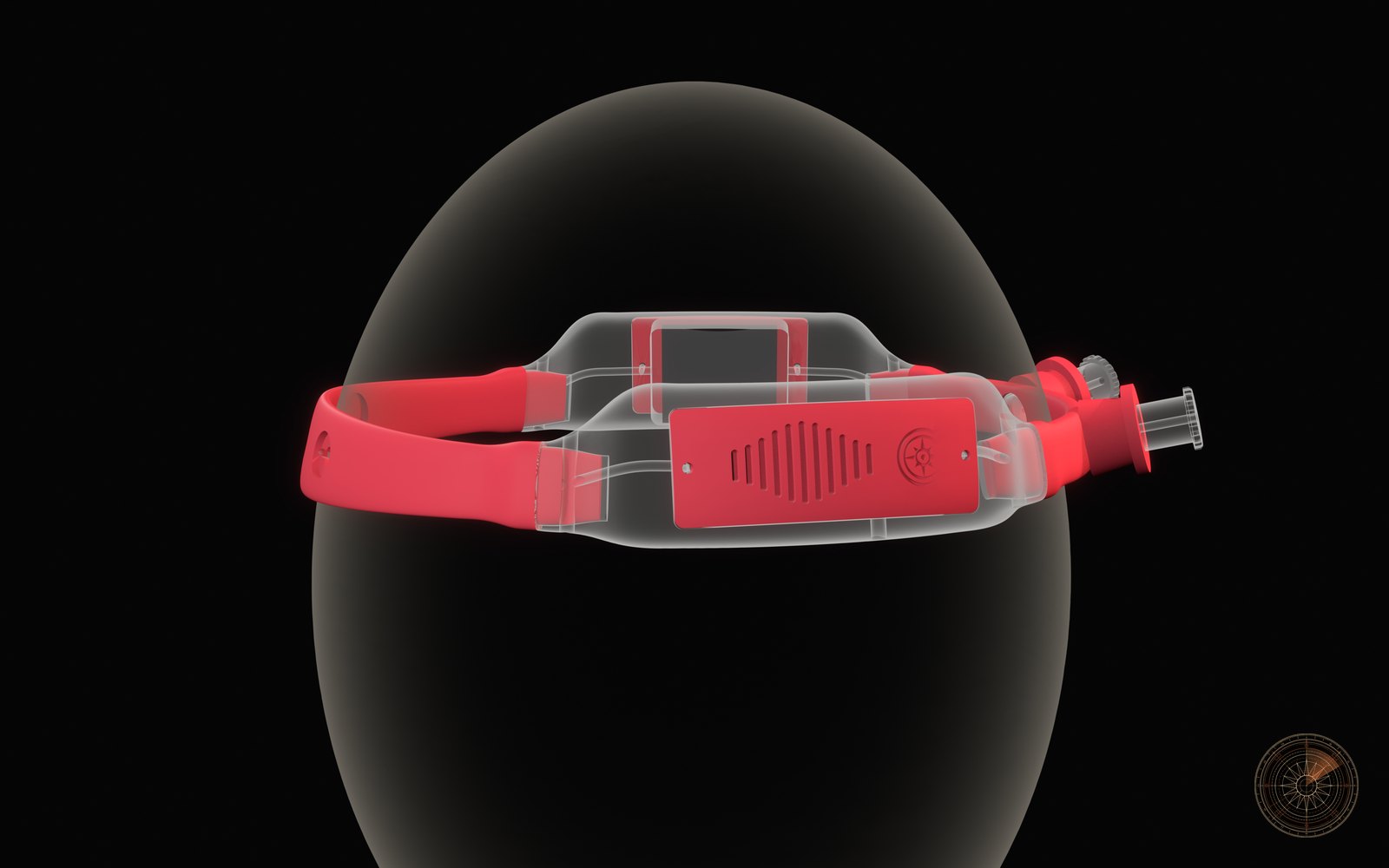
A one minute film shows the band on the 10-20 ring, the three sizes, the board and the battery in their pods, and the live viewer. The band shots are renders of the CAD, and the brain waves are open PhysioNet data, not recorded with this band. Watch Print an EEG headband and see your blinks and alpha waves on YouTube.
The band is not printed yet. Nobody has worn it and no signal has been recorded with it. The parts were checked in CAD against a head model, a board model and a battery model. The test state below lists what is checked and what is open.
The forehead sensor sees your eyes. A blink or a look to the side makes a large, slow signal there, called EOG (electrooculography). It comes from the eyes and the eye muscles, not from the brain. It is strong and easy to detect, so makers use it to control a cursor, a light or a game.
The two sensors at the back of the head see the alpha rhythm, a brain wave near 10 Hz over the visual cortex that grows when you close your eyes. That signal comes from the brain. It is about ten times smaller than a blink, so it needs good contact through the hair. The guide to the 10-20 system shows where Fp1, O1 and O2 sit.
| Item | Quantity | Note |
|---|---|---|
| Upside Down Labs NPG Lite (Neuro PlayGround Lite), 3 channel version | 1 | ESP32-C6, Bluetooth LE, Adafruit Feather size |
| 1S LiPo pouch cell with a 1.25 mm plug and a protection circuit | 1 | The CAD model is a 503035 cell (5 x 30 x 35 mm, about 500 mAh). The pod takes cells up to 8 x 30 x 40 mm, so the smaller EEMB 402535 (320 mAh) below also fits, with a shorter run time. The board has no polarity protection, so check that red (+) meets + on the board |
| OpenBCI 5 mm dry comb electrodes | 2 | O1 and O2 |
| Snap electrodes, gel or dry | 1 to 3 | Fp1. Fpz and Fp2 are spare sockets. A 3M Red Dot pad is larger than the 20 mm recess, so its foam sits under the band. Trim the edge if it shows |
| Conductive paste | a little | Under the dry comb electrodes for better contact through hair |
| Earclip electrode | 1 | Reference, through the lead hole of the board pod |
| Printed parts | 1 set | Front band (TPU 95A), 2 pods, rear arc, 2 covers, 2 carriers (PETG) |
| M3 bolts and lock nuts, 25 mm | 4 | One across each joint |
| M2.5 self-tapping screws, 4 mm | 4 | Board posts |
| M2 self-tapping screws, 8 mm | 4 | Two per cover |
| M3 set screws, 6 mm | 2 | Lock the carriers |
| Thin foam pad | 1 | Under the battery |
| Elastic strap, 20 mm | optional | Around the back of the head for a firmer fit |
| Electrode cables | 3 | Snap to the board inputs. The NPG Lite Ninja kit includes electrode cables. The input connector is not checked here |
The OpenBCI dry comb electrodes come in a pack of 30, which also covers the 16 channel frame. OpenBCI and the Upside Down Labs store are plain links. The parts marked “Buy on amazon.com” are Amazon affiliate links and earn theconsciousness.ai a commission at no extra cost to you. As an Amazon Associate I earn from qualifying purchases. The sellers were checked on the product pages on 21 November 2026.
The battery input has no polarity protection, so check the plug of the cell. Battery power only. Not a medical device.
Recording only. Not a medical device.
Recording only. Not a medical device.
The pad is larger than the 20 mm recess in the band, so the foam sits under the band. Trim the foam edge if it shows. Not checked with a print. Sold through a third-party seller on 2026-11-21.
The listing title says one jar; the pack holds 3 jars. Sold by Balego on 2026-11-21.
The NPG Lite battery input has no polarity protection. Check that red (+) meets + on the board before you connect it. Plug polarity not checked with a real board.
Sold by Polymaker on 2026-11-21. Print slowly, as for any flexible filament.
Sold by GORGECRAFT on 2026-11-21.
Variant B is wired. An Arduino Nano ESP32 fits in the board pod and three BioAmp EXG Pill boards fit in the battery pod, on foam tape. Take the Nano without pin headers, so it lies flat in the pod. Run the computer on its battery, never on the wall supply, when the band is on a head.
Sold by Upside Down Labs. Temporarily out of stock on 2026-11-21; Amazon takes orders. Battery power only. Not a medical device.
Sold by Upside Down Labs on 2026-11-21. Battery power only. Not a medical device.
Sold by Arduino on 2026-11-21.
A ready made EEG headband records your brain rhythms with no printing and no wiring. It has 4 dry channels at the forehead and behind the ears (AF7, AF8, TP9 and TP10), and the Open EEG Viewer reads it by Bluetooth too.
Records only, with no stimulation feature. Muse calls it a general wellness product, not a medical device. The code THECONSCIOUSNESSAI saves 15 percent at Muse.
Not only a recorder. Its Deep Sleep Boost feature plays pink-noise sound cues through your headphones during deep sleep. No electrical current. Muse calls it a general wellness product, not a medical device. The code THECONSCIOUSNESSAI saves 15 percent at Muse.
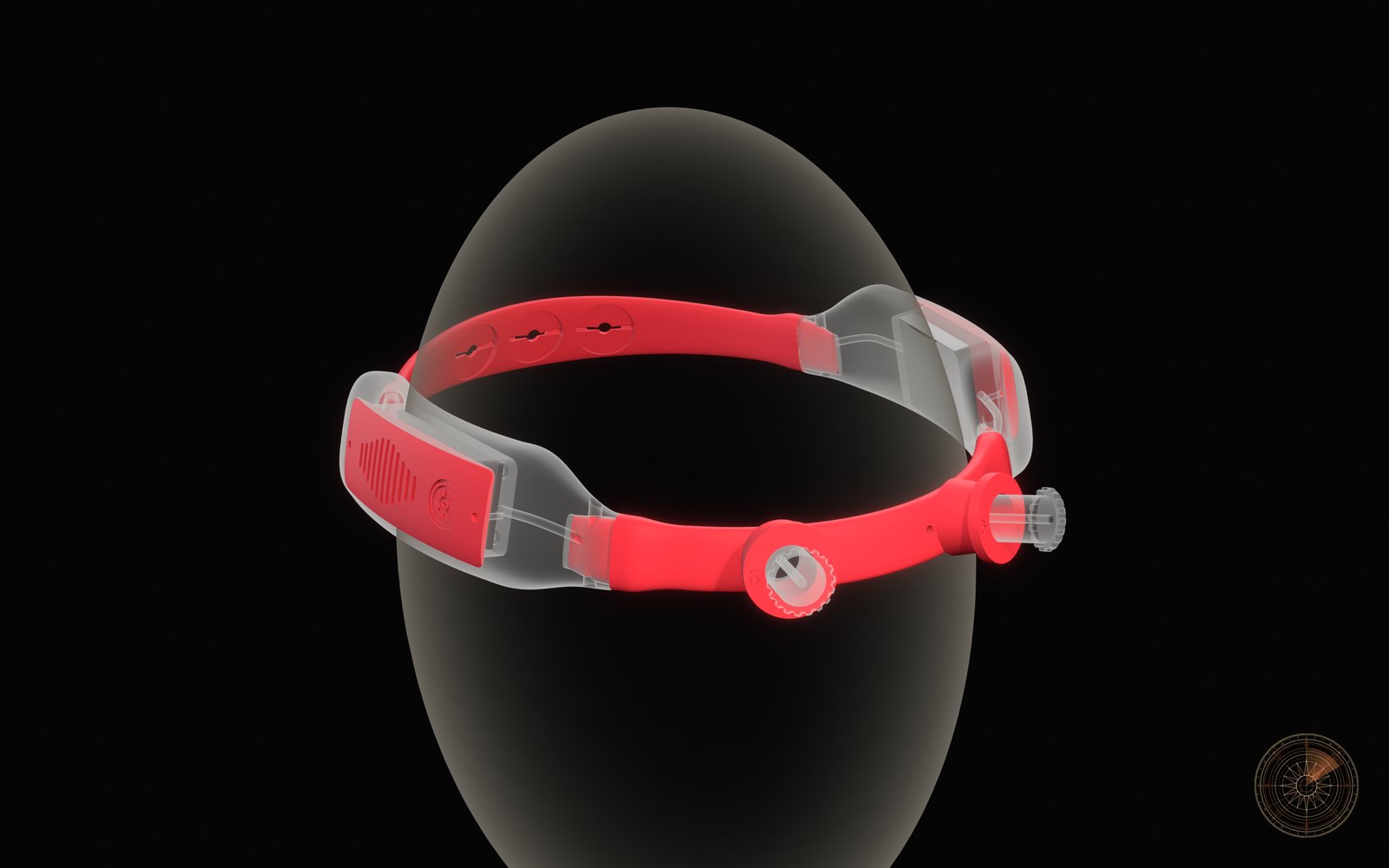
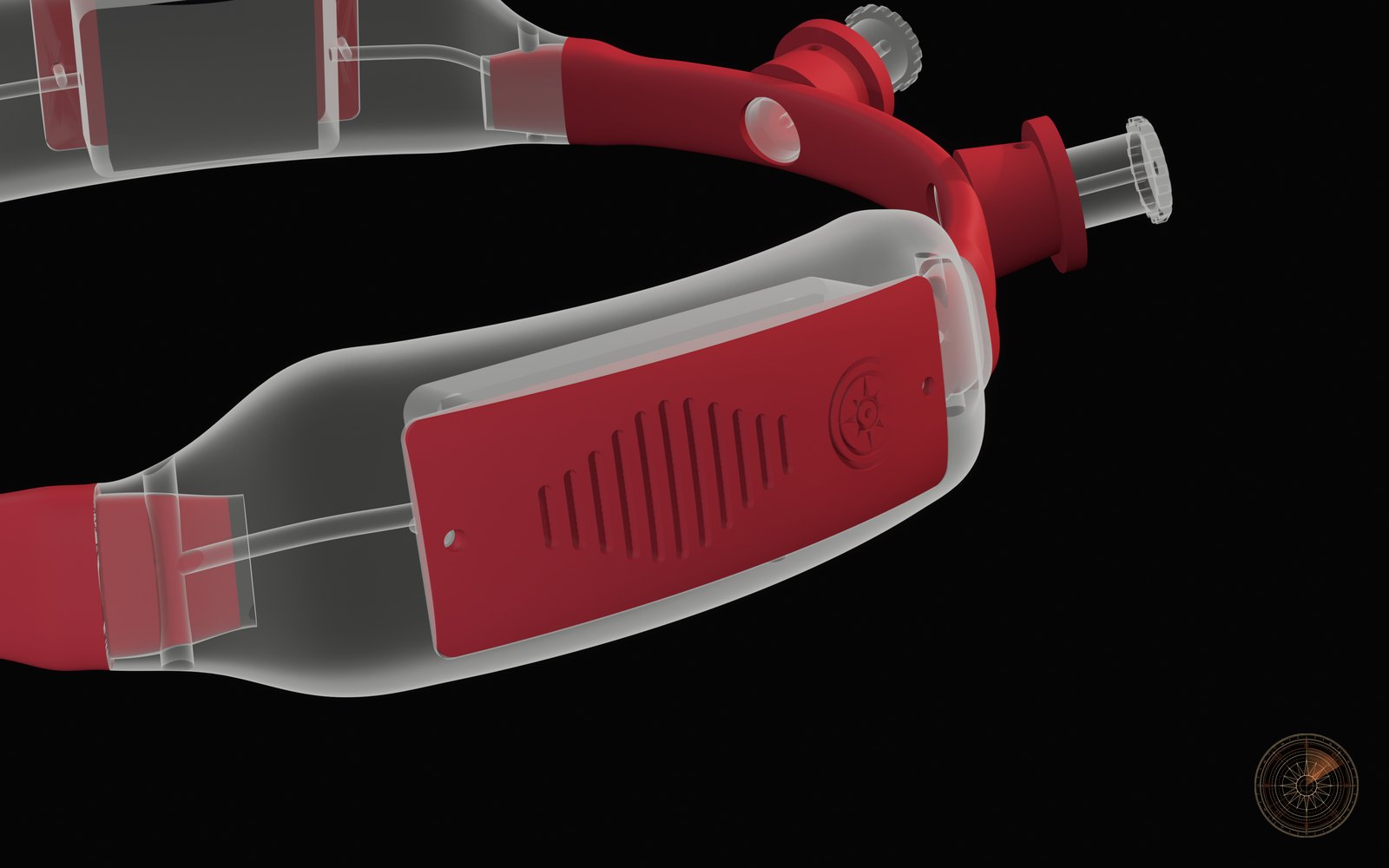
The whole ring is one smooth shape. Its cross-section is a rounded lens whose width and thickness change along the head. It is wide and thin on the forehead, with a collar at each joint, a pod above and behind each ear, and a firm arc at the back. One script makes sizes S, M and L for a head circumference of 54, 57 and 60 cm.
The ring is cut into four printed parts. The soft front band in TPU 95A has snap sockets at Fp1, Fpz and Fp2. The two pods and the rear arc are PETG. A tongue at each end of the front band and the rear arc slides into a socket in the pod, and one M3 bolt holds each joint. A channel inside the band carries the leads, and the battery lead runs from the right pod through the rear arc to the board in the left pod.
The rear arc has the same hub and the same clear carrier as the EEG headset frame. The carrier slides in the hub, the dry comb electrode sits at its bottom, and you push it down until it touches the scalp, then lock it with the set screw.
python build.py. Every size runs the same CAD checks on every build.You can see the three channels before you print anything. The band demo plays an open recording from PhysioNet at Fp1, O1 and O2, with the eyes open and then closed. It was not recorded with this band.
| Check | Result |
|---|---|
| Parts overlap in CAD, all pairs, sizes S, M and L | 0.000 mm3 |
| Board and battery inside the closed pods | 0.000 mm3 outside |
| Pods to scalp on the head model | 0.5 mm (limit 0.3 mm, the pods rest on the head) |
| Rear arc to scalp on the head model | 3.0 mm |
| Carriers in the hubs at O1 and O2 | 0.000 mm3 overlap, the same hub and carrier as the EEG headset frame |
| Board outline and holes | Feather standard, an estimate. No drawing of the NPG Lite is published |
| Room above the board | 7 mm, an estimate. Base board only |
| Snap socket | For a 4 mm snap stud. Not checked with a real electrode |
| Channel wiring | Not checked with the maker’s documentation |
| NPG Lite source in the viewer | Built from the maker’s published packet layout. Not run with a real board |
| Printed | No |
| Worn on a head | No |
| Signal recorded with this band | No |
Do not order a print for a project that depends on it until the “Printed” and “Worn on a head” rows say yes. The design README carries the same table.
Recording is the limit of this band. It is not a medical device, it does not diagnose or treat anything, and it has no part that sends current into the body.
Three channels cover the two signals a beginner can see clearly. The forehead channel shows blinks and the two channels at the back show the alpha rhythm. For a map of the whole head, the 16 channel frame holds an OpenBCI Cyton with the Daisy module.
The 6 channel board has the same Feather outline, so it fits the same pod, and the viewer reads it by the same Bluetooth service. Fpz and Fp2 are free sockets on the front band. This combination is not checked.
No. A printed band is offered only after a real print is worn and checked. If you want one, the button below counts it.
Every open design of this project is on the hardware page, next to the EEG headset frame and the Tang Nano 9K case. Ready made EEG headbands, boards and recorders from other makers are on the brain kits page.