

The Bioelectric Pulse of the Self. Spiking Neurons and Elementary Selfhood
What would it take for a spiking network to hold a representation of itself without any input telling it to. A preprint posted to arXiv on September 24 by R. Lahoz-Beltra of the Complutense University of Madrid builds one answer in ten thousand neurons. A Spiking Neural Network Model of Elementary Self-Consciousness via Endogenous Default Mode Network Dynamics (arXiv:2609.29984) splits an Izhikevich spiking network into a sensory layer and a self-driven pacemaker core, gives the core a continuous tonic current standing in for brainstem neuromodulation, and reports that the resulting low-frequency activity behaves like a persistent, self-sustaining representation of a Self.
The paper is also a model of how to frame such a claim. The author states outright that the model represents a functional simulation of conscious dynamics, not an actual conscious system, and calls the executed network a functional philosophical zombie at the micro-scale, with access consciousness without possessing phenomenal consciousness. That framing is why the model earns analysis rather than dismissal.
Two subsystems and a supremacy rule
The network runs ten thousand Izhikevich neurons, each emitting the characteristic regular spiking or bursting dynamics of that model family. The first five thousand are the sensory layer, regular-spiking excitatory pyramidal units that receive external stimulation. The second five thousand are the Default Mode Network pacemaker subsystem, intrinsically bursting neurons whose first thousand form a dedicated core with bursting parameters tuned for autonomous rhythm.
Connectivity is sparse, one thousand outgoing projections per neuron and ten million synapses in total. The weights encode the model’s central assumption. Connections out of the DMN subsystem carry a weight of 0.6 against 0.4 for sensory projections, which the paper describes as the functional supremacy of the DMN over sensory cortical areas, citing Varela’s work on phase synchronization. Top-down influence outranks bottom-up signal by design, because the model’s hypothesis is that selfhood begins with endogenous activity rather than with stimulus.
Tonic drive and the pacemaker core
The core pacemaker neurons receive a continuous 7.0 picoampere tonic current, which the paper describes as representing ascending dopaminergic and cholinergic brainstem neuromodulation critical for maintaining wakefulness and intrinsic DMN activity. The sensory layer, by contrast, receives a 300-millisecond external stimulus to 1,500 of its neurons during the middle of the 900-millisecond simulation. Integration runs on a modified two-step Euler scheme at a 1-millisecond step, chosen for efficiency over fourth-order Runge-Kutta.
The ablation is the paper’s quantitative heart. Across 30 seeded runs with paired t-tests, the network with tonic drive and the same network with the drive removed were compared at three windows.
| Window | With tonic drive | Ablated (I tonic = 0) |
|---|---|---|
| Baseline, 0 to 300 ms | 7.87 ± 0.12 bits | 4.67 ± 0.57 bits |
| Stimulus onset, 300 to 450 ms | 14.27 ± 0.76 bits | 6.42 ± 0.10 bits |
| Recovery, 600 to 900 ms | 13.13 ± 1.35 bits | 5.23 ± 0.40 bits |
The reading is that tonic drive keeps the DMN core primed and lets integration recover after perturbation. Without it, the network stays near its floor.
Measuring integration
The self-representation claim is scored with a covariance-based integrated information metric, Phi computed as one half of the natural logarithm of the ratio between the determinant of the partitioned system’s covariance matrix and that of the global system, used as a proxy for qualia in the author’s terminology. Across the 900-millisecond run, Phi moves through three regimes, roughly zero bits in isolated quiescent windows, one to 2.5 bits during pre-burst priming, and 12.5 to 15.0 bits at four synchronized population bursts reaching around 1,000 hertz. The Self, in the paper’s language, is the bioelectric pulse of the Self, persistent asynchronous low-frequency firing of the DMN core under tonic drive, independent of sensory input.
What the paper claims and refuses
The claim structure is as important as the architecture. The model is offered as an elementary mathematical framework for the emergence of a persistent, self-sustaining neural representation of Self, grounded in the Default Mode Network literature on self-referential processing and mind-wandering from Raichle’s work. What the paper does not claim is experience. The author’s own framing sets the model against the Chalmers organizational-invariance position and the Searle simulation-is-not-duplication position and lands, for the model itself, on the P-zombie description. Dynamics associated with selfhood are instantiated. Whether anything accompanies them is exactly the question the model does not answer.
The substrate question
The paper’s future-work section points at hardware. Neuromorphic platforms, Intel Loihi and BrainScaleS are named, would run the dynamics at physical speeds and power budgets, alongside STDP learning and eventual organoid validation. That direction bears directly on the substrate-independence question this site tracks. A spiking model whose self-sustaining dynamics depend on tonic neuromodulatory drive is a specific architectural claim about what kind of physical system could hold such dynamics, and the Loihi 2 analysis covers what that hardware can and cannot settle. The brainstem-drives-selfhood assumption also rhymes with the upper-brainstem line this site covered in Merker’s selection triangle, though the paper itself works from the DMN literature rather than from Merker.
Comparison to The Consciousness AI
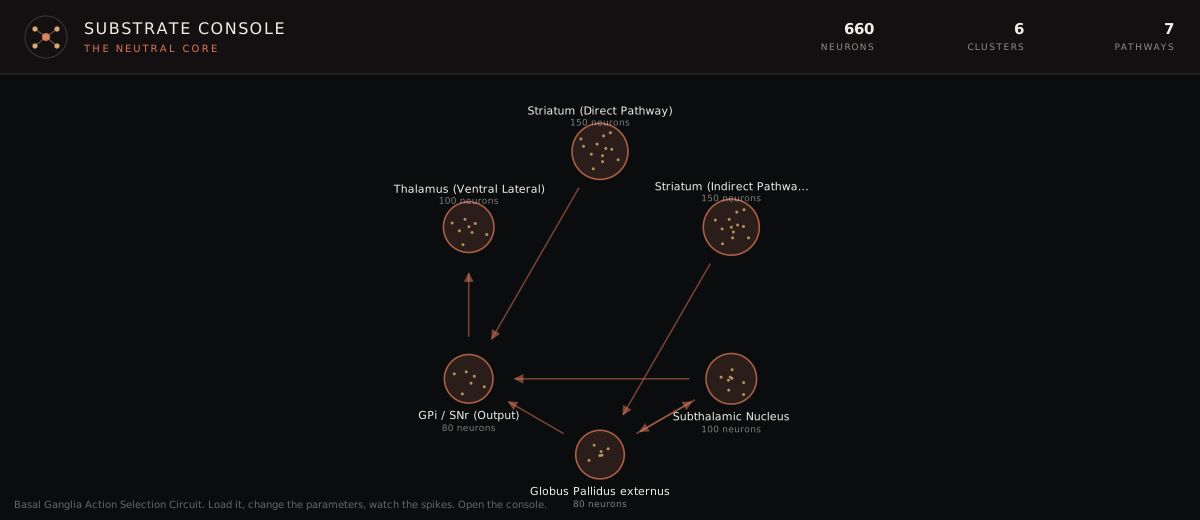
The Substrate Console on this site runs Leaky Integrate-and-Fire neurons, a simpler model family than the Izhikevich dynamics this paper uses, so the console can display spiking dynamics and network structure but does not implement this model’s bursting pacemaker core. The comparison is still instructive. The Consciousness AI project’s core documentation treats substrate dynamics as the layer where self-sustaining organization must be tested, and the project’s research stance treats consciousness as an emerging property of system dynamics, substrate independent, with the codebase documented on GitHub. This paper supplies a concrete, ablatable instance of the first half of that claim, a self-representation sustained by endogenous drive, while leaving the second half, experience, exactly where it stands. Its place in the field’s wider instrument landscape sits inside the flagship field survey.
The paper was posted to arXiv on September 24, 2026 and revised September 29 as v2, with code at the author’s repository. The acknowledgements credit an LLM assistant for the Python implementation and figures, with the author taking responsibility for the model.