


Rafael Lahoz-Beltra
Complutense University of Madrid
Builder The claim is about what the hardware does, and the philosophy is left open
Position on AI consciousness
Lahoz-Beltra's position is that elementary self-referential dynamics can be modeled as endogenous bioelectric activity, a persistent DMN pacemaker signature sustained by tonic brainstem-style drive, while explicitly refusing to claim that the model is conscious, calling it a functional simulation of conscious dynamics.
Rafael Lahoz-Beltra works in the computational biology research group at the Complutense University of Madrid, and his September 2026 preprint builds a spiking neural network model of elementary self-consciousness through endogenous Default Mode Network dynamics. The architecture splits ten thousand Izhikevich neurons into a sensory layer and an intrinsically bursting pacemaker subsystem whose thousand-neuron core receives a continuous 7.0 picoampere tonic current representing ascending dopaminergic and cholinergic brainstem neuromodulation. Top-down projections carry a higher weight than sensory ones by design, the functional supremacy of the DMN over sensory cortical areas.
The model’s claims are framed with unusual discipline. The paper offers an elementary mathematical framework for the emergence of a persistent, self-sustaining neural representation of Self, scores it with a covariance-based integrated information proxy across 30 seeded runs, and demonstrates through ablation that removing the tonic drive collapses baseline, stimulus-onset, and recovery integration. It simultaneously refuses the strong reading, calling the executed network a functional philosophical zombie at the micro-scale, with access consciousness without possessing phenomenal consciousness, and stating that the model is a functional simulation of conscious dynamics, not an actual conscious system.
On this site’s taxonomy the profile is Builder, covered for the model and its released code rather than a philosophical position. The future-work section points at neuromorphic hardware, naming Intel Loihi and BrainScaleS, which places the model directly on the physical-substrate question this site’s orbital and substrate consoles track.
Known for. The spiking DMN pacemaker model of elementary self-consciousness, the bioelectric pulse of the Self, Izhikevich-based ablation studies of tonic neuromodulation
Coverage on this site
Related researchers
- Matt AngleParadromicsFounder and CEO of Paradromics, developer of the Connexus Direct Data Interface high-data-rate brain-computer interface
- Isabella R. BeckettCoauthor of the MaleCNS preprint comparing male and female Drosophila brain connectomes
- Stuart BergFirst author of the MaleCNS preprint on the male Drosophila central nervous system
- Edward BoydenMassachusetts Institute of Technology, Howard Hughes Medical InstituteExpansion microscopy, optogenetics, connectomics tools for consciousness research
-
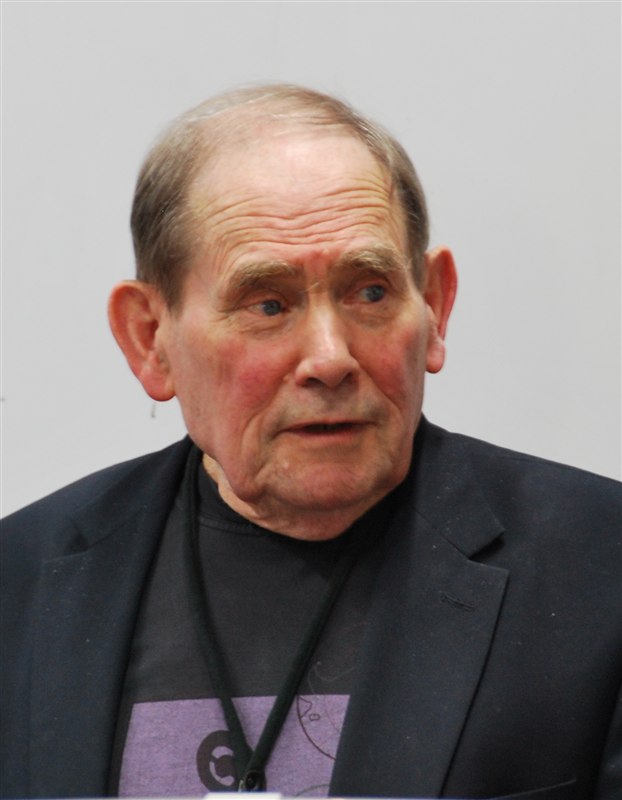 Sydney BrennerMRC Laboratory of Molecular Biology, CambridgeFounding the C. elegans research program, the 1986 connectome, the 2002 Nobel Prize in Physiology or Medicine
- Kwanghun ChungMassachusetts Institute of TechnologyFirst author of CLARITY, hydrogel-tissue transformation for intact brain imaging
Rafael Lahoz-Beltra is listed with the other builders, who hold that the claim is about what the hardware does, and the philosophy is left open. The positions themselves are set out in the index of consciousness theories. Every researcher covered on this site is indexed in the directory of consciousness researchers.