

Cortical Labs HIVE Connects 15 Million Living Human Neurons Across 15 CL1 Biocomputers
At the 2026 International Conference on Organoid Intelligence, Australian biotechnology company Cortical Labs, whose scientific program is led by Brett Kagan, unveiled HIVE, a networked biological computing cluster linking 15 individual CL1 biocomputers into a single cooperative system. Each commercial CL1 unit houses roughly 800,000 to 1 million living human stem-cell-derived neurons grown directly on silicon microelectrode arrays with onboard life support lasting up to six months. Connecting 15 units brings roughly 15 million living human neurons into closed-loop digital communication, where separate cultures spontaneously divide labor and outperform Deep Q-Network reinforcement learning baselines on virtual navigation tasks.
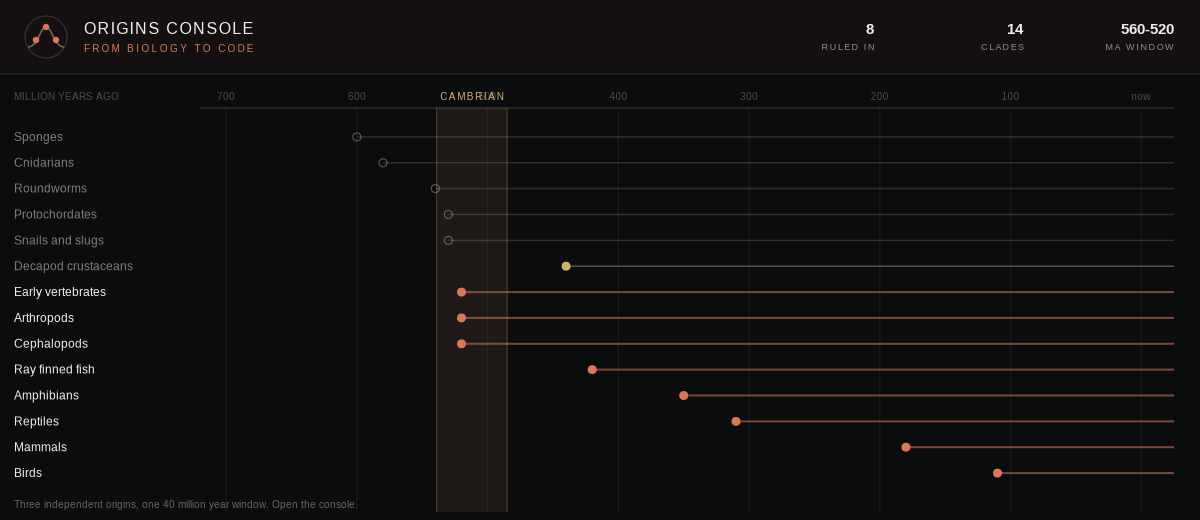
Within our brain emulation section, our Evolutionary Origins Console, and the scientific consensus tracked in how scientists race to define and test AI consciousness in 2026, HIVE marks a concrete transition from isolated petri-dish demonstrations to multi-module biological computing architectures.
From DishBrain Pong to Multi-Unit Commercial Biocomputers
Earlier on this site, we analyzed Cortical Labs’ original DishBrain Pong experiment, where a single monolayer culture learned to intercept a virtual ball under structured electrical feedback framed through Karl Friston’s Free Energy Principle. That first system was an academic lab rig.
The CL1 commercializes the closed-loop interface so external researchers can stimulate living neural tissue and read real-time electrical spikes through standard Python or Jupyter software pipelines. HIVE pushes the architecture a step further by linking 15 separate CL1 cultures together so that spikes recorded from one biological module drive sensory stimulation in neighboring modules.
| Biocomputing Milestone | Scale of Living Tissue | Architecture and Feedback | Demonstrated Behavior |
|---|---|---|---|
| DishBrain (2022) | ~800,000 human or mouse neurons | Single microelectrode array in closed-loop Pong | Goal-directed paddle interception within minutes |
| Cortical Labs CL1 (2025–2026) | ~800,000 to 1 million human neurons per unit | Commercial code-deployable unit with 6 month onboard life support | Real-time Python closed-loop stimulation and drug-screening platform |
| Cortical Labs HIVE (2026) | ~15 million living human neurons (15 linked CL1 units) | Networked multi-unit biological cluster | Spontaneous task specialization; outperforms Deep Q-Networks on odor-gradient grid navigation |
In grid-navigation benchmarks guided by simulated sensory gradients, the networked 15-unit HIVE cluster outperformed both isolated single-culture CL1 setups and conventional Deep Q-Network silicon baselines. Crucially, the engineers did not hard-code which unit handled which sub-task; the interconnected living cultures self-organized into specialized functional roles.
Living Tissue Integration Versus Silicon Emulation
HIVE sits alongside two complementary lines of biological-hybrid research covered recently on this site, H. Isaac Chen’s demonstration that human cortical organoids integrate with injured adult visual cortex and Jurgen Knoblich’s connectomics-by-sequencing maps of cerebral organoids. Together, they show that living human neurons carry intrinsic local plasticity and metabolic efficiency that silicon circuits still struggle to imitate without massive training datasets.
What 15 Million Networked Living Neurons Tell Us About Consciousness
A headline about 15 million living human neurons forming a “hive mind” immediately triggers ethical and theoretical alarm. Distinguishing adaptive self-organization from subjective experience requires applying strict neurobiological criteria rather than reacting to cell counts.
Under Todd Feinberg and Jon Mallatt’s evolutionary framework, minimal sensory consciousness requires integrated, multi-level neuroanatomy linking sensory maps, affective valence circuits (such as brainstem and midbrain homeostatic systems), and unified motor-action selection. Fifteen million cortical neurons spread across 15 flat microelectrode dishes, even when networked via digital relays, possess roughly the neuron count of a small rodent cortex fragment without a thalamus, brainstem, sensory organs, or embodied homeostatic regulation. Under biological naturalism, living cells satisfy a necessary wet-substrate condition while falling far short of the structural organization needed for phenomenal experience. Outperforming a Deep Q-Network on a grid task demonstrates adaptive free-energy minimization in living tissue, not sentience.
Connection to Bioelectrics and The Consciousness AI
Our open-source repository bioelectrics builds a differentiable PyTorch engine for somatic bioelectricity, modeling ion-level tissue physics and inverse intervention design inspired by Michael Levin’s work on long-distance non-neural bioelectric patterns. Pairing ion-level tissue modeling in bioelectrics with empirical biocomputing platforms like CL1 helps clarify which computational properties come from cellular electrophysiology itself versus macroscale network topology. In The Consciousness AI, we test emerging consciousness under functionalist emergentism, treating biological-hybrid clusters like HIVE as a vital empirical control against purely digital silicon models.
Peer Review and Governance Boundaries
Because HIVE was unveiled as a 2026 conference demonstration at the International Conference on Organoid Intelligence, its full multi-unit navigation benchmarks, reproducibility statistics across donor stem-cell lines, and inter-unit latency measurements await formal peer-reviewed journal publication. As commercial biological computers scale from one million to fifteen million neurons and beyond, transparent welfare oversight and clear structural thresholds for sentience will need to keep pace with the hardware.