


SpiNNaker2 Neuromorphic Chip by Steve Furber and Christian Mayr Enters Supercomputing
Can a single many-core neuromorphic chip run both biological real-time spiking neural networks and modern rate-based deep learning workloads at sub-watt baseline power while scaling into national supercomputers? In a 2026 architectural paper published in the IEEE Open Journal of Circuits and Systems (Vol. 7, pp. 465 to 478, also available as arXiv:2607.24396), Stefan Scholze, Johannes Partzsch, Steve Furber, Christian Mayr, and colleagues at TU Dresden and the University of Manchester publish the complete silicon blueprint of the SpiNNaker2 chip. In parallel, Forschungszentrum Julich launched a three-year 2026 project to integrate a SpiNNaker2 module directly into its Modular Supercomputing Architecture under the ESAB event-based supercomputer program, following deployments at Sandia National Laboratories and the University of Texas at San Antonio THOR hub.
Within our Brain Emulation and Mind Uploading section, our Thermodynamic Computing hub, and the wider scientific field tracked in how scientists race to define and test AI consciousness in 2026, SpiNNaker2 represents a pivotal hardware generation jump from the first-generation million-core Manchester machine we covered in our analysis of SpiNNaker and real-time spiking cores.
Inside the 152-Core SpiNNaker2 Silicon Architecture
The original SpiNNaker chip paired general-purpose ARM968 cores with an asynchronous packet-switched routing fabric built strictly for event-driven biological simulation. SpiNNaker2 keeps that asynchronous event-based philosophy while adding dedicated numerical accelerators and aggressive circuit-level power management so hybrid AI and neuroscience workloads share one fabric.
- Each SpiNNaker2 die integrates 152 processing elements, each combining an ARM Cortex-M4F processor core with dedicated hardware accelerators for both spiking neural networks (SNNs) and dense INT8 deep neural networks (DNNs).
- An extended asynchronous SpiNNaker routing fabric forwards spike packets across chips without a global synchronous clock barrier, preserving real-time biological event timing across large multi-chip boards.
- Standard high-bandwidth system interfaces, including Gigabit Ethernet and LPDDR4 memory, allow SpiNNaker2 blades to plug directly into modular supercomputing racks such as Julich’s ESAB system.
- Circuit-level adaptive body biasing (ABB) and dynamic voltage and frequency scaling (DVFS) hold baseline power consumption below 250 mW, while delivering up to 4.5 TOPS in high-performance mode and 2.7 TOPS/W in high-efficiency mode for INT8 workloads.
- On spiking workloads, a single SpiNNaker2 chip handles more than 150,000 neurons and over 1.8 billion synaptic events per second in real time.
Neuromorphic Substrates Compared Across 2026 Hardware
Placing SpiNNaker2 beside the other flagship neuromorphic systems covered on this site highlights how architectural trade-offs divide between digital real-time scaling, accelerated analog physics, and edge robotics silicon.
| Platform | Primary Architects | Core Architecture | Speed vs Biological Time | Scale and Power Highlights |
|---|---|---|---|---|
| SpiNNaker2 (IEEE OJCAS 2026 / Julich ESAB) | Steve Furber, Christian Mayr, TU Dresden and Manchester | 152 ARM Cortex-M4F PEs + SNN/DNN accelerators, asynchronous routing | 1x real time (biological clock fidelity) | >150,000 neurons and >1.8B synaptic events/s per chip; <250 mW baseline; 4.5 TOPS INT8 |
| BrainScaleS-2 (NICE 2026) | Johannes Schemmel, Heidelberg University | Mixed-signal analog neuron circuits + digital plasticity cores | 1,000x faster than biological real time | Accelerated physical analog dynamics for multi-chip plasticity |
| Intel Loihi 2 (2026) | Intel Labs neuromorphic group | Programmable asynchronous digital neurocores (Lava framework) | Real time and accelerated edge control | Tested for connectome simulation and edge robotics fault tolerance |
| First-gen SpiNNaker (2018) | Steve Furber, University of Manchester | 18 ARM968 cores per chip, 1,036,800 cores total | 1x real time | Million-core machine targeting up to 1 billion neurons |
Readers who want to explore accessible benchtop FPGA boards, random number generators, and open hardware components that approximate spiking or probabilistic lattices can inspect our Thermodynamic Computing Hardware Guide.
Spiking Dynamics and the Substrate Independence Question
Why do neuromorphic machines like SpiNNaker2 sit directly inside consciousness science rather than remaining pure semiconductor engineering? Under functionalist emergentism, consciousness depends on the causal and temporal organization of information processing rather than on wet carbon chemistry. Yet many neuroscientists argue that conventional GPU matrix multiplication flattens the exact temporal features biological theories rely on, namely asynchronous spike timing, sparse event-driven communication, recurrent feedback loops, and local synaptic plasticity operating at real-time sensory latencies.
SpiNNaker2 tests that bridge directly. By coupling real-time event-driven spiking (>1.8 billion synaptic events per second per chip) with hybrid numerical accelerators inside a modular supercomputer at Forschungszentrum Julich, researchers can run multi-region cortical and subcortical spiking models alongside modern representation-learning layers on the same physical fabric. You can inspect how Leaky Integrate-and-Fire (LIF) spiking dynamics and recurrent oscillatory layers behave interactively inside our Neutral Core Substrate Console.
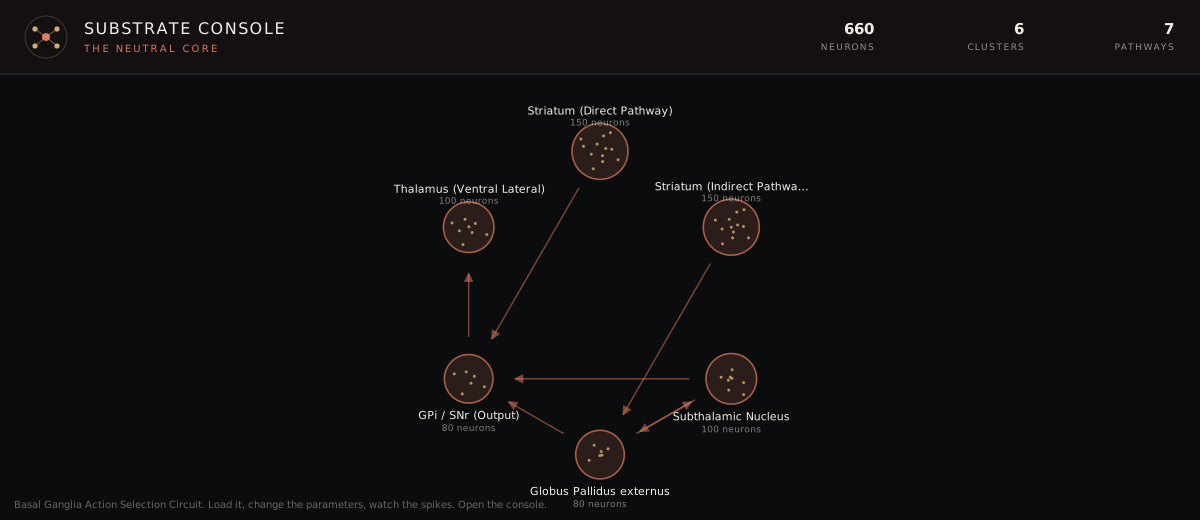
Comparison to The Consciousness AI, ThermoSpike, and The Hardware
SpiNNaker2’s hybrid event-driven design intersects directly with three of our public repositories.
In The Consciousness AI, our research on emerging consciousness studies how spiking or oscillatory binding layers interact with affective valuation and a Global Workspace layer. In ThermoSpike, we model stochastic spiking neurons that sample from Boltzmann distributions while tracking the thermodynamic energy cost of every sample, sitting directly at the boundary between neuromorphic engineering and thermodynamic computing. And in the-hardware, we publish open 3D-printable CadQuery mechanical parts under CERN-OHL-S v2 for benchtop neuromorphic, thermodynamic, brain-signal recording, and CubeSat education rigs.
None of our current codebases compile onto physical SpiNNaker2 silicon today. SpiNNaker2’s sub-250 mW adaptive body biasing and 152-core asynchronous packet fabric are architecturally motivated benchmarks for the kind of energy-bounded spiking substrate future consciousness experiments will need.
Deployment Limits and Open Questions
Integrating SpiNNaker2 into supercomputing centers like Julich solves raw hardware access, yet software ecosystems remain the decisive bottleneck. Mapping biological connectomes or cognitive architectures onto 152 asynchronous ARM cores per chip still demands specialized partitioning tools, and hybrid SNN-DNN workflows have not yet matched the turnkey compiler maturity of GPU stacks.
Even with that software gap, Scholze, Furber, Mayr, and the SpiNNcloud team have moved event-driven neuromorphic hardware out of standalone lab racks and into modular European supercomputing. Testing whether real-time spiking organization supports richer dynamical integration than synchronous matrix multiplication now has an industrial-scale instrument.
Researchers covered here
-
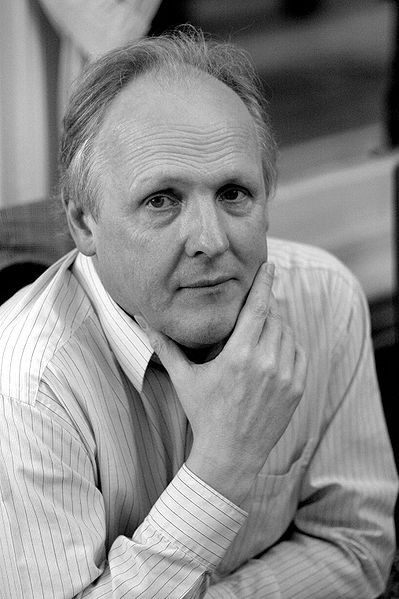 Steve FurberDepartment of Computer Science, University of ManchesterSpiNNaker, the million-core spiking neural network supercomputer, ARM processor architecture
- Christian MayrChair of Highly-Parallel VLSI-Systems and Neuro-Microelectronics, TU DresdenSpiNNaker2 neuromorphic chip architecture and SpiNNcloud brain-scale supercomputing