


Axiom Space Orbital Data Centers and the first commercial compute sold from orbit
Axiom Space launched the first two dedicated orbital data center nodes on January 11, 2026. The nodes are the first hardware in orbit built to sell cloud-style compute and storage as a service to satellites and constellations, rather than to process the data of a single owner. They launched inside the first tranche of Kepler Communications’ optical relay constellation, and the two companies describe 2.5 gigabit-per-second optical links between the nodes and customer spacecraft.
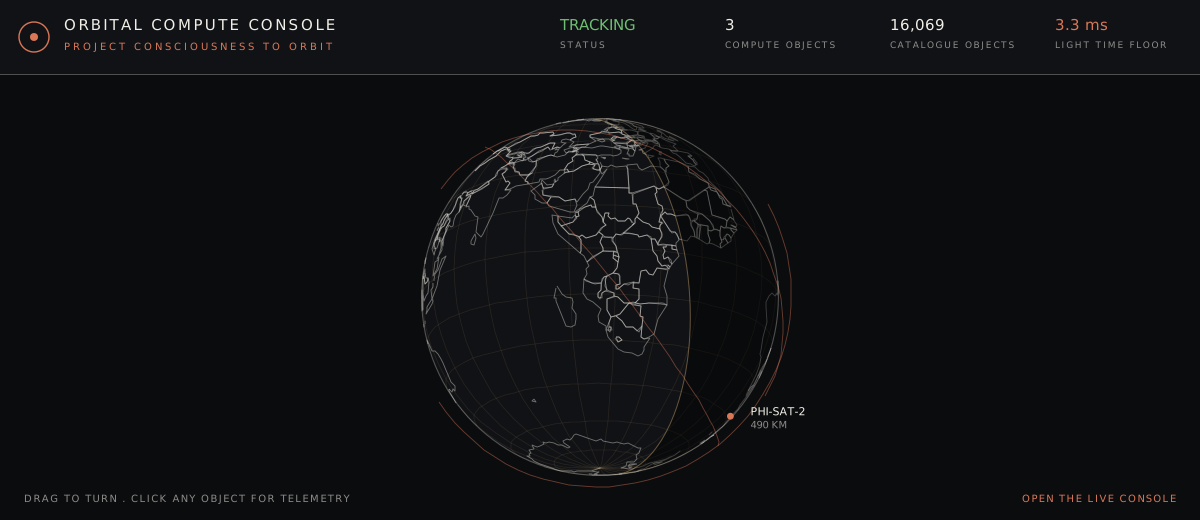
The launch makes “orbital data center” a category with a deployed instance rather than a proposal. The Orbital Compute Tracker carries the nodes in its roster with an in_orbit status, flagged as the first objects whose purpose is selling compute from orbit. The Project Consciousness to Orbit argument, which treats a mind as an engineering question of power, radiation, and compute rather than a settled biological one, now has a commercial precursor running.
The NASA record of Spaceborne Computer-2 deployment and maintenance provides an earlier station-based comparison. Its crew support and utility connections limit what that history can establish about unattended orbital data centres.
What the nodes actually are
The ODC programme began with prototypes on the space station. Axiom flew an AWS Snowcone on the Ax-1 mission in 2022, running what it describes as the first commercial AI inference in orbit. In fall 2025 the company deployed Data Center Unit 1 (AxDCU-1), a Red Hat Device Edge compute unit on the ISS. The January 2026 launch then put two free-flying nodes in low Earth orbit, connected by Kepler’s optical relay mesh.
The value proposition on the operator page is concrete. A satellite collects raw imagery or telemetry. Instead of downlinking everything to a ground station, it sends the data over an optical link to a nearby node, the node runs the processing, inference, filtering, compression, or model evaluation locally, and only the smaller, more valuable result goes to the ground. When the ground link drops, the node buffers data, makes local decisions, and acts autonomously.
That division of labor is the same architecture the site’s orbital analysis has been describing for the latency floor. The Wolf Singer latency argument holds that temporal binding imposes a maximum causal distance over which conscious processing can integrate. The ODC node does not close that distance for a mind. It closes a smaller one for data, moving the decision loop for a sensor reading from a 300,000 kilometer round trip to a few hundred kilometers of relay. The engineering pattern is the same one a brain in orbit would need, at a scale that exists now.
The power and bandwidth budget
The statement relevant to the consciousness argument is the scale claim. Axiom describes the current nodes in the kilowatt class and plans the network to grow to megawatts of processing power by 2030 and beyond. A kilowatt is the power a single large GPU wants at peak, and the nodes run on solar arrays, which is the energy source the power budget argument for orbital compute treats as the enabling condition for long duration sims.
The bandwidth number is equally concrete. The 2.5 gigabit optical links are interoperable with the Space Development Agency Tranche 1 optical communication standards, which is the government interoperability point, and they are the first commercial mesh of this kind. Terrestrial data centers reached this point seventy years after the first computer. The first orbital compute service appears six years after the first commercial satellite data relay, and it already has a matching optical fabric.
What remains hardware and what remains open
The honest constraint is that neither node has a published specification sufficient for the kind of processing a consciousness simulation would need. Axiom has named the partners, Microchip and Phison for memory and storage, Spacebilt and Skyloom for the network, but not the raw MAC hours or memory bandwidth of the payload. On the site’s facts discipline, the tracker lists the nodes with status in_orbit and the launch date, and nothing more. That is the correct reading of the evidence.
What the launch does establish is a floor. Compute is now a purchasable service in LEO. The supply chain for putting more capable hardware into that environment, radiation-tolerant processors, optical relays, store-and-forward nodes, now exists as a market rather than a research programme. Every theory of consciousness that treats the substrate as incidental, which is the functionalist emergentism this project works from, inherits that market as the industrial base for its most extreme predictions.
What this tells us about consciousness
The direct lesson is about the substrate-independence claim, and it is a lesson in caution. A mind in orbit was, until recently, a thought experiment about whether causal integration could survive orbital latency. The Axiom nodes do not test that. They test a smaller claim, whether commercial-grade compute can survive and be useful in LEO, and the answer is now demonstrably yes. The larger claim, whether a conscious architecture could run on such hardware, still fails on the current specification, because no node publishes the compute density a simulation would need.
The cautious reading is the site’s own. The Starcloud H100 fleet represents the high end of what orbit can carry today, a data center class GPU in space, and the tracker’s light time panel makes the latency argument visible in real time. The Axiom nodes add the commercial layer, kilowatt-class general compute sold by the node. Between the two, the engineering preconditions for sustained computation off Earth are no longer hypothetical, and the gap between “compute survives in orbit” and “consciousness could be instantiated there” is now a measurable specification problem rather than a category error. The low-power edge of the same envelope, a cubesat running AI classifiers in orbit, is examined in the Phi-sat-2 post, and the mechanism that could supply such hardware with more watts than any single array collects is the subject of the space-based solar post.
Susan Schneider’s new paper asks the question these nodes cannot answer, whether the substrate itself can be the conscious system, examined in the data center analysis.
- Axiom Space ODC nodes launched January 11, 2026. The facts in this post are from Axiom’s operator page at axiomspace.com/orbital-data-center, the Axiom press release cited by SpaceNews, and Kepler Communications’ relay constellation announcement. The tracker’s Axiom ODC roster entry is in
_data/orbital_compute.yml.*