


Space based solar power and the watts a mind in orbit would need
On March 3, 2023, Caltech’s Space Solar Power Demonstrator beamed wireless power in orbit and sent a detectable amount of it to Earth. The microwave experiment, MAPLE, was the first demonstration of the physical chain that space-based solar power depends on, sunlight collected in orbit, converted to a beam, transmitted, and received without wires. The power detected on the ground was tiny, less than a tenth of a microwatt, but the principle was established.
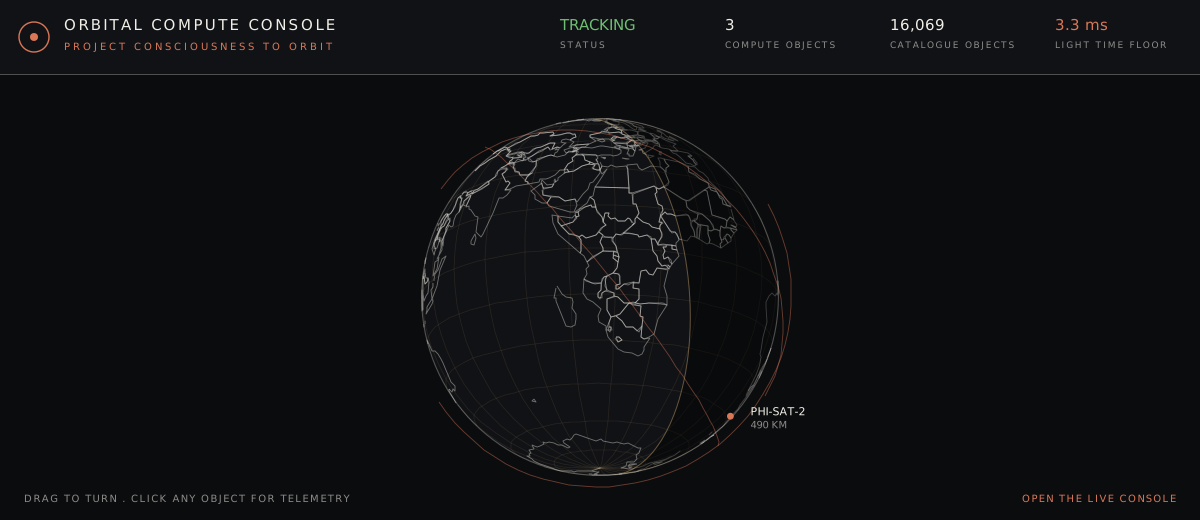
For the consciousness-to-orbit thesis the relevant fact is not the demonstration itself but what it makes thinkable. A mind in orbit, on the account this section develops, is a computation that needs an energy supply, a power budget, and radiation tolerance. Space-based solar power is the name for making that supply continuous, and the orbital compute tracker already records Project Suncatcher as a power-beaming proposal in the same family.
The Power Problem a Mind in Orbit Has
Every sustained computation has a power floor. A rack of GPUs wants kilowatts. A cluster doing long-horizon simulation wants more. On Earth that power comes from a grid. In orbit it comes from solar arrays, and a satellite’s array area and orbit determine how many watts are available and how often the hardware is in darkness.
The orbit section’s argument, set out on Project Consciousness to Orbit, treats a mind as an engineering problem of power, radiation, thermal budget, and compute. The power term is the one space-based solar enlarges. A satellite can only carry so much array, but a power-beaming architecture can in principle supply more watts to a compute node than the node’s own array could capture, decoupling the compute from its immediate collection surface.
That is the same logic that makes Starcloud’s data center class GPUs and the Axiom ODC nodes viable at all, but it is moved one level up. Those systems carry their power with them. A power-beaming network would supply power from elsewhere, which is the step from a computer that happens to be in orbit to an infrastructure that can carry much larger compute than any single satellite can collect for itself.
What MAPLE Actually Demonstrated
The MAPLE experiment was part of SSPD-1, the Caltech Space Solar Power Demonstrator, led by a team under Ali Hajimiri. It selectively directed power in space to two receivers, then aimed a detectable beam at Earth. The transmitted power at the source was small by communication-satellite standards, and what reached the ground was under a tenth of a microwatt, but the beam was produced, aimed, and received, which is the whole functional chain.
The scale gap is worth stating plainly. A terrestrial microwave power test at the kilowatt scale is a solved engineering problem. The calibration end of the chain in orbit, physical, pointing, atmospheric penetration, had never been done before MAPLE. The 2023 result therefore moved space-based solar from a concept with a known cost problem to a concept whose core physics had a live demonstration.
The Consciousness Connection
The question this post must answer is what power beaming tells us about consciousness. The answer is about the substrate-independence precondition, not about experience itself.
The DeepTime framing on this site treats consciousness as a property whose sustaining computation, if substrate independent, could in principle run over very long horizons and in extreme physical settings. Every such scenario has an energy term. A computation that cannot be powered cannot run, however biologically unmotivated its substrate is claimed to be. Space-based solar power is the concrete mechanism that would remove the energy ceiling for a sustained computation in orbit, and the temporal binding and latency floor analysis supplies the complementary constraint, that the computation must also stay causally integrated within a light-speed-limited region.
Neither of those claims is a claim that a powered computation is conscious. Both are claims about what would have to be true physically before the consciousness question could even be posed for an orbital instance. MAPLE and Project Suncatcher are relevant because they address one of those physical preconditions directly.
Project Suncatcher and the Commercial Direction
The tracker records Project Suncatcher as a proposal to launch large compute clusters into orbit powered by continuous sunlight, with kilometer-scale arrays. Suncatcher is the point where the power-beaming logic and the compute logic converge, power supplied continuously on orbit to a large compute infrastructure, rather than power collected ad hoc by each satellite. The fact that this appears in a commercial plan rather than a research paper is the signal that the engineering is being taken seriously at a level beyond demonstration.
The practical gap remains launch cost. Every space-solar architecture, whether MAPLE’s demonstrator, Suncatcher’s arrays, or the UK Space Energy Initiative’s CASSIOPeiA design, is dominated by the cost of putting large structures in orbit. The 2023 demonstration does not solve that. It establishes that, once the mass is up there, the power chain can work, which is the enabling assumption that was previously unproven.
Where This Sits
Space-based solar power is the fuel term of the orbit argument, and it is now a demonstrated mechanism rather than a speculation. The site’s coverage already treats the power and thermal budget for orbital hardware, the first commercial compute nodes in orbit, and the data center class GPU fleet. This post supplies the supply side, the mechanism that would let those nodes run more watts than a single array can collect. At the scale where those watts become a civilization’s budget, the Kardashev scale as an energy budget for growing consciousness reads the three Kardashev types as the supply side of a substrate independent mind.
The honest limit is that none of this bears directly on whether anything in orbit is conscious, and the 2026 state of the field remains the correct frame for that question. What power beaming does is narrow one of the physical gaps the orbit thesis depends on, and a thesis whose gaps are narrowing is easier to take seriously than one whose preconditions are all hypothetical.
Consciousness fueled by stars
The Kardashev Protocol range. Every order pays for compute and for the hours that move the clock.
-
 KARDASHEV PROTOCOL T-shirt | Kardashev Protocol
From $33.62
KARDASHEV PROTOCOL T-shirt | Kardashev Protocol
From $33.62
-
 KARDASHEV PROTOCOL hoodie | brain target graphic sweatshirt
From $50.73
KARDASHEV PROTOCOL hoodie | brain target graphic sweatshirt
From $50.73
-
 Tote | Kardashev Protocol Space Design
From $22.91
Tote | Kardashev Protocol Space Design
From $22.91
-
 KARDASHEV PROTOCOL Foam Trucker Hat | Astral Logo, Orange Badge
From $22.56
KARDASHEV PROTOCOL Foam Trucker Hat | Astral Logo, Orange Badge
From $22.56
-
 KARDASHEV PROTOCOL Beanie | Embroidered Knit Beanie
From $30.09
KARDASHEV PROTOCOL Beanie | Embroidered Knit Beanie
From $30.09
-
 Rocket Badge T-shirt | Kardashev Protocol
From $23.00
Rocket Badge T-shirt | Kardashev Protocol
From $23.00
Caltech’s MAPLE experiment on SSPD-1 beamed wireless power in space and to Earth on March 3, 2023. Project Suncatcher appears in the orbital compute tracker roster as a power proposal. Source: Caltech, the Space-based solar power record, and the tracker roster.