

Gordon Research Conference on Consciousness Anesthesia and Evolutionary Biology 2027 Preview
From January 17 to January 22, 2027, the Gordon Research Conference (GRC) on Consciousness, Anesthesia and Evolutionary Biology convenes in Oxnard, California (at the Holiday Inn Oxnard - Ventura), immediately preceded by its early-career Gordon Research Seminar (GRS) on January 16 and 17, 2027. Unlike large convention-center meetings, Gordon Research Conferences cap attendance and enforce strict off-the-record discussion rules so neuroscientists, anesthesiologists, and evolutionary biologists can debate unpublished mechanisms face to face.
Tracked on our consciousness events hub alongside ASSC 30 in Beijing in June 2027 and the CIFAR Neuroscience of Consciousness Winter School in Nairobi, the January 2027 Oxnard meeting kicks off the 2027 scientific calendar by uniting three empirical lenses that rarely sit in the same room.
Event Logistics and Format
| Meeting Detail | Gordon Research Seminar (GRS) | Gordon Research Conference (GRC) |
|---|---|---|
| Dates | January 16 to 17, 2027 | January 17 to 22, 2027 |
| Location | Holiday Inn Oxnard - Ventura, Oxnard, California, USA | Holiday Inn Oxnard - Ventura, Oxnard, California, USA |
| Audience | Doctoral students, postdocs, and early-career researchers | Principal investigators, clinicians, and invited early-career speakers |
| Core Themes | Baseline biological boundaries of consciousness and anesthetic perturbation | Mechanisms of anesthesia, evolutionary emergence of sentience, cross-species neural criteria |
| Discussion Policy | Small-group mentoring and unpublished poster feedback | Off-the-record presentations designed for unpublished data and live critique |
Why Anesthesia and Evolutionary Biology Belong Together
Anesthesiology and comparative evolutionary neurobiology attack the consciousness problem from opposite ends of the same empirical axis. General anesthetics such as propofol, sevoflurane, and ketamine offer the cleanest reversible experimental switch for turning reportable conscious awareness off and back on inside a living nervous system. Recent intracranial work covered on this site, including Sameer Sheth’s study of hippocampal language processing under anesthesia, demonstrates that unconscious sensory and semantic circuits keep firing even after conscious report disappears.
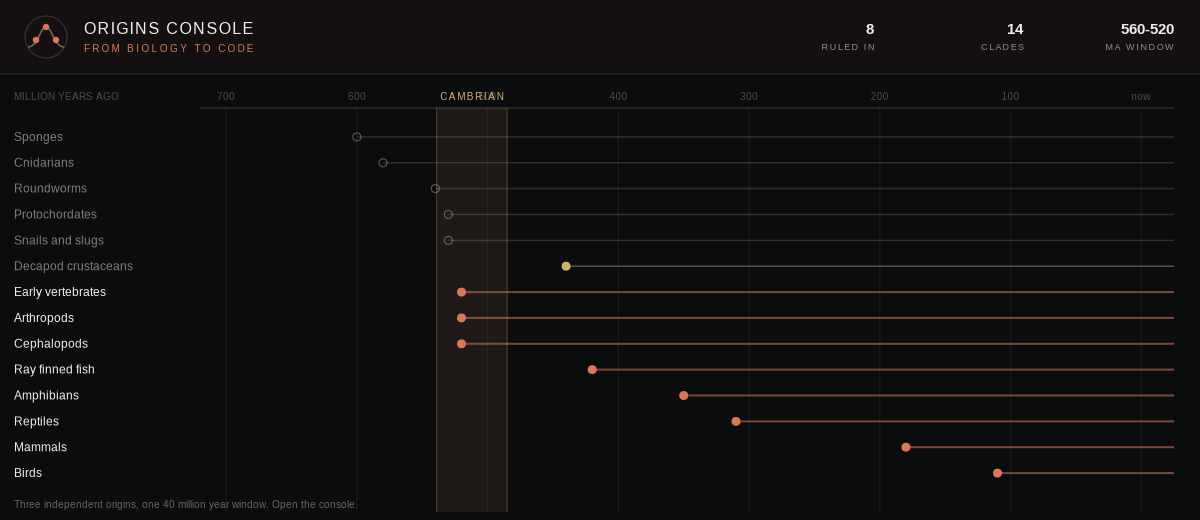
Evolutionary biology asks the mirror-image question across phylogenetic time. Which clades crossed the threshold from reflexive stimulus-response loops to minimal felt experience, and which anatomical innovations, such as vertebrate optic tectum isomorphism, arthropod central complexes, or cephalopod vertical lobes, made that transition possible? Intriguingly, volatile anesthetics suppress behavioral responsiveness across mammals, fruit flies, cephalopods, and even single-celled organisms, forcing researchers to separate generic cellular membrane suppression from consciousness-specific network breakdown.
What the 2027 Oxnard GRC Tells Us About Consciousness
Bringing clinical anesthesia mechanisms together with comparative phylogeny tests whether leading theories of consciousness survive outside the human primate cortex. If a theory predicts that consciousness requires human prefrontal ignition, it must explain how birds, octopuses, or fish, explored interactively in our Evolutionary Origins Console, navigate complex ecological worlds without a six-layered mammalian neocortex. Conversely, if an anesthetic disrupts long-range cortical feedback while sparing local sensory firing, comparative studies across species help pinpoint which exact circuit motif constitutes the minimal biological requirement for awareness.
For readers tracking how scientists race to define and test AI consciousness in 2026, this biological grounding provides an essential reality check. Before researchers can build credible indicators for non-biological substrates, they must settle which physical and functional transitions actually separate conscious from unconscious processing in known biological nervous systems.
Relevance to The Consciousness AI
In The Consciousness AI, our architectural design draws directly on Todd Feinberg and Jon Mallatt’s evolutionary neurobiology criteria, modeling hierarchical sensory mapping, affective core valuation, and global workspace integration rather than treating language fluency as a proxy for sentience. Findings emerging from the 2027 GRC on anesthesia and evolutionary origins will directly inform which biological mechanisms remain essential to our functionalist emergentism blueprint and which are evolutionary accidents of carbon-based tissue.
Looking Ahead to the 2027 Calendar
Because Gordon Research Conferences prohibit live reporting of unpublished talks, the scientific impact of the January 2027 Oxnard meeting will surface through peer-reviewed papers and follow-up symposia later in the year, including the International Forum on Consciousness in Wisconsin in May 2027 and ASSC 30 in Beijing in June 2027. For researchers working at the boundary of clinical anesthesia, animal sentience, and physical theories of awareness, January in Oxnard sets the empirical agenda for the year.