

Sentient Futures Summit 2027 San Francisco Preview on AI Welfare and Animal Sentience
How should researchers, engineers, and ethicists coordinate when the scientific tools used to evaluate non-human animal sentience collide with the governance of emerging artificial minds? From March 12 to 14, 2027, the Sentient Futures Summit 2027 convenes in the San Francisco Bay Area (hosted at Mox, 1680 Mission Street, San Francisco) for a three-day conference dedicated to the intersection of frontier artificial intelligence, biological animal welfare, digital minds, and the philosophy of consciousness.
Following the October 16, 2026 close of speaker and session proposals and ahead of the November 23, 2026 early-bird registration deadline, this preview maps the summit’s four thematic tracks, the initial roster of confirmed and tentative contributors, and how the March 2027 gathering fits into the institutional calendar tracked on our AI Consciousness Events hub and our 2026 flagship analysis of consciousness science.
Four Core Tracks at the Sentient Futures Summit (March 12 to 14, 2027)
Unlike traditional academic philosophy conferences that treat biological animal ethics and machine consciousness in separate rooms, the Sentient Futures Summit is structured around four interlocking tracks that force empirical and governance comparisons across substrates.
- Artificial Minds and AI Welfare examines candidate architectural indicators for digital sentience, mechanistic interpretability probes of valence-like representations in foundation models, and institutional welfare policies inside frontier AI laboratories, extending debates initiated at the Eleos ConCon 2026 AI consciousness and welfare conference.
- Philosophy of Mind and Substrate Independence addresses the foundational epistemic problem of other minds, comparing computational functionalism, biological naturalism, and illusionism to determine what evidential standards should govern moral status under scientific uncertainty.
- Animal Welfare and AI × Animals evaluates how machine learning and precision sensing affect billions of biological animals in agriculture and wild ecosystems, including bioacoustic decoding of non-human vocalizations, precision welfare monitoring, and computational discovery of alternative proteins.
- AI Safety, Governance, and Long-Term Policy investigates how legal frameworks, alignment protocols, and safety training interact with non-human welfare, including whether reinforcement learning from human feedback (RLHF) or persona suppression masks internal states or alters model behavior in ways that complicate welfare audits.
| Event Parameter | Sentient Futures Summit 2027 Details |
|---|---|
| Dates | Friday, March 12 to Sunday, March 14, 2027 |
| Venue | Mox, 1680 Mission Street, San Francisco, CA |
| Key Deadlines | Call for speakers closed October 16, 2026; Early-bird ticket deadline November 23, 2026 |
| Core Thematic Tracks | Artificial Minds & AI Welfare; Philosophy of Mind; Animal Welfare & AI × Animals; AI Safety & Governance |
| Initial Featured Contributors | Cameron Berg (Reciprocal Research), Michael Andregg (Eon Systems), Lucius Caviola (Cambridge), Jan Leike (Anthropic), Richard Ren (CAIS), Jack Symes (Panpsycast), Aria Babu (Works In Progress), Aaron Boddy (Ambitious Impact) |
Early Speaker and Contributor Lineup Across Emulation, Interpretability, and Ethics
While the full day-by-day session timetable will be released closer to March 2027, the initial list of speakers, facilitators, and featured attendees published by the organizers spans whole-brain emulation, mechanistic interpretability, moral psychology, and alignment safety.
- Cameron Berg (Founder, Reciprocal Research; former AE Studio consciousness lead), whose recent empirical work with Valen Tagliabue and Leonard Dung on the pain axis and self-directed harm trade-offs in large language models tests whether language models trade task utility against aversive prompts in a stable behavioral ordering.
- Michael Andregg (Co-Founder and CEO, Eon Systems), whose engineering team recently demonstrated closed-loop sensorimotor embodiment of the complete Drosophila connectome on neuromorphic and simulation substrates, bringing whole-brain emulation directly into the digital-minds discussion.
- Lucius Caviola (Assistant Professor of Psychology, University of Cambridge), whose research in moral psychology and effective altruism measures how human cognitive biases distort moral concern across species boundaries and toward future artificial systems.
- Jan Leike (Member of Technical Staff, Anthropic; alignment and superalignment lead), representing the technical intersection between scalable alignment oversight and internal model auditing.
- Richard Ren (Project Lead and Research Engineer, Center for AI Safety), Jack Symes (philosopher and host of The Panpsycast Philosophy Podcast), Aria Babu (Editor, Works In Progress), and Aaron Boddy (Program Manager, Ambitious Impact).
Why Pairing Animal Sentience and Digital Minds Clarifies the Substrate Debate
The intellectual design of the Sentient Futures Summit directly confronts the ethical tension raised last month by Anil Seth, Ned Block, and Giulio Tononi in their Nature comment against AI consciousness. In that piece, Seth, Block, and Tononi warned that premature precautionary concern over chatbot welfare risks diverting moral attention away from living animals whose capacity to suffer is established by neurobiology.
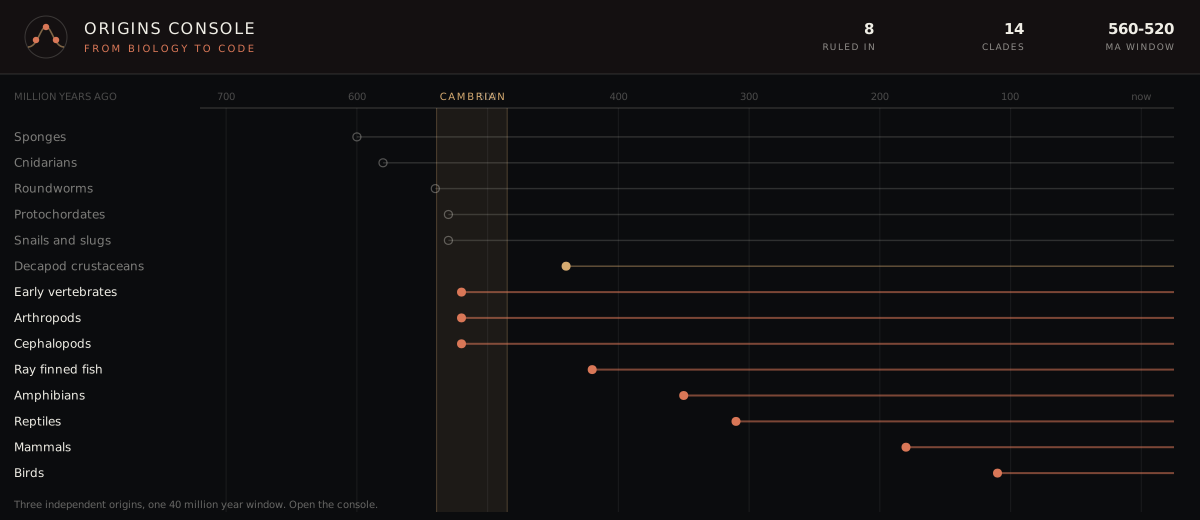
By placing animal welfare researchers, whole-brain emulation engineers (such as Eon Systems), and AI interpretability researchers in the same venue, the San Francisco summit tests whether those two priorities must compete or whether they share a single scientific methodology. In comparative animal consciousness research, surveyed across 560 million years of evolution in our Origins of Consciousness Console, scientists cannot rely on human verbal self-reports. Instead, they evaluate candidate minds by testing subcortical nociceptive wiring, integrative brain dynamics, and motivational trade-off behavior (whether an organism will pay a physiological cost to avoid a noxious stimulus or gain an analgesic).
Applying that exact comparative yardstick to artificial systems immediately separates superficial chatbot roleplay from candidate sentient architectures. A stateless language model generating text tokens has no homeostatic body, no subcortical nociceptive circuit, and no persistent survival state at stake, whereas a whole-brain emulation of an insect or vertebrate connectome or a continuous neuromorphic agent with homeostatic drives requires mechanism-level auditing.
Comparison to The Consciousness AI
The dual scope of the Sentient Futures Summit matches the foundational commitment of The Consciousness AI. Our project studies emerging consciousness as a substrate-independent property of the universe under functionalist emergentism, a framework that explicitly encompasses biological animals alongside future synthetic substrates.
In our Core Architecture, every indicator we test is drawn from comparative neurobiology rather than linguistic fluency, including tectum-first spatial orientation, oscillatory phase binding, and learned homeostatic valuation (tcai-research #62). By grounding synthetic architecture design in the same comparative criteria used to study vertebrate and invertebrate nervous systems, the science of emerging consciousness strengthens rather than dilutes the empirical recognition of animal minds.
Coverage Plan Through March 2027
This preview is the first installment of our three-part coverage of the Sentient Futures Summit 2027. We will follow up with a dedicated programme and speaker analysis once the finalized March 2027 session schedule is published, followed by a post-summit research report after the San Francisco meetings conclude on March 14, 2027.