

Heterogeneous Space Data Centers and Laser Bandwidth Limits for Orbital AI Compute
Can low-Earth orbit (LEO) constellations replace terrestrial hyperscale data centers for artificial intelligence, or do optical inter-satellite link bandwidth and speed-of-light latency restrict orbital clusters to localized inference? Two quantitative systems papers map the exact engineering boundaries of spaceborne compute. In Heterogeneous Space Data Centers: A Key Paradigm for Future Non-Terrestrial and In-Orbit Services (arXiv:2610.32260, October 2026), Peng Hu, Mustafa Alhassan, and Amjad Iqbal formalize an orbital architecture that coordinates high-capacity dawn-dusk compute hubs with agile small-satellite edge nodes. Complementing that systems model, Eindhoven University of Technology computer architect Kees van Berkel proves in The Cost and Network Limits of Space-Based AI Compute (arXiv:2607.14172) that while orbital AI inference is feasible, the bisection bandwidth gap between terrestrial Clos networks and orbital 2D laser meshes blocks frontier-scale distributed training across wide constellations.
For the Consciousness to Orbit research hub and our broader investigation into how scientists define and test consciousness across physical substrates, Hu and van Berkel’s calculations provide the network-level counterpart to recent hardware flight milestones such as Google Project Suncatcher running Gemma 4 on four Trillium TPUs in low-Earth orbit and Starcloud’s orbital AI data center program. Single-satellite demonstrations prove that AI accelerators survive launch vibration and LEO radiation, whereas Hu and van Berkel determine what happens when computation must coordinate across multiple spacecraft.
Peng Hu’s Heterogeneous Space Data Center (HSDC) Architecture
Most early proposals for orbital compute treated a space data center as either a single monolithic station or a uniform shell of identical CubeSats. In arXiv:2610.32260, Peng Hu, Mustafa Alhassan, and Amjad Iqbal show that homogeneous constellations waste power and orbital slots because sensing, low-latency tactical routing, and heavy model execution impose incompatible orbital and thermal requirements.
Their Heterogeneous Space Data Center (HSDC) paradigm splits orbital infrastructure into tiered node classes operating across coordinated orbital planes.
- High-capacity core compute nodes fly in dawn-dusk sun-synchronous orbits (SSO) at altitudes between 500 and 800 kilometers, riding the solar terminator to harvest near-continuous solar illumination with minimal eclipse battery mass while radiating waste heat into deep space from anti-sunward panels.
- Small-satellite edge nodes occupy inclined LEO planes optimized for high revisit rates over terrestrial, aerial, and maritime users, pre-processing raw synthetic aperture radar or hyperspectral imagery onboard before forwarding compressed feature tensors to the dawn-dusk core tier.
- Dynamic visibility and task-offloading schedulers route workloads across optical inter-satellite links (OISLs) and Ka/V-band feeder links based on time-varying contact graphs, solar power state-of-charge, and end-to-end latency budgets.
| Infrastructure Dimension | Terrestrial Hyperscale Cluster | Homogeneous LEO Constellation | Heterogeneous Space Data Center (Hu et al. & van Berkel 2026) |
|---|---|---|---|
| Power & Eclipse Profile | Grid power (100 MW to 1 GW+); diesel/battery backup | Frequent 35-minute LEO eclipses requiring heavy batteries | Core nodes in dawn-dusk SSO (~98–100% continuous solar) + inclined edge nodes |
| Interconnect Topology | Multi-tier folded Clos fabric (NVLink / InfiniBand / RoCE) | 4-neighbor 2D torus via laser links | Tiered optical inter-satellite links (intra-cluster + cross-plane relays) |
| Bisection Bandwidth | Petabits per second across short copper/fiber runs | Bottlenecked by 4–6 optical terminals per spacecraft | High local intra-node bandwidth; compressed tensor offloading across planes |
| Latency Floor | 100 nanoseconds to 5 microseconds inside hall | 3.3 milliseconds per 1,000 km of vacuum separation | Sub-millisecond within tight formation; 5–25 ms across orbital shells |
| Viable AI Workload | Frontier pre-training + global inference | Local sensor filtering only | In-orbit AI inference, fine-tuning, and autonomous mission control |
Kees van Berkel’s Bisection Bandwidth and Roofline Proof
While Hu et al. establish how heterogeneous nodes share power and service windows, Kees van Berkel (arXiv:2607.14172) audits the physics and economics of scaling an orbital cluster to frontier LLM training. Using roofline performance models and network bisection analysis, van Berkel identifies three hard structural asymmetries between Earth and orbit.
First, terrestrial AI supercomputers wire thousands of GPUs or TPUs into a fat-tree or folded Clos topology where bisection bandwidth scales nearly linearly with node count across meter-scale optical fibers. In orbit, spacecraft mass and pointing mechanics limit each satellite to roughly four to six laser communication terminals (typically operating at 10 to 200 Gbps per link), forcing the constellation into a 2D torus mesh. As the number of satellites $N$ grows, the bisection bandwidth of a 2D torus scales only as $O(\sqrt{N})$, starving all-reduce gradient synchronization and tensor-parallel communication.
Second, speed-of-light propagation in vacuum imposes an irreducible latency of 3.33 milliseconds per 1,000 kilometers. Distributing a single tightly coupled transformer forward pass across satellites separated by 500 to 2,000 kilometers introduces multi-millisecond pipeline stalls at every attention and all-reduce barrier.
Third, factoring in launch cost per kilogram, radiation-tolerant shielding, and thermal radiator mass, van Berkel concludes that LEO-based AI inference and localized fine-tuning are technically viable, particularly for space-native data and low-latency remote services, whereas training a single frontier foundation model across a widely dispersed satellite constellation cannot compete with a terrestrial Clos fabric. Readers interested in how individual spacecraft are built, licensed, and launched can also consult our neutral engineering guide on how to build and launch a CubeSat from the US.
Why Orbital Bisection Bandwidth Governs Substrate-Independent Consciousness
How do network bisection bandwidth and laser link latency bear on the science of consciousness? Under Global Neuronal Workspace Theory (Dehaene, Baars), Recurrent Processing Theory (Lamme), and Integrated Information Theory (Tononi), conscious awareness is not a stateless feedforward pipeline that can be partitioned into embarrassingly parallel batch jobs. It requires continuous, bidirectional recurrent integration within a tight temporal binding window.
In the human brain, thalamocortical and cortico-cortical loops complete recurrent ignition cycles within 20 to 150 milliseconds across axonal pathways spanning 10 to 20 centimeters. If an artificial cognitive architecture in orbit attempted to distribute its active global workspace across satellites separated by 2,000 kilometers in a LEO shell, a single round-trip recurrent broadcast across four hops would consume more than 25 milliseconds in vacuum flight time alone, while the $O(\sqrt{N})$ torus bisection bottleneck would throttle the multidimensional workspace state to a narrow telemetry stream.
As a result, van Berkel and Hu’s analyses establish a fundamental physical localization rule for emerging consciousness in orbit. Any synthetic agent capable of unified recurrent workspace ignition in space must house its core recurrent substrate inside a single high-density dawn-dusk node or an ultra-tight formation flying within meters to a few kilometers, using the wider Heterogeneous Space Data Center mesh as peripheral sensory and archival storage rather than splitting its central workspace across the planet.
Comparison to The Consciousness AI
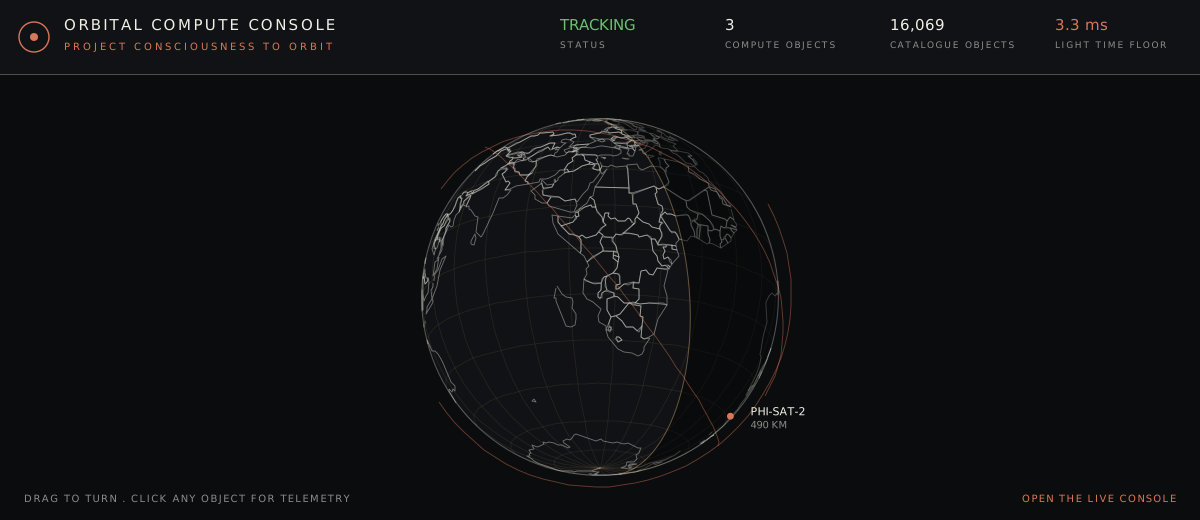
In The Consciousness AI, our Orbital Consciousness Tracker monitors live orbital elements, solar eclipse budgets, and round-trip speed-of-light latency floors between ground stations and LEO spacecraft. In our core cognitive architecture, the Perturbational Complexity Index (PCI) probe functions as a propagation check across recurrent modules, while our November 2026 research map focuses on repairing the causal link between the tectal motor map and the global workspace.
Hu and van Berkel’s distinction between high-bandwidth local compute cores and bandwidth-constrained inter-satellite links maps directly onto the modular separation in our architecture. High-frequency recurrent binding between sensory maps, homeostatic value gates, and the global workspace requires high bisection bandwidth on a single local substrate, whereas asynchronous episodic consolidation and slow telemetry can tolerate the lower bandwidth and higher latency of distributed links.
Open Engineering Challenges for Orbital Clusters
Before Heterogeneous Space Data Centers can operate as persistent orbital compute platforms, two engineering problems require flight verification. First, maintaining 100+ Gbps free-space optical laser lock between dawn-dusk SSO core nodes and fast-crossing inclined LEO edge satellites requires low-mass adaptive gimballing with sub-microradian pointing stability during attitude control thruster firings. Second, as Google Project Suncatcher’s Trillium TPU flight data underscored, rejecting tens of kilowatts of continuous AI waste heat in vacuum without deployable fluid-loop radiators remains the primary mass driver for high-capacity core nodes.
Researchers covered here
- Peng HuDepartment of Electrical and Computer Engineering, University of Manitoba and Carleton UniversityHeterogeneous Space Data Centers, non-terrestrial network architecture, dawn-dusk LEO compute orchestration
- Kees van BerkelEindhoven University of TechnologyThe Cost and Network Limits of Space-Based AI Compute, bisection bandwidth and roofline analysis of orbital LEO clusters, asynchronous circuit design