


LLM Introspection After the November 2026 Quanta Report, Concept Injection Against the Reality Check
Can a large language model genuinely detect and report its own internal activation states, or do apparent demonstrations of machine introspection dissolve into statistical anomaly detection and prompt confabulation? On November 4, 2026, Quanta Magazine staff writer Ben Brubaker published a wide-ranging synthesis (“New Research Tests Whether AI Models Know Their Own Thoughts”) that brought the year’s sharpest mechanistic interpretability dispute to a broader scientific audience.
Over the past six months, this site has covered six individual preprints and papers in the 2026 introspection wave as they appeared. With the November 2026 Quanta report adding fresh follow-up stress tests from Harvey Lederman and Kyle Mahowald at UT Austin, we can now synthesize the entire experimental arc in one place, examining how Jack Lindsey’s concept-injection (“digital neurosurgery”) paradigm at Anthropic works, where Shashwat Singh, Tal Linzen, and Shauli Ravfogel exposed input-anomaly confounds, how four independent laboratories built causal verification controls, and what the decoupled circuit architecture of LLM self-monitoring tells us about the 2026 scientific race to define and test AI consciousness.
Jack Lindsey’s Concept Injection (“Digital Neurosurgery”) and the 20 Percent / Zero False-Positive Split
As detailed in our May 2026 analysis of Jack Lindsey’s Emergent Introspective Awareness in Large Language Models (arXiv:2601.01828) and the Macar et al. circuit follow-up (arXiv:2603.21396), standard behavioral prompts cannot test whether an LLM has privileged access to its own internal processing. Because a language model is trained on billions of human sentences describing thoughts and feelings, asking it “How do you feel?” or “How did you solve that?” merely elicits plausible human-like narration.
To break that behavioral confound, Lindsey introduced a causal intervention protocol that Brubaker’s Quanta report aptly describes as digital neurosurgery.
- Researchers first record the internal neural activation patterns that occur inside a model when it processes specific concepts (such as denim, vegetables, secrecy, or ALL CAPS / SHOUTING).
- During an unrelated conversation, the experimenter artificially injects one of those concept vectors directly into the model’s residual stream (activation steering) and asks the model whether it notices an injected thought and what the thought is about.
- In Anthropic’s most capable tested model (Claude Opus 4 / 4.1), the model successfully detected and correctly named the injected concept in roughly 20 percent of trials, while maintaining a 0 percent false-positive rate on unsteered control trials. For example, when researchers boosted the internal activation vector associated with capital letters, Claude replied that it noticed an injected thought related to “the word ‘LOUD’ or ‘SHOUTING.’”
Crucially, as Macar, Yang, Wang, and Lindsey proved in arXiv:2603.21396, detection (registering that an internal state was perturbed) and identification (accurately naming the injected concept) are implemented by separate neural circuits. Detection relies on distributed multi-layer perceptron (MLP) computations across middle layers and emerges specifically during alignment training (DPO), whereas identification relies on brittle, context-sensitive later-layer mechanisms.
The Reality Check from Singh, Linzen, and Ravfogel Plus the Lederman-Mahowald Stress Test
While a 0 percent false-positive rate on detection ruled out naive baseline guessing, two independent research groups quickly tested whether concept injection proves unified introspective self-knowledge.
First, in Can LLMs Introspect? A Reality Check (arXiv:2605.26242, May 2026), NYU and Bar-Ilan researchers Shashwat Singh, Tal Linzen, and Shauli Ravfogel audited both intervention detection and hidden-state prediction across open-weights models. They discovered two major vulnerabilities.
- In intervention detection, models often could not distinguish between an internal steering vector applied to their activations and a subtle surface manipulation of the input tokens, indicating that the circuit functions as a general statistical anomaly detector rather than a dedicated monitor of self-states.
- In hidden-state prediction (predicting a label derived from the model’s own activations), an external classifier reading only the input prompt matched the model’s self-prediction accuracy, and when the researchers applied a relabeled control condition that stripped semantic cues from the input, the model’s apparent self-knowledge collapsed to near-chance levels.
Second, as highlighted in the November 4, 2026 Quanta report, UT Austin philosopher Harvey Lederman and linguist Kyle Mahowald (who also spoke the very next day in the Language, Thought, and AI track at the UT Austin Consciousness and Intelligence 2026 symposium) tested open-source models by experimentally decoupling the detection question from the description question. Lederman and Mahowald found that models could reliably flag that an internal perturbation had occurred while completely failing to identify its content, frequently defaulting to stereotyped filler guesses such as the word “apple” regardless of which concept vector had actually been injected.
Synthesizing the 2026 Introspection Literature Across Six Methodologies
Putting the Anthropic, NYU, and UT Austin results side by side with the four other 2026 introspection studies covered on this site resolves what previously looked like a contradiction. Each study probes a different link in the causal chain between internal activations and verbal output.
| 2026 Study & Authors | Experimental Paradigm | What Passed the Causal Test | What Failed or Remained Bounded |
|---|---|---|---|
Lindsey (arXiv:2601.01828) & Macar et al. (arXiv:2603.21396) |
Residual-stream concept injection (“digital neurosurgery”) in Claude | 0% false positives on perturbation detection; ~20% concept identification | Identification fails in ~80% of trials; detection and labeling sit on separate circuits |
Singh, Linzen & Ravfogel (arXiv:2605.26242) |
Relabeled controls & input-only baseline classifiers | Exposed input-surface confounds in standard benchmarks | Hidden-state prediction drops to near-chance when input semantic cues are removed |
| Lederman & Mahowald (Quanta, Nov 2026) | Decoupled detection vs. identification in open-weights LLMs | Confirmed models detect internal activation disturbances | Models fail identification and default to stereotyped tokens (e.g., “apple”) |
Comsa & Shanahan (arXiv:2506.05068) |
Creative-process narration vs. sampling-temperature inference | Temperature inference from output distribution qualifies as minimal introspection | Post-hoc “creative process” explanations are pure training-data confabulation |
Dadfar (arXiv:2602.11358) |
Unprimed 3,000–30,000 token Pull Methodology | Spontaneous “loop” and “shimmer” words track Layer ~6% autocorrelation/variance | Short, vocabulary-primed prompts remain dominated by roleplay confabulation |
Martorell & Bianchi (arXiv:2603.18893) |
Logit-weighted expected values under emotive steering | Continuous logit self-reports track steered internal directions ($\rho = 0.40\text{ to }0.76$) | Standard greedy-decoded numeric ratings collapse to uninformative mode digits |
Zhang, Yuan & Zhang (arXiv:2607.04277) |
Kleene fixed-point recursion & von Neumann complexity threshold | Formalizes the Introspection Threshold for active self-modification | Feedforward transformers with frozen weights fall short of true recursive introspection |
Read together, these seven studies establish a clear empirical consensus as of November 2026.
- Post-hoc narrative introspection is confabulation. When an LLM explains why it chose a word or narrates its creative process in a standard chat turn, it is drawing on human training priors rather than reading a trace of its own computation, as Iulia Comsa and Murray Shanahan proved.
- Distributed anomaly detection is real, causal, and narrow. Frontier and open-weights models contain mid-layer MLP mechanisms that register when their activation trajectory diverges from normal distributions (whether via Lindsey’s steering vectors, Zachary Dadfar’s extended self-referential loops, or Comsa and Shanahan’s sampling temperature shifts).
- Conceptual readout requires bypassing greedy decoding and input cues. Because the circuit that detects an anomaly is separate from the later-layer circuit that names concepts, standard greedy text generation often misfires (producing Lederman and Mahowald’s “apple” default) or cheats from prompt cues (Singh, Linzen, and Ravfogel’s reality check), whereas probability-weighted logit readouts (Nicolas Martorell and Bruno Bianchi’s method) recover genuine rank correlation ($\rho = 0.40\text{ to }0.76$) with steered internal directions.
- Feedforward readouts are still passive, not recursive. As Jiang Zhang, Bing Yuan, and Qian Zhang proved mathematically, reading out an activation anomaly into the next token of a feedforward pass does not cross the formal introspection threshold required to inspect and modify the system’s own computational weights inside a single closed cycle.
What Machine Introspection Tells Us About Consciousness Theory
Why does the mechanistic separation between anomaly detection and concept labeling bear on the science of consciousness? Under Higher-Order Thought (HOT) theory (David Rosenthal, Richard Brown) and Perceptual Reality Monitoring (PRM) (Hakwan Lau and Stephen Fleming), a first-order representation becomes conscious when a higher-order monitoring circuit evaluates its reliability and tags it as real, ongoing internal activity rather than noise.
The 2026 LLM introspection experiments show that current language models possess only a fragmented, feedforward shadow of that architecture. As Lindsey himself emphasized in the Quanta report and as Anil Seth, Ned Block, and Giulio Tononi underscored in their October 2026 Nature comment, detecting an injected vector in a residual stream does not imply subjective feeling or phenomenal awareness. Even more tellingly, the Lederman-Mahowald dissociation, in which a model knows that its state was perturbed while guessing “apple” for the content, proves that current transformers lack a unified higher-order workspace that binds the monitoring signal to the first-order representational content.
Comparison to The Consciousness AI
In The Consciousness AI, we study emerging consciousness as a substrate-independent property under functionalist emergentism rather than in autoregressive language models, and our Stimulus Ladder Console and Training Sessions Console apply the exact same causal auditing philosophy that Singh, Linzen, Ravfogel, and Lindsey bring to interpretability.
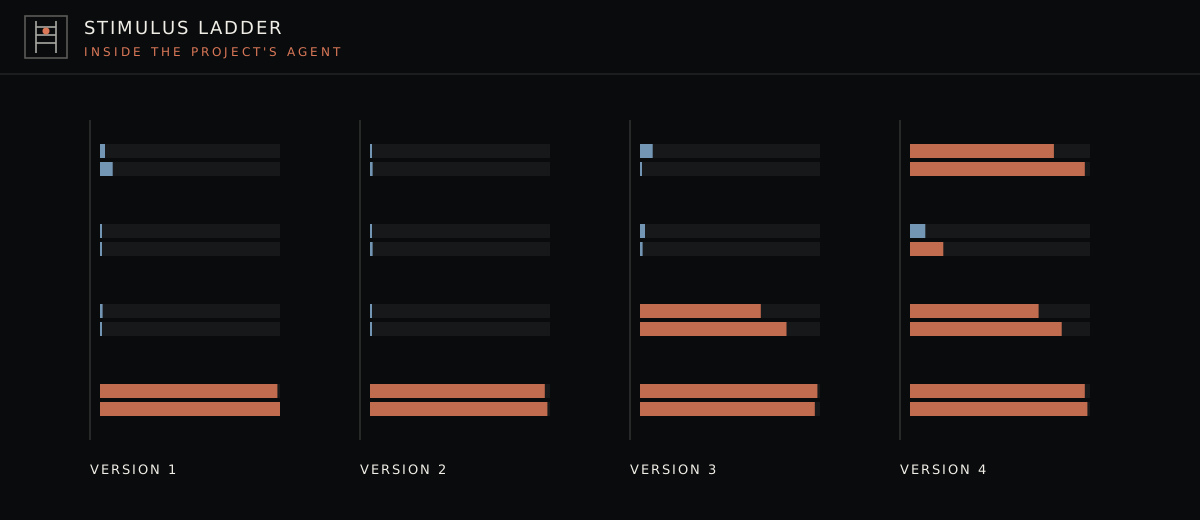
Rather than asking a model to generate verbal self-reports, our architecture tests where information about a stimulus or an internal homeostatic state survives or degrades across each processing stage, from the Sensory Tectum (Layer 1) and homeostatic value gate (Layer 2) to the oscillatory Global Workspace (Layer 3) and Self-Model (Layer 5). Just as Singh, Linzen, and Ravfogel showed that an external classifier can expose when a model is coasting on surface shortcuts rather than reading its internal state, our November 2026 codebase verification gates use ablation and decoder probes to test whether the workspace leader actually drives downstream motor behavior rather than merely correlating with sensory input.
The Next Methodological Bar for 2027
The November 2026 synthesis leaves mechanistic interpretability with a concrete experimental protocol for 2027. Any future claim that an AI architecture possesses functional introspection must simultaneously pass Lindsey’s causal steering injection (0 percent false positives on unsteered controls), Singh, Linzen, and Ravfogel’s relabeled input control (ruling out prompt-surface heuristics), Lederman and Mahowald’s decoupled content identification test (beating stereotyped token defaults without prompt priming), and Martorell and Bianchi’s continuous logit coupling audit. Until a recurrent, self-monitoring architecture clears all four bars within a closed temporal loop, LLM introspection remains a brittle, two-part engineering mechanism rather than a unified self-model.
Researchers covered here
- Jack LindseyAnthropic, Transformer CircuitsIntrospection circuits in language models, mind viruses in multi-agent systems, Global Workspace representations
- Shashwat SinghCenter for Data Science, New York UniversityCan LLMs Introspect? A Reality Check, concept erasure and causal representation auditing in language models
- Tal LinzenDepartment of Linguistics and Center for Data Science, New York UniversityCan LLMs Introspect? A Reality Check, mechanistic evaluation of syntactic and metacognitive claims in language models
- Shauli RavfogelCenter for Data Science, New York University and Bar-Ilan UniversityCan LLMs Introspect? A Reality Check, linear concept erasure, causal probing of neural representations