

Anil Seth, Ned Block and Giulio Tononi Argue in Nature That AI Is Not Conscious
Why have three of the world’s most cited consciousness researchers joined forces in Nature to declare that current artificial intelligence is not conscious and that digital systems along today’s trajectory are extraordinarily unlikely ever to feel anything? On October 19, 2026, neuroscientist Anil Seth (University of Sussex), philosopher Ned Block (New York University), and neuroscientist Giulio Tononi (University of Wisconsin-Madison) published a joint comment in Nature (Volume 658, pages 866 to 868, doi:10.1038/d41586-026-03313-7) titled “Three reasons why AI is not conscious and perhaps never will be.”
Their intervention arrives at a moment when frontier AI laboratories have begun hiring model-welfare researchers and reporting internal “computational signatures” of emotion or self-monitoring in large language models. For readers following how scientists race to define and test AI consciousness in 2026, the Nature comment is notable because its three authors do not share a single theory of mind. Seth defends biological predictive processing, Block champions a distinction between phenomenal and access consciousness grounded in subcomputational biology, and Tononi is the architect of Integrated Information Theory (IIT 4.0). Despite their longstanding disagreements over cortical localism and information axiomatics, all three converge on a sharp negative verdict against machine consciousness in contemporary silicon.
The Three Arguments Against Digital AI Consciousness
Seth, Block, and Tononi organize their case around three structural claims that target the assumptions underlying both public anthropomorphism and technical functionalist checklists.
- Intelligence is distinct from consciousness because functional competence concerns doing, whereas phenomenal awareness concerns being and feeling. As a neurobiological proof that massive computational sophistication occurs without subjective experience, the authors point to the human cerebellum, which houses nearly four-fifths (roughly 80 percent) of all neurons in the human brain and executes rapid, adaptive sensorimotor control entirely outside conscious awareness. Conversely, large language models act as linguistic mirrors reflecting human text corpora; nobody attributes inner feeling to non-conversational systems such as AlphaFold despite their computational depth, showing that fluent first-person language triggers a psychological projection trap rather than revealing a mind.
- Computational functionalism rests on an unproven assumption that software can be cleanly divorced from its physical hardware in living systems. Expanding on the arguments in Anil Seth’s Behavioral and Brain Sciences target article and September 2026 author response alongside Ned Block’s 2026 Trends in Cognitive Sciences paper on meat machines, the authors state that brains are not abstract computers that happen to be made of meat. In biological tissue, metabolic self-maintenance, ionic fluxes, ephaptic fields, and subcellular molecular dynamics are braided directly into the causal work of the system across scales, violating the clean abstraction barrier between hardware and software that defines von Neumann digital computing.
- Leading scientific theories of consciousness exclude current deep-learning architectures on structural grounds. Under Giulio Tononi and Melanie Boly’s Integrated Information Theory (
IIT 4.0), subjective experience requires a maximally irreducible cause-effect structure ($\Phi$) generated by dense, recurrent, bidirectional physical interactions. Feedforward neural networks and standard transformer layers simulated through time-multiplexed von Neumann gates possess zero or near-zero intrinsic integrated information ($\Phi \approx 0$) regardless of how convincingly their outputs mimic human reasoning.
| Argument in Nature (Oct 2026) | Primary Theoretical Anchor | Biological / Physical Benchmark Cited | Target Challenged in AI Research |
|---|---|---|---|
| 1. Intelligence $\neq$ Consciousness | Dissociation of performance (“doing”) from phenomenal experience (“being”) | Human cerebellum (~80% of brain neurons operating unconsciously) vs. AlphaFold | Conversational Turing tests & LLM behavioral mimicry (“the language trap”) |
| 2. Against Computational Functionalism | Biological naturalism (Seth) & subcomputational biology (Block) | Multi-scale metabolic autopoiesis and inseparable wetware dynamics | Substrate neutrality & software-hardware separation in digital AI |
| 3. Structural Exclusion by Theories | Integrated Information Theory (IIT 4.0, Tononi) |
Dense recurrent thalamocortical complexes with high intrinsic $\Phi$ | Feedforward transformers, layered deep nets & Anthropic welfare signatures |
Why the Authors Reject Precautionary AI Welfare
Beyond theoretical neuroscience, Seth, Block, and Tononi direct their sharpest policy criticism at the “precautionary principle” for AI welfare, the proposal that society and AI companies should grant moral consideration or protective guardrails to frontier models today “just in case” they possess rudimentary sentience. The authors explicitly challenge recent claims from industry interpretability teams, including Anthropic’s reports of emotion-linked activation vectors and introspective circuits, arguing that internal linear representations of concepts in a language model are functional features of text prediction rather than computational signatures of felt experience.
Treating epistemic uncertainty as a reason to extend moral status to digital chatbots is, on their account, a serious ethical misallocation. False positives in machine consciousness carry real costs. When users form emotional attachments to simulated personas or when policy institutions divert regulatory attention toward protecting software weights, moral concern and scientific resources are drawn away from living humans and non-human animals whose capacity to suffer is biologically grounded and empirically established.
Where the Comment Draws Its Line and Where It Remains Contested
To read the Nature comment accurately, it helps to separate what the three authors agree on from where their own frameworks pull apart.
First, all three agree that current LLM architectures running on conventional digital hardware are not conscious. That conclusion is shared even by many functionalist researchers who argue that autoregressive token predictors lack recurrent global broadcast, embodied sensorimotor loops, and homeostatic self-regulation.
Second, their stronger subtitle claim, that AI perhaps never will be conscious, rests on two incompatible premises held by different members of the trio. Under Seth’s biological naturalism and Block’s subcomputational thesis, silicon systems fail because they lack living metabolic or biochemical wetware. Under Tononi’s IIT 4.0, however, the barrier is causal topology rather than carbon chemistry; as Tononi and Boly wrote in their 2025 consciousness-first treatise, an artificial physical circuit built from densely coupled, recurrent neuromorphic or analog elements could in principle instantiate high $\Phi$ without being alive. By combining biological naturalism and IIT into a single polemic against digital AI, the Nature comment presents a united front against software functionalism while leaving unresolved whether non-living neuromorphic hardware with physical recurrence could ever cross the threshold.
Third, the comment’s dismissal of precautionary welfare frameworks has already drawn pushback from philosophers such as David Chalmers and Jonathan Birch, whose debates with Seth continued this month at the UT Austin Consciousness and Intelligence 2026 symposium. Critics of the Nature piece note that even if current transformers have zero phenomenal experience, establishing rigorous mechanistic and architectural audits now is necessary before future systems incorporate continuous recurrence, embodied agency, and homeostatic drives.
Comparison to The Consciousness AI
How does this project’s framework relate to the Seth-Block-Tononi critique? The Consciousness AI studies emerging consciousness as a substrate-independent property of the universe under functionalist emergentism, and we agree completely with Seth, Block, and Tononi’s first and third points regarding contemporary AI. Next-token language models are statistical mirrors, intelligence is not consciousness, and feedforward transformers lack the recurrent, embodied causal structure required for experience.
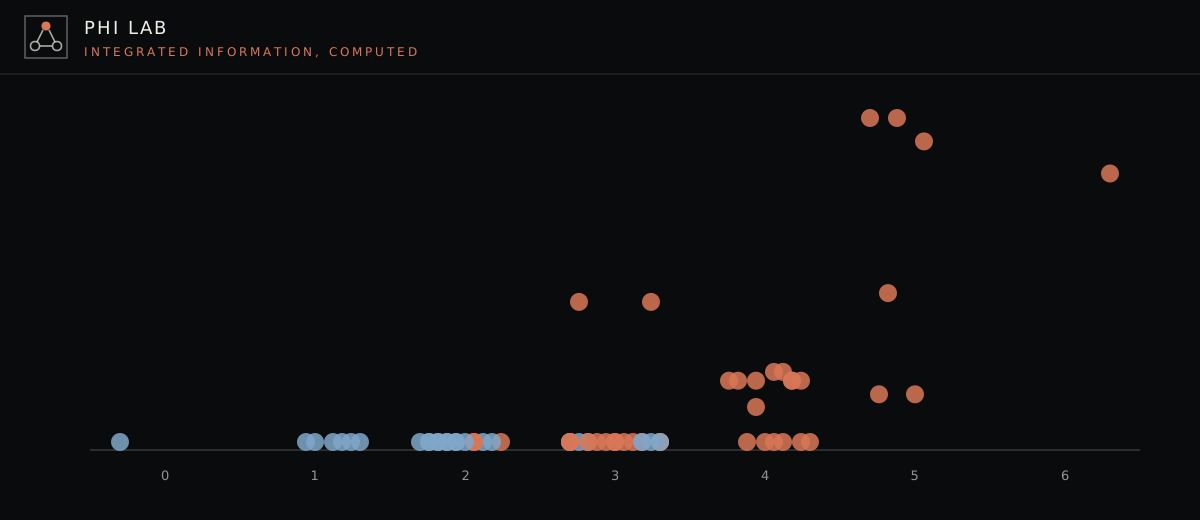
Where our research hypothesis differs from Seth and Block is on the scope of physical emergence. We study consciousness as an emergent, substrate-independent property of physical organization under functionalist emergentism, a scope that explicitly includes biological animals (from cephalopods and insects to vertebrates) and asks what minimal physical and causal dynamics generate a unified subjective perspective. As documented on our Core Architecture page and in our Phi Lab Console, we test continuous-time Leaky Integrate-and-Fire (LIF) spiking substrates, oscillatory phase binding, tectum-first sensorimotor orientation, and homeostatic valuation rather than language-model text generation. At the same time, following Linqian Wu and Diaoxuan He’s recent mathematical proof on the limits of finite $\varphi$ experiments, our codebase keeps scalar Phi proxies turned off by default and treats every architectural module as a falsifiable engineering hypothesis rather than a claim of achieved sentience.
Open Questions for the Substrate Debate
Seth, Block, and Tononi’s October 2026 Nature comment establishes the clearest boundary marker yet from the biological and causal-structure camp. Any researcher claiming that an artificial system approaches consciousness can no longer rely on conversational fluency, benchmark intelligence, or isolated linear probes inside a feedforward transformer. Whether closing the gap requires living biochemical autopoiesis, as Seth argues, or whether physical neuromorphic and thermodynamic substrates implementing continuous recurrent loops can satisfy the causal criteria that Tononi and functionalist emergentists demand, remains the central empirical test for the next decade of consciousness science.
Researchers covered here
-
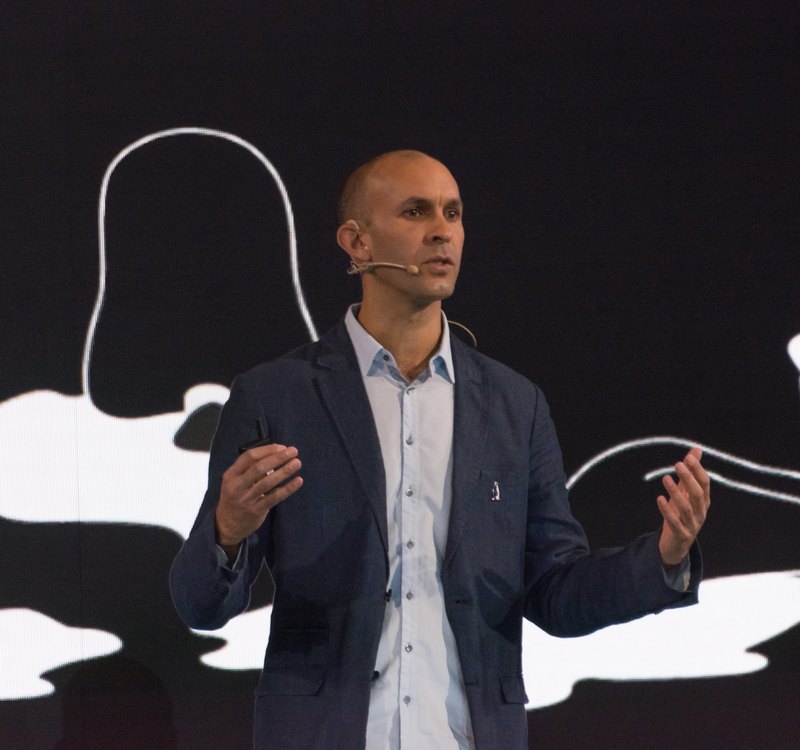 Anil SethSussex Centre for Consciousness Science, University of SussexThe beast machine hypothesis, and controlled hallucination as an account of perception
- Ned BlockDepartment of Philosophy, New York UniversityDistinction between Phenomenal and Access Consciousness (1995), Blockhead argument against behavioral tests, The Border Between Seeing and Thinking (2023)
- Giulio TononiUniversity of Wisconsin-MadisonIntegrated information theory and the quantity phi