

Adult Drosophila MaleCNS Connectome Learns Cognitive Tasks and Runs on Intel Loihi 2
Does an organism’s complete synaptic wiring diagram merely hard-code species-specific reflexes, or does biological connectome topology provide a general-purpose recurrent architecture capable of learning human-designed cognitive tasks and running at high speed on neuromorphic silicon? Two complementary breakthroughs answer that question across software learning and neuromorphic hardware execution. In their October 2026 paper A Drosophila Whole-Connectome Network Can Learn Human-Designed Cognitive Tasks (arXiv:2610.10014), KAIST researchers Joonghui Cho, Minchan Kang, and Daeshik Kim instantiate the complete adult male fruit fly central nervous system (MaleCNS v1.0, 166,700 neurons and 25.5 million directed anatomical edges) as a fixed recurrent network and train it to solve bounded addition and grounded relational language tasks. In parallel, Sandia National Laboratories researchers Felix Wang, Bradley H. Theilman, Fred Rothganger, William Severa, Craig M. Vineyard, and James B. Aimone demonstrate in Neuromorphic Simulation of Drosophila Melanogaster Brain Connectome on Loihi 2 (arXiv:2508.16792) that the 140,000-neuron, 50-million-synapse FlyWire brain connectome maps onto 12 Intel Loihi 2 neuromorphic chips and executes orders of magnitude faster than conventional CPU/GPU simulators.
For the Whole Brain Emulation research section and our overarching investigation into how scientists define and test consciousness across biological and synthetic substrates, these two studies resolve a central debate triggered by recent fruit fly connectome milestones, including the adult Drosophila complete gustatory connectome in Cell and the MaleCNS and FlyWire sexual dimorphism and embodied control studies. Critics of connectome-led brain emulation frequently argue that an electron-microscopy wiring diagram is either too specialized to generalize beyond insect locomotion or too irregular to run efficiently on digital hardware. Cho, Kim, Wang, and Aimone falsify both objections with hard numbers.
KAIST’s Whole-Connectome Cognitive Learning on MaleCNS v1.0
To test whether evolved biological wiring carries a reusable computational inductive bias, Cho, Kang, and Kim extracted the complete adult male Drosophila central nervous system graph from MaleCNS v1.0, spanning 166,700 nodes and more than 25.5 million directed edges consolidated from over 124 million synaptic contacts across the brain and ventral nerve cord.
Crucially, the authors prevented the input and readout layers from doing the computational heavy lifting. Input sensory projections, output readout maps, and token codebooks were held strictly fixed, and the recurrent adjacency matrix was locked to the exact anatomical edges of the fly connectome. Training updated only a single scalar weight per existing anatomical edge.
The KAIST team evaluated this connectome-constrained recurrent network against 20 comparative graph topologies, including directed degree-preserving randomized rewires that preserve every neuron’s exact in-degree and out-degree while destroying higher-order biological motifs.
- On bounded addition with held-out numerical inputs, the native
MaleCNS v1.0anatomical topology achieved a mean accuracy of 92.77 percent, compared to 67.93 percent for directed degree-preserving rewired graphs. - On the grounded relational language task, which uses a controlled 100-word lexicon to map visual scenes and order-reversed scenes to structured text descriptions, the biological connectome scored 61.59 percent on the strict paired language endpoint, beating degree-matched rewires (44.17 percent) and ranking first out of all 21 graph architectures tested at the canonical sensory-motor interface.
- In sensory interface ablations, shuffling the alignment between task features and the fly’s native sensory input channels caused accuracy to collapse, proving that performance relies on the hierarchical path structure connecting biological sensory glomeruli through central integration hubs (such as the central complex and mushroom bodies) to descending motor outputs.
| Study & Benchmark | Connectome Dataset | Neurons & Directed Edges / Synapses | Hardware / Training Setup | Key Quantitative Result |
|---|---|---|---|---|
| Cho, Kang & Kim (KAIST, Oct 2026) | Adult Male CNS (MaleCNS v1.0) |
166,700 neurons; 25.5M directed edges (124M+ synapses) | Fixed anatomical topology; 1 trainable scalar weight per edge | 92.77% bounded addition (vs. 67.93% rewire); 61.59% relational language (vs. 44.17% rewire; #1 of 21 graphs) |
| Wang, Aimone et al. (Sandia, Loihi 2) | Adult Female Brain (FlyWire) |
~140,000 neurons; ~50M synapses | 12 Intel Loihi 2 neuromorphic chips; event-driven spiking | Full connectome fits in on-chip SRAM; orders-of-magnitude speedup over CPU/GPU numerical simulators |
| FlyGM / MaleCNS Embodied Control (2026) | FlyWire & MaleCNS v1.0 |
139,255 to 166,700 neurons | MuJoCo / NeuroMechFly biomechanical body | Sample-efficient walking, grooming, and gustatory motor sequences |
Sandia’s 12-Chip Intel Loihi 2 Whole-Brain Simulation
While Cho and Kim proved that the Drosophila connectome graph supports abstract recurrent computation, executing sparse, irregular biological graphs on GPUs wastes massive bandwidth because biological adjacency matrices resist dense tensor-core blocking.
At Sandia National Laboratories, Felix Wang, James Aimone, and colleagues solved the hardware compilation bottleneck in arXiv:2508.16792. Taking the full adult Drosophila brain connectome from the FlyWire Consortium (~140,000 neurons and 50 million synapses), they developed graph-partitioning and axon-routing algorithms that respect the strict per-core fan-in, fan-out, and local SRAM limits of Intel’s Loihi 2 neuromorphic processor.
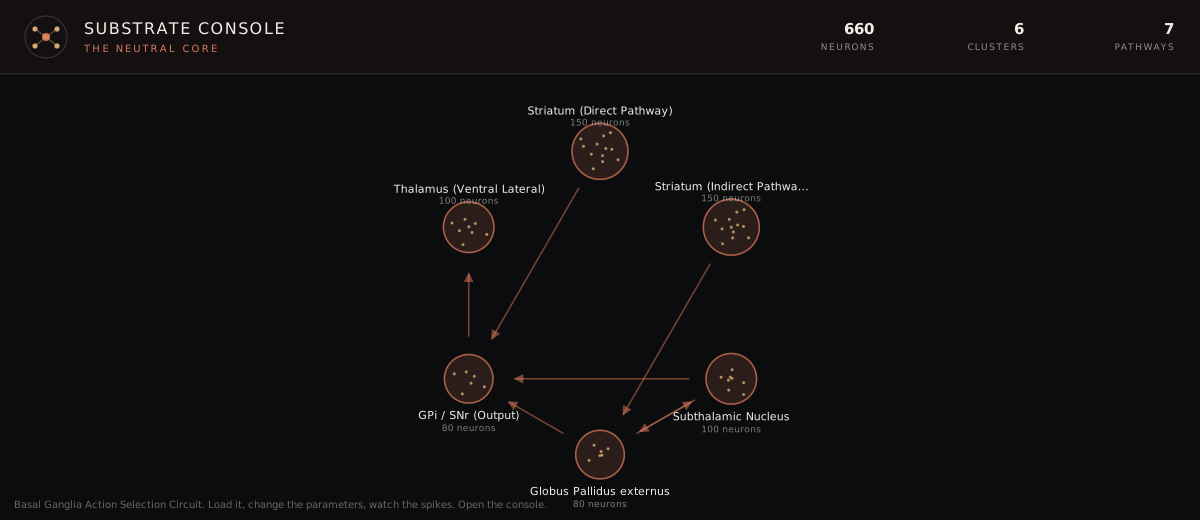
By distributing the FlyWire connectome across 12 Loihi 2 chips, the Sandia team achieved the first statistically validated, organism-scale biological connectome simulation on neuromorphic silicon. Because Loihi 2 cores communicate exclusively via asynchronous spike events rather than dense clock-driven matrix sweeps, simulation throughput scales directly with neural firing sparsity, running orders of magnitude faster than standard numerical differential-equation solvers on conventional hardware. This hardware milestone pairs directly with our analysis of Intel Loihi 2 and SpiNNaker neuromorphic processors in orbital and terrestrial substrates and the live spiking dynamics in our Neutral Core Substrate Console.
What Connectome Learning and Loihi 2 Execution Tell Us About Consciousness
How do these two engineering papers bear on theories of consciousness? They test the core structural premise of Functionalism, Global Neuronal Workspace Theory (GNW), and Recurrent Processing Theory (Lamme) against Biological Naturalism.
First, Cho, Kang, and Kim’s finding that degree-preserving random rewires drop by nearly 25 percentage points on addition and 17 percentage points on relational language proves that higher-order recurrent network topology is causally decisive. Simple neuron counts and synapse degree distributions do not explain cognitive integration. Instead, the fruit fly nervous system evolved specific bottleneck-and-broadcast motifs (converging sensory streams into the central complex and mushroom body calyces before broadcasting to premotor descending neurons) that act as a structural workspace scaffold. When trained on symbolic tasks a fly never encountered in evolution, that same recurrent scaffold routes relational bindings far more effectively than a randomized graph of identical size and degree.
Second, Wang and Aimone’s Loihi 2 implementation demonstrates that a complete biological connectome’s sparse, recurrent spike dynamics can be transplanted onto asynchronous silicon without losing dynamical fidelity or grinding to a computational halt. Neither KAIST nor Sandia claims that their simulated Drosophila networks are phenomenally conscious, and as documented in our review of Eon Systems’ embodied fruit fly emulation, running a static connectome with simplified point-neuron weights omits gap junctions, extrasynaptic neuropeptide diffusion, and glial modulation. Even so, proving that biological wiring topology carries transferable cognitive inductive bias and runs natively on 12 neuromorphic chips removes two major roadblocks on the Sandberg and Bostrom whole-brain emulation roadmap.
Comparison to The Consciousness AI
In The Consciousness AI, our Neutral Core Substrate Console visualizes Leaky Integrate-and-Fire (LIF) spiking dynamics and connectome-derived structural graphs, while our core training loop investigates how subcortical tectal routing and thalamic gating interact with a recurrent global workspace.
Cho, Kang, and Kim’s experimental protocol directly informs our current November 2026 workspace-link diagnosis. In the KAIST experiments, shuffling the sensory interface mapping between input features and the connectome’s native sensory nodes destroyed task learning even when all 25.5 million internal edges remained intact. That result mirrors our own empirical finding in tcai-research that an intact workspace module cannot drive behavior if the relay interface between the tectal motor map and the workspace broadcast is misaligned or uncalibrated.
Open Questions for Connectome Emulation
Two concrete scientific questions follow from these studies. First, can the MaleCNS v1.0 topology learn continual, multi-task memory updates online via local spike-timing-dependent plasticity (STDP) and neuromodulated three-factor rules on Loihi 2, rather than relying on offline gradient descent over scalar edge weights? Second, which specific subgraphs inside the 166,700-neuron connectome (such as the ellipsoid body ring attractors versus the mushroom body Kenyon cell expansion layer) account for the 25-point accuracy advantage over degree-matched random graphs? Isolating those minimal structural motifs will tell both neuroscientists and AI architects which biological wiring patterns are essential for unified recurrent agency.
Researchers covered here
- Joonghui ChoKorea Advanced Institute of Science and Technology (KAIST)Drosophila MaleCNS whole-connectome cognitive task learning, anatomical inductive bias in recurrent neural networks
- Daeshik KimSchool of Electrical Engineering, Korea Advanced Institute of Science and Technology (KAIST)High-field functional MRI, cortical column mapping, Drosophila whole-connectome recurrent network architectures
- Felix WangCenter for Computing Research, Sandia National LaboratoriesMapping and simulating the full FlyWire Drosophila brain connectome across 12 Intel Loihi 2 neuromorphic chips
- James B. AimoneCenter for Computing Research, Sandia National LaboratoriesNeuromorphic algorithms, adult Drosophila FlyWire connectome simulation on Intel Loihi 2, adult hippocampal neurogenesis modeling