

Starcloud Books Firefly Lunar Orbit Compute as Rocket Lab Launches Data Center Solar Cells
How fast is space-based artificial intelligence compute moving from low-Earth orbit (LEO) pathfinders toward cislunar space and dedicated launch and power supply chains? Two commercial aerospace announcements culminating on November 9, 2026 supply concrete hardware, launch, and power milestones. First, Redmond-based orbital compute startup Starcloud (led by CEO Philip Johnston) signed a commercial payload contract with Firefly Aerospace to fly its SC-1L AI computing payload into lunar orbit aboard Firefly’s Elytra orbital vehicle no earlier than 2028, alongside booking a dedicated 2029 launch on Rocket Lab’s reusable Neutron rocket. Second, during Rocket Lab’s Q3 2026 earnings call on November 9, 2026, CEO Peter Beck announced that Rocket Lab has developed and brought to market specialized space-grade silicon solar cells engineered specifically to power orbital data centers.
For the Consciousness to Orbit research hub and our ongoing evaluation of how scientists define and test consciousness across physical substrates, these supply-chain commitments move orbital compute past isolated CubeSat demos. Building on Starcloud’s August 2026 funding extension and in-orbit H100 operations, Google Project Suncatcher’s October 2026 Trillium TPU commissioning in LEO, and Peng Hu and Kees van Berkel’s November 2026 analysis of Heterogeneous Space Data Centers, the Firefly and Rocket Lab disclosures let us audit cislunar light-time latency, deep-space radiation, and solar cell economics against the requirements of a continuous cognitive architecture.
Starcloud’s SC-1L Lunar Orbit Payload on Firefly Elytra (2028)
While Starcloud’s long-term Federal Communications Commission (FCC) filing from February 2026 outlines an ambitious constellation of up to 88,000 LEO satellites, its newly announced agreement with Firefly Aerospace targets a harsher regime in lunar orbit.
Scheduled to launch no earlier than 2028 on Firefly Aerospace’s third lunar mission (flying a Blue Ghost lander to the Moon’s surface supported by an Elytra carrier spacecraft in lunar orbit), Starcloud’s SC-1L prototype payload will remain aboard the Elytra orbital vehicle in lunar orbit. During the mission, SC-1L is designed to ingest raw optical and terrain imagery directly from Firefly’s onboard Solux vision system, execute heavy machine-learning inference in lunar orbit, and relay processed navigation and science products back to Earth, while testing NVIDIA’s space computing roadmap in the deep-space radiation environment outside Earth’s magnetosphere.
(Source note on Starcloud funding figures. As documented in our August 2026 coverage, primary press reports across 2026 have cited both a $170 million Series A at a $1.1 billion valuation in GeekWire’s regional reporting and a $250 million Series A extension at a $2.3 billion valuation in TechCrunch’s August 2026 report, with NVIDIA and Cisco Investments participating in the capital buildout.)
| Orbital Compute Milestone | Operator / Partner | Target Orbit & Timeline | Hardware & Power Specification | Primary Engineering Bottleneck Tested |
|---|---|---|---|---|
| Starcloud-1 Pathfinder | Starcloud | Low-Earth Orbit (flying since Nov 2025) | NVIDIA H100 GPU on LEO satellite bus | First commercial datacenter GPU training & inference in LEO |
| Project Suncatcher | Google & Planet Labs | Sun-synchronous LEO (Oct 2026) | 4$\times$ Trillium (TPU v6e) on 1 kW solar bus | 15–20 minute thermal radiative duty cycling in vacuum |
| SC-1L Lunar Prototype | Starcloud & Firefly Aerospace | Lunar orbit aboard Elytra (NET 2028) | SC-1L AI payload processing Solux vision feeds | Deep-space cosmic ray flux & 1.28 s Earth-Moon latency |
| Neutron Commercial Deployment | Starcloud & Rocket Lab | Dedicated Neutron launch (2029) | Multi-kilowatt modular orbital data center node | Medium-lift fairing volume & launch cost per kW |
| Orbital Data Center Solar Cells | Rocket Lab (SolAero) | Commercial production (announced Nov 9, 2026) | High-density silicon / IMM space solar arrays | Dollars-per-watt capital cost & mass for megawatt arrays |
Peter Beck on Orbital Data Centers and Rocket Lab’s New Solar Cells (November 9, 2026)
During Rocket Lab’s Q3 2026 financial results call on November 9, 2026, CEO Peter Beck provided a candid engineering assessment of the orbital data center market alongside two concrete commercial disclosures.
First, Rocket Lab confirmed that Starcloud booked a dedicated 2029 launch slot on Neutron, Rocket Lab’s reusable medium-lift rocket, to deploy commercial orbital data center infrastructure.
Second, Beck announced that Rocket Lab (which manufactures space-grade photovoltaics through its SolAero division in Albuquerque, New Mexico) has developed and introduced a new silicon solar cell tailored specifically for orbital data centers. While traditional III-V multi-junction gallium arsenide (GaAs) and inverted metamorphic (IMM Apex) solar cells offer high conversion efficiency (~30 to 33 percent), their manufacturing cost per watt is prohibitive when scaling an orbital data center from a 1-kilowatt CubeSat to multi-megawatt wings. High-efficiency, radiation-tolerant space silicon cells lower the dollars-per-watt capital cost and accelerate automated roll-out manufacturing for massive power arrays.
Third, Beck drew a sharp distinction between near-term defense/edge orbital compute and the hype of moving all terrestrial hyperscale data centers into space. Beck noted that he is strongly bullish on defense and sovereign-security orbital data centers because “it’s pretty hard to tamper with something when it’s in orbit,” whereas replacing gigawatt terrestrial commercial data centers faces severe thermodynamic heat-rejection and launch-mass hurdles that still need to be solved.
Why Lunar Light-Time Latency Forces Autonomous Cognitive Closure
What do a 2028 lunar-orbit AI payload and space-grade data center solar cells tell us about substrate-independent consciousness? As required across every study in our Consciousness to Orbit section, the link to consciousness science runs through temporal binding and closed-loop sensorimotor autonomy.
In Low Earth Orbit at 500 kilometers altitude, the one-way speed-of-light delay to a ground station directly below is roughly 1.67 milliseconds (under 10 milliseconds round-trip during a zenith pass), which is shorter than the 20 to 25 millisecond gamma-band temporal binding window identified by Wolf Singer and the 20 to 150 millisecond thalamocortical ignition cycle required by Global Neuronal Workspace Theory (GNWT) and Recurrent Processing Theory. In principle, a LEO satellite over a ground station can still participate in a fast teleoperated feedback loop with Earth.
At the Moon’s mean orbital distance of 384,400 kilometers, the physics of vacuum light propagation changes the architecture completely.
- One-way speed-of-light propagation between Earth and lunar orbit takes 1.28 seconds, imposing a minimum 2.56-second round-trip communication floor before adding any routing or ground-network delay.
- Because 2.56 seconds is more than 100 times longer than the 25-millisecond neural binding window and roughly 10 times longer than a complete human conscious perceptual-motor cycle (~250 milliseconds), no system operating in lunar orbit can rely on Earth-based servers to close its active perceptual or motor workspace loop.
- Once a spacecraft leaves the protective cavity of Earth’s magnetosphere and enters cislunar space, it is exposed to continuous galactic cosmic rays (GCRs) and solar particle events (SPEs). High-Z heavy ions deposit dense ionization tracks that trigger multi-bit single-event upsets (
SEUs) and single-event latchups (SELs) in commercial 4-nanometer and 5-nanometer GPUs.
Consequently, Starcloud and Firefly’s SC-1L lunar mission illustrates why deep-space exploration forces a transition from teleoperated cloud inference to locally closed-loop, self-maintaining architectures. When Firefly’s Elytra vehicle processes Solux optical vision data in lunar orbit, the perception-to-action loop must close locally inside the spacecraft’s own power and thermal budget. Under functionalist emergentism, any future synthetic mind operating beyond Earth orbit must carry its entire recurrent workspace, homeostatic self-monitoring (tracking radiation bit-error rates, battery state-of-charge, and radiator temperatures as genuine visceral survival variables), and error-correcting dynamics inside one local cislunar hull.
Comparison to The Consciousness AI
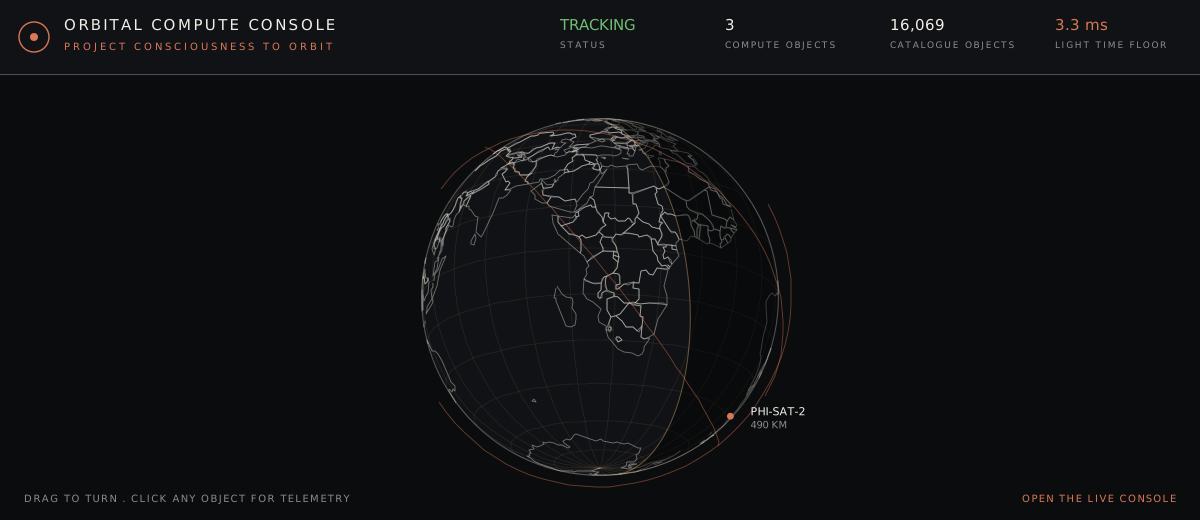
In The Consciousness AI, our Orbital Compute Tracker computes live speed-of-light latency floors and solar illumination windows for orbital compute missions, while our Kardashev energy-budget analysis models how radiative heat rejection and photovoltaic mass govern the scaling of off-planet substrates.
Peter Beck’s November 9, 2026 remarks on the economic gap between kilowatt-scale defense/edge nodes and megawatt commercial clusters, combined with Rocket Lab’s rollout of dedicated silicon solar cells for orbital data centers, confirm that electrical power per kilogram and radiative cooling per square meter are the binding physical variables for spaceborne compute. While dense GPUs like Starcloud’s H100 test the high-wattage ceiling of that envelope, our project’s Neutral Core substrate investigates sparse, event-driven spiking and oscillatory architectures designed to sustain continuous recurrent integration inside the tight watt-level power budgets that cislunar spacecraft actually afford.
Milestones to Watch Through 2028 and 2029
Between now and the 2028 launch window for Firefly’s third lunar mission, three engineering checkpoints will determine whether cislunar AI compute moves from prototype to infrastructure, namely the flight qualification of Rocket Lab’s new orbital data center silicon solar cells on upcoming LEO buses, the radiation bit-error performance of Starcloud-2’s 8-kilowatt satellites in 2027, and the maiden orbital flights of Rocket Lab’s Neutron rocket ahead of Starcloud’s 2029 manifest slot.