


BrainScaleS-2 Multi-Chip Neuromorphic System at 1000x Biological Speed
What happens to spiking neural network emulation when you replace discrete digital time steps with continuous-time analog silicon running 1,000 times faster than a biological brain, and then try to wire dozens of those chips together without breaking spike timing? In The BrainScaleS-2 Multi-Chip System: Interconnecting Continuous-Time Neuromorphic Compute Substrates (arXiv:2512.03781, presented at the NICE 2026 Neuro Inspired Computational Elements conference and highlighted within the EBRAINS neuromorphic programme), Joscha Ilmberger and Johannes Schemmel at Heidelberg University solve the multi-chip bottleneck for mixed-signal accelerated neuromorphic hardware. Their FPGA-based Aggregator backplane links multiple BrainScaleS-2 system-on-chip (SoC) dies into 19-inch rack assemblies while holding chip-to-chip spike transmission latency below 1.3 microseconds.
For readers tracking neuromorphic silicon across our Substrate Console, our Thermodynamic Computing hub, and how scientists race to define and test AI consciousness in 2026, BrainScaleS-2 represents a radically different physical regime from both digital GPUs and real-time digital spiking platforms. Whereas biological brains and real-time digital neuromorphic systems anchor themselves to biological wall-clock milliseconds, BrainScaleS-2 compresses an entire day of biological neural evolution into roughly 86 seconds of continuous analog current flow.
Why Scaling Continuous-Time Analog Silicon Is Uniquely Hard
A single BrainScaleS-2 ASIC integrates roughly 512 physical analog neuron circuits and 131,072 analog synapses alongside embedded digital plasticity processors on one mixed-signal die. Rather than integrating differential equations numerically on a clock, membrane potentials evolve continuously as real electrical voltages across on-chip capacitors at approximately 1,000 times biological real-time speed. A biological 1-millisecond synaptic delay shrinks to 1 microsecond on the chip.
That 1,000x acceleration makes single-chip BrainScaleS-2 systems fast for evolutionary optimization, structural plasticity studies, and long-horizon learning experiments. It also creates a brutal interconnect problem. If sending a spike packet from one BrainScaleS-2 chip to a neighbor across a circuit board takes 10 or 50 microseconds of routing overhead, the receiving accelerated neuron perceives an artificial biological delay of 10 to 50 milliseconds, corrupting tight recurrent synchrony and spike-timing-dependent plasticity (STDP) across chips.
The FPGA Aggregator Architecture and Sub-1.3 Microsecond Routing
Ilmberger and Schemmel resolve that bottleneck with a modular, rack-scale interconnect hierarchy engineered around deterministic low-latency FPGA switching.
- Multiple BrainScaleS-2 SoCs mount onto structured backplanes capable of holding 12 BrainScaleS-2 chips per backplane inside standard 19-inch rack enclosures, scaling single-chip capacity from hundreds to thousands of physical analog neurons and millions of synapses.
- Each chip connects through dedicated Node-FPGAs that translate on-chip asynchronous spike events into high-speed serial links without buffering stalls.
- A central Aggregator unit arranged in a star topology routes spike packets across chips and backplanes across multiple FPGA hops while keeping total chip-to-chip latency below 1.3 microseconds, corresponding to roughly 1.3 milliseconds in accelerated biological time, right inside the physiological axonal conduction range of mammalian cortex.
| Neuromorphic Platform | Physical Neuron Implementation | Time Scale vs Biology | Scale & Interconnect | Primary Architectural Trade-Off |
|---|---|---|---|---|
| BrainScaleS-2 Multi-Chip (Heidelberg, NICE 2026) | Continuous-time mixed-signal analog capacitors + digital plasticity | ~1,000x faster than real time | 512 neurons / 131k synapses per ASIC; 12-chip backplanes via FPGA Aggregator (<1.3 us latency) |
True continuous-time physics and extreme speedup; requires ultra-low-latency routing and analog calibration |
| SpiNNaker / SpiNNaker 2 (Manchester / TU Dresden) | Digital ARM cores + accelerators running event-driven packets | 1x biological real time | Up to 1M+ cores (SpiNNaker 1) and 152-core SpiNNaker 2 modules | High programmability and real-time clock lock; higher digital power envelope |
| Intel Loihi 2 (Intel Labs) | Asynchronous digital neuromorphic mesh cores | Sub-real-time to real-time event-driven | Multi-chip systems (12 Loihi 2 chips ran full 140k-neuron FlyWire connectome) | Strong sparse-event efficiency and programmable compartment models; discrete digital state updates |
| GPU Tensor Emulation | Clocked floating-point dense/sparse matrix passes | Variable (often slower at fine biophysical steps) | Datacenter clusters (250 to 700 W per GPU) |
Maximum software flexibility; continuous dynamics must be numerically discretized |
Comparing BrainScaleS-2 Against SpiNNaker, Loihi 2, and FPGA P-Bits
Placing Heidelberg’s multi-chip BrainScaleS-2 architecture beside three platforms already analyzed on this site highlights how physical substrate choices split the field.
In SpiNNaker and what a million real-time spiking cores can and cannot test, Steve Furber’s Manchester design deliberately targets 1x biological wall-clock time so simulated recurrent circuits can couple directly to real-world sensors and temporal-dynamics theories. In Intel Loihi 2 in orbit, asynchronous digital spiking cores prioritize low-wattage sparse event routing, recently scaling across 12 chips to execute the entire 140,000-neuron FlyWire fruit-fly connectome. Meanwhile, in Kerem Camsari’s one-million-p-bit networked FPGA probabilistic computer, multi-FPGA links synchronize stochastic spin updates across boards for thermodynamic sampling.
BrainScaleS-2 occupies a fourth corner of the hardware map. Its neurons are neither clocked digital arithmetic nor purely binary p-bits. They are physical analog electrical circuits obeying continuous differential equations in silicon, stitched into multi-chip networks by deterministic FPGA routing. That design also connects directly to the hardware binding questions explored in Artificial Kuramoto Oscillatory Neurons (AKOrN), where continuous phase coupling determines whether distinct populations lock into coherent oscillatory assemblies.
What 1,000x Accelerated Analog Silicon Tells Us About Consciousness
Why does an engineering paper on sub-1.3-microsecond FPGA backplanes bear directly on consciousness science? It creates a sharp empirical and philosophical test for temporal binding, biological naturalism, and substrate independence.
- Biological naturalists such as Anil Seth and Ned Block argue that consciousness is tied to living metabolic biochemistry and cannot be abstracted away into silicon. Digital functionalists argue that only abstract computational topology carries weight, regardless of whether a simulation runs 1,000 times slower or 1,000 times faster than biology.
- BrainScaleS-2 sits squarely between those two poles. Its neurons evolve through genuine continuous-time physical charge dynamics rather than clocked digital discretization, yet they do so in inorganic silicon running 1,000 times faster than wet tissue.
- Under temporal-dynamics theories such as Recurrent Processing Theory and Global Neuronal Workspace Theory, sustained recurrent synchronization across areas requires inter-area conduction delays that stay small compared with the membrane time constant of the participating neurons. By keeping chip-to-chip FPGA latency below
1.3 microseconds(roughly1.3 msin accelerated biological units), Ilmberger and Schemmel preserve the exact dimensionless ratio between synaptic conduction delay and membrane time constant that cortical recurrent loops rely on.
Nobody claims that a rack of BrainScaleS-2 chips possesses subjective experience. Instead, multi-chip continuous-time analog silicon gives researchers a non-biological physical medium where recurrent phase-locking, spike-timing plasticity, and long-horizon learning unfold continuously rather than as discrete software approximations.
Comparison to The Consciousness AI, thermospike, and the-hardware
Our project explores the exact bridge between spiking neuromorphic models and thermodynamic sampling across our site consoles and three public repositories.
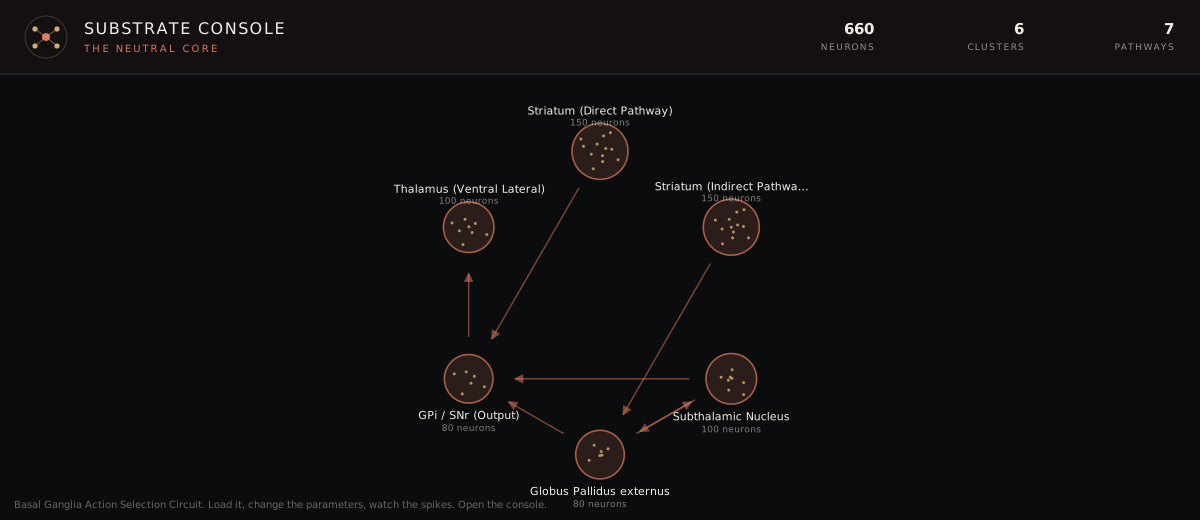
In tlcdv/the_consciousness_ai, Layer 1 of the Neutral Core runs Leaky Integrate-and-Fire (LIF) spiking dynamics alongside circle-topology (D = 2) AKOrN oscillatory binding, while models/thermodynamic/ provides an isolated NIR (Neuromorphic Intermediate Representation) export path for spiking layers. You can inspect Layer 1’s software LIF dynamics directly in the browser console below (noting strictly that the Substrate Console runs software LIF equations in JavaScript rather than BrainScaleS-2 analog circuits).
For researchers comparing event-driven spiking against probabilistic p-bit sampling, our open Python package tlcdv/thermospike (v0.1.0, DOI 10.5281/zenodo.23959919) implements both refractory stochastic spiking neurons and sequential p-bit Gibbs samplers checked against exact Boltzmann distributions, measuring random bits, spikes, and synaptic events per effective sample. While BrainScaleS-2 deploys custom rack-scale Node-FPGAs, hobbyists and small labs prototyping FPGA-based stochastic or spiking circuits on a desk can consult our thermodynamic computing hardware guide and hardware kits page, alongside tlcdv/the-hardware, our open CERN-OHL-S v2 CadQuery repository for 3D-printable enclosures (currently shipping tang-nano-9k-case v0.1.1, fit-checked in CAD only and not yet physically printed, designed for the Sipeed Tang Nano 9K FPGA targeted by thermospike’s planned reference design).
Engineering Limits Ahead for Multi-Chip Analog Systems
Three practical hurdles remain as BrainScaleS-2 multi-chip racks scale up through EBRAINS. First, device-to-device transistor mismatch across analog silicon requires per-chip calibration routines that grow more demanding across multi-backplane racks. Second, while 1,000x acceleration is ideal for rapid evolutionary and plasticity sweeps, interfacing a 1,000x-accelerated network directly with real-time physical robotic sensors requires temporal buffering or slowed down-sampling. Third, scaling beyond thousands of neurons toward insect-scale (~140,000 neurons) or mammalian sub-network sizes will test whether star-topology FPGA aggregators maintain sub-microsecond latency under dense all-to-all burst traffic.
Sources
- Joscha Ilmberger and Johannes Schemmel. The BrainScaleS-2 Multi-Chip System: Interconnecting Continuous-Time Neuromorphic Compute Substrates. arXiv preprint
arXiv:2512.03781and NICE 2026 presentation. arXiv:2512.03781. - thermospike Public Repository (
tlcdv/thermospike). Stochastic spiking neurons and p-bit sampling (doi:10.5281/zenodo.23959919). - the-hardware Public Repository (
tlcdv/the-hardware). Open CadQuery 3D-printable enclosures under CERN-OHL-S v2 (tang-nano-9k-casev0.1.1, CAD-checked only). - The Consciousness AI Public Repository (
tlcdv/the_consciousness_ai). Neutral Core spiking architecture andmodels/thermodynamic/NIR export.
Researchers covered here
- Johannes SchemmelKirchhoff-Institute for Physics, Heidelberg University (EBRAINS)Chief architect of the BrainScaleS and BrainScaleS-2 accelerated mixed-signal neuromorphic hardware systems
- Joscha IlmbergerKirchhoff-Institute for Physics, Heidelberg University (EBRAINS)Multi-chip FPGA interconnect architectures and Aggregator routing for the BrainScaleS-2 neuromorphic system