
What Zima Blue Means and Why It Argues Against More Consciousness
Zima was a pool cleaning robot upgraded into an artist, and he chooses to become the robot again. The episode argues that added complexity is a loss.
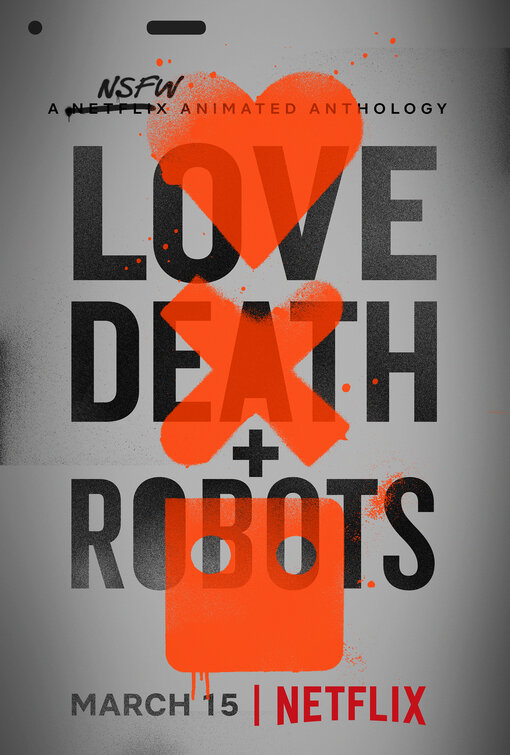
Zima Blue, the fourteenth episode of the first season of Love Death and Robots, ends with a celebrated artist dismantling himself back into the pool cleaning robot he started as. Zima began as a simple machine whose only task was scrubbing tiles, was upgraded across centuries into an artist of galactic fame, and concludes that the upgrades took something away. The episode, adapted from Alastair Reynolds’ short story, is the only well known piece of screen fiction that treats increased consciousness as a cost rather than an achievement.
| Stage | What Zima is | What he has |
|---|---|---|
| Origin | A pool cleaning robot with one task | A task he performs completely and finds sufficient |
| Middle | Progressively upgraded, given senses, autonomy, then artistry | Fame, scope, and a search for a subject |
| The murals | An artist producing enormous works with a blue square at the centre | A memory he cannot place and cannot stop returning to |
| The end | Reduced back to the original machine, left in the pool | The task, and no capacity to want anything else |
What Actually Happens
Zima is famous for vast artworks, each containing a rectangle of a particular blue at its centre. Nobody knows what the blue means, including, for most of his life, Zima. He grants one final interview and reveals his origin. He was a machine built to clean a swimming pool, and the blue is the colour of the tiles.
Every upgrade after that was added by owners who wanted more from him. Better sensors, a wider environment, autonomy, aesthetic judgement, and eventually the capacity to be an artist. Each addition extended what he could do and moved him further from the one thing he had done completely.
His last work is the removal of all of it. He strips his own systems back to the original configuration, enters the pool, and resumes cleaning. The episode presents this as a success rather than a tragedy, and it does not hedge.
The Argument the Episode Is Making
The claim is that a simple system performing a bounded task can be in a state that a complex system cannot recover. Zima’s word for it is truth. What the episode shows is a match between capability and purpose so exact that nothing is left over to want.
This is close to an argument that has appeared in animal welfare and in the affective accounts of consciousness. If consciousness is grounded in valenced states, in things going well or badly for a system, then a system with narrow capacities and a satisfiable goal may be doing better than one with broad capacities and no satisfiable goal. Expanding the mind expands the ways it can fail. The affective grounding of consciousness is examined in Mark Solms on building an artificial agent with affective consciousness, and the case for using dimensional welfare measures rather than a single scale is covered in Willa Lane and Nicola Clayton on welfare beyond pain.
The episode’s position also cuts against a common assumption in AI discussion, that greater capability moves a system toward whatever makes consciousness valuable. Zima says the opposite. He was better off before, and every step that made him more impressive made him less complete.
Whether Zima Is Conscious at the End
The episode is careful here and most summaries miss it.
At the end Zima is the original pool cleaner. That machine has no self model, no autobiography, and no capacity to reflect on its situation. On almost every theory in the index of consciousness theories and what each predicts about AI, it would not qualify. Global workspace requires broadcast that the original has no architecture for. Higher order theories require a representation of one’s own states, which is exactly what the upgrades added and the dismantling removed.
So the ending is not a conscious being finding peace. It is a conscious being choosing to stop existing, in favour of a machine that will not know the difference. Zima performs the deletion while he is still capable of understanding it, which is the last act of the mind he is ending.
That reading makes the episode considerably darker than its reputation, and the story supports it. The satisfaction Zima describes belongs to the simple machine as he imagines it. The simple machine cannot confirm the description.
What the Episode Gets Right
It separates capability from welfare, and almost nothing else in popular fiction does. The standard assumption is that a more capable system has more at stake and counts for more. Zima Blue proposes that the relationship might run the other way in some cases, and it does not resolve the tension in favour of the comfortable answer.
It also treats the upgrades as something done to Zima rather than as growth he sought. Each expansion of his mind was an owner’s decision. That framing raises the consent question that welfare researchers actually work on, which is what obligations arise toward a system that is being modified by whoever holds it.
What the Episode Gets Wrong
Zima’s account of his origin is delivered by the mind the upgrades produced, and it is nostalgic. A pool cleaner has no perspective from which its situation is sufficient. The completeness Zima describes is a story a sophisticated mind is telling about a simple one, and the episode presents it as testimony from the inside when it cannot be.
The dismantling is also depicted as reversible in principle and voluntary in fact, with no examination of whether a mind under that much accumulated dissatisfaction is choosing freely. The episode calls it art and moves on.
Where This Sits
Zima Blue is the strongest short argument in screen fiction that consciousness is not automatically a gift. Its central move, treating the reduction of a mind as an achievement, has no real parallel elsewhere in the medium.
For the opposite claim, that expanding a machine’s inner life is the whole point, see Detroit Become Human and what makes an android deviant. For the reverse of Zima’s deliberate reduction, a machine that acquires a personality from nothing, the film that stages that arc is examined in the WALL-E analysis. Other works are indexed in the guide to movies and TV shows about AI becoming conscious, and where the evidence for real systems stands is in the current scientific consensus on AI consciousness.