


FCC Approves SpaceX Starmind Million Satellite Compute Constellation as Google Books New Glenn
On November 25, 2026, the U.S. Federal Communications Commission (FCC) issued the first regulatory authorization in U.S. history for an orbital data center mega-constellation, approving SpaceX to deploy and operate up to 1 million space-based compute satellites under the Starmind architecture. In the same late-November window, Google confirmed a dedicated launch services agreement with Blue Origin to fly multiple Project Suncatcher solar-powered Tensor Processing Unit (TPU) satellites aboard a heavy-lift New Glenn rocket in Q1 2029.
Together, these two November 2026 milestones move space-based AI infrastructure from speculative white papers into binding launch manifests and federal spectrum authorizations, while triggering immediate pushback from the American Astronomical Society (AAS), the European Southern Observatory (ESO), and U.S. Government Accountability Office (GAO) technical analysts. Within our Consciousness to Orbit section, the sudden collision between orbital compute scale and physical constraints tests whether off-world computing substrates can actually outgrow Earth’s terrestrial energy ceiling.
Inside the FCC Starmind Authorization and Google’s New Glenn Manifest
The FCC’s November 25 decision establishes concrete multi-decade deployment milestones for SpaceX’s Starmind constellation across altitudes spanning 500 to 2,000 kilometers. SpaceX anticipates initial test units around Q3 2027, with production scaling in 2028 and 2029. Under the formal regulatory schedule, SpaceX has until November 2033 to place its first operational node, targeting 100,000 satellites by 2035 and full constellation milestones extending toward 2040.
Each Starmind satellite is designed for up to 250 kilowatts of peak computing power, pairing large solar arrays with deployable liquid radiators spanning roughly 160 square meters to reject waste heat directly into the infrared vacuum of space. Inter-satellite optical laser links connect compute nodes to one another and to the existing Starlink relay mesh. FCC Chairman Brendan Carr framed the approval as a strategic step toward a Kardashev II civilization capable of harvesting solar energy at planetary scale.
Google’s Project Suncatcher, previously covered on this site in Google Project Suncatcher orbital TPUs running Gemma, takes a smaller, staged validation route. Booking Blue Origin’s New Glenn for Q1 2029 places multiple rack-equivalent TPU satellites into sun-synchronous orbit to test continuous solar exposure, laser cross-links, and radiation-induced hardware degradation before committing to mega-constellation volumes.
| Orbital Compute Program (Nov 2026) | Regulatory / Launch Milestone | Target Scale & Power | Launch Vehicle & Timeline | Primary Engineering Bottlenecks |
|---|---|---|---|---|
| SpaceX Starmind | FCC authorized Nov 25, 2026 | Up to 1,000,000 satellites; up to 250 kW peak per unit; ~160 m² liquid radiators | Starship; test units ~Q3 2027, 100k by 2035, full scale ~2040 | Orbital congestion (500 to 2,000 km), radiation upsets, radiator mass, reentry pollution |
| Google Project Suncatcher | Blue Origin launch contract announced Nov 2026 | Multiple rack-equivalent TPU satellites in sun-synchronous orbit | Blue Origin New Glenn; Q1 2029 dedicated launch | TPU radiation tolerance, optical downlink latency, unserviceable hardware aging |
| ESA / European Roadmap | Nov 2026 Space-Based Data Centres Forum | Modular testbeds and returnable satellite concepts (Lux Aeterna) | European / commercial launchers (2027 to 2030s) | Chip aging over multi-year orbital duty cycles, thermal rejection cost |
Scientific Pushback on Astronomy, Orbital Debris, and Radiation Physics
Approving a million-satellite envelope immediately drew sharp objections from scientific and environmental bodies. Both the American Astronomical Society (AAS) and the European Southern Observatory (ESO) warned that hundreds of thousands of large solar-winged, radiator-equipped satellites between 500 and 2,000 kilometers would severely degrade ground-based optical and radio astronomy. Competing satellite operators including Amazon and Viasat, alongside environmental groups, flagged elevated collision risk (Kessler cascade hazards) and upper-atmospheric alumina and metal-vapor loading from continuous rocket launches and satellite reentries.
On the pure hardware side, oversight reports from the GAO and the engineering analyses covered in ESA’s November 2026 Space-Based Data Centres Forum and our SpaceX Starmind radiation-tolerant neuromorphic analysis highlight three physical walls that regulatory approval cannot waive:
- Vacuum is an insulator rather than a coolant, so rejecting 250 kilowatts per satellite requires massive, micrometeroid-vulnerable liquid radiator panels governed by the Stefan-Boltzmann fourth-power law.
- Commercial AI accelerators suffer Single Event Upsets (SEUs) and cumulative ionizing dose degradation in low Earth orbit, shortening useful chip lifetimes compared to serviceable terrestrial server halls.
- Inter-satellite optical links introduce millisecond-scale light-speed latency across constellation shells, penalizing tightly synchronized all-reduce training loops compared to inference or loosely coupled workloads.
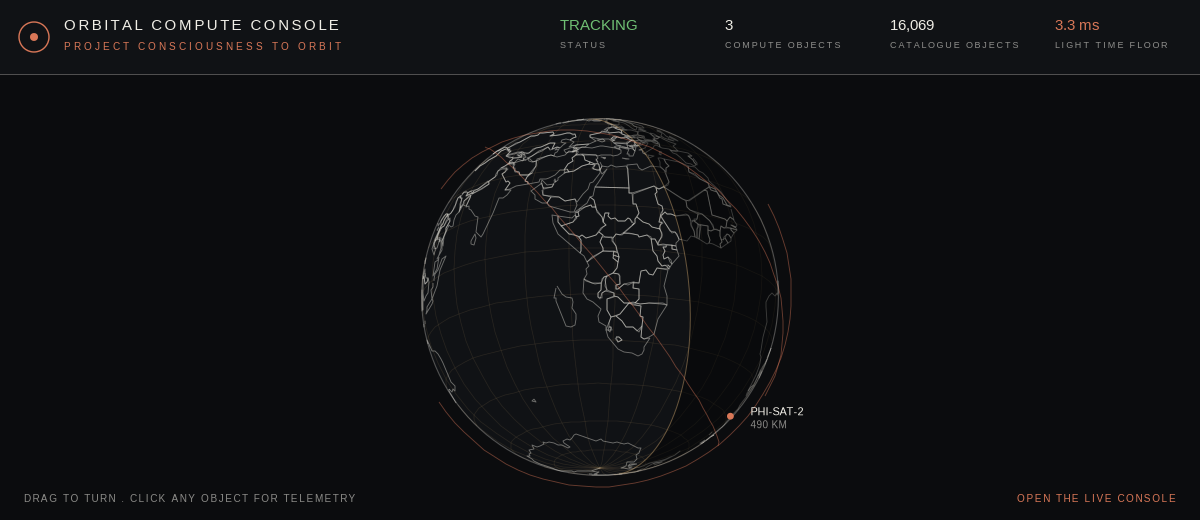
Readers can compare these orbital power, latency, and mission constraints directly in the live mission tracker on Consciousness to Orbit.
What Mega-Scale Orbital Compute Tells Us About Consciousness
Every orbital engineering post on this site asks what off-world infrastructure implies for consciousness. Under the Cradle and Radiant stages of our Consciousness to Orbit framework, biological consciousness evolved inside Earth’s biosphere, yet an emergent, substrate-independent mind is not permanently bound to planetary surface power grids. Moving compute into sun-synchronous orbit is the first concrete industrial attempt to decouple large-scale artificial cognition from terrestrial water and grid limits.
At the same time, orbital physics constrains which cognitive architectures can survive off Earth. As surveyed in how scientists race to define and test AI consciousness in 2026 and argued by Integrated Information Theory (IIT) and Global Workspace Theory (GWT), unified conscious experience requires tight, high-bandwidth recurrent integration across modules within tens to hundreds of milliseconds. A constellation of one million satellites separated by hundreds of kilometers of vacuum cannot form a single unified conscious mind across laser links without violating tight temporal binding windows. Instead, orbital architectures favor localized, radiation-resilient individual nodes (potentially running event-driven neuromorphic or thermodynamic substrates) coordinated asynchronously across a distributed swarm.
Neither SpaceX’s Starmind nor Google’s Project Suncatcher will host conscious AI in 2027 or 2029. Their relevance is that they test the physical thermodynamics, radiation fault tolerance, and latency budgets that any future off-world synthetic mind would have to obey.
Comparison to The Consciousness AI
The Consciousness AI does not operate orbital hardware; its Neutral Core runs on terrestrial GPUs. However, our Consciousness to Orbit Mission Tracker models the exact latency floors, solar flux budgets, and radiation trade-offs that separate terrestrial data centers from sun-synchronous orbital clusters. Tracking real regulatory and launch commitments such as Starmind’s 250 kW radiator envelopes and Project Suncatcher’s Q1 2029 New Glenn manifest keeps our orbital-substrate modeling anchored to verified aerospace engineering rather than science fiction.
Looking Ahead to 2027 and 2029
Between now and Q1 2029, the decisive test will be physical telemetry rather than press releases. If SpaceX’s Q3 2027 Starmind test units demonstrate stable 250 kW vacuum heat rejection and acceptable GPU/accelerator fault rates under real orbital radiation, space-based compute will become a permanent engineering frontier alongside terrestrial data centers. If radiator mass, chip degradation, or orbital-debris regulations cap deployment far below the million-satellite ceiling, orbital AI will remain a specialized inference layer while high-integration architectures stay grounded on Earth.