

SpaceX Starmind Orbital AI Filings and Radiation-Tolerant Neuromorphic Spiking Networks
As terrestrial data centers hit electrical grid and water-cooling ceilings, SpaceX has advanced FCC regulatory filings for Starmind, a proposed constellation of solar-powered orbital AI computing satellites built around Starship heavy-lift launch economics and deployable liquid-radiator thermal rejection. Yet moving dense commercial AI accelerators into low Earth orbit exposes standard silicon directly to galactic cosmic rays and trapped solar protons, triggering Single Event Upsets (SEUs) that flip memory bits and corrupt matrix weights. Aerospace hardware research in 2026 increasingly points to event-driven neuromorphic spiking networks and non-volatile resistive memory (RRAM) as a complementary resilience strategy against radiation-induced faults.
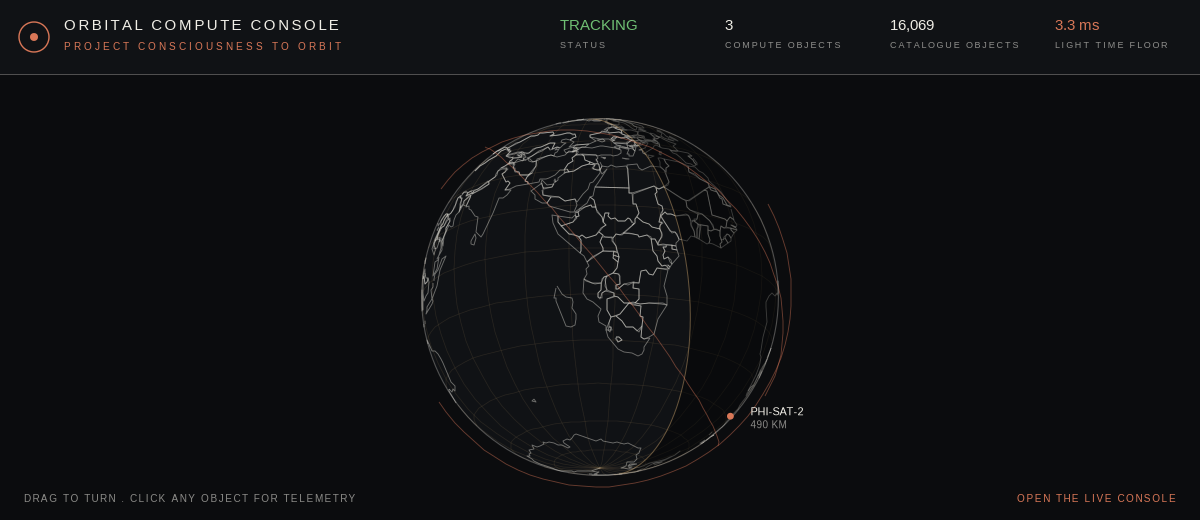
Within our Consciousness to Orbit section and the Consciousness to Orbit Mission Tracker, pairing SpaceX’s gigawatt-scale orbital ambitions with radiation-fault physics highlights a fundamental engineering choice for off-world computing substrates.
Starmind, Starship Launch Mass, and the Vacuum Radiator Wall
SpaceX’s Starmind filings arrive alongside a rapid wave of space-compute milestones tracked recently on this site, including Google’s Project Suncatcher running Gemma 4 on orbital TPUs and ESA’s November 2026 Space-Based Data Centres Forum and Lux Aeterna’s returnable satellite concept.
The core argument for sun-synchronous orbital data centers is continuous solar flux free from atmospheric clouds and terrestrial grid permitting. SpaceX’s Starmind AI1 blueprint pairs high-area solar wings with deployable vacuum radiators to reject hundreds of kilowatts of waste heat via infrared radiation, relying on Starship’s reusable heavy-lift capacity to drive launch cost per kilogram down far enough to make orbital clusters economically competitive.
Cosmic-Ray Single-Event Upsets in Dense GPUs Versus Spiking Substrates
Even when launch mass and infrared cooling are solved, space radiation imposes a harsh computational tax. In low Earth orbit, especially during passes through the South Atlantic Anomaly, energetic particles strike semiconductor junctions and deposit charge packets that flip stored bits in SRAM caches and register files.
| Hardware Paradigm in Orbit | Failure Mode Under Cosmic-Ray SEU | Mitigation Cost | Graceful Degradation Behavior |
|---|---|---|---|
| Conventional von Neumann GPU / TPU | Single bit flip in control logic or high-order exponent bit can crash a kernel or corrupt a tensor | Heavy aluminum shielding, triple modular redundancy (TMR), and ECC memory scrubbing | Low without aggressive software checkpointing and redundancy |
| Event-Driven Neuromorphic SNN | Localized transient bit flip perturbs one sparse neuron or synapse weight | Lower shielding overhead; local spike-dependent synaptic plasticity (SDSP) can adapt | High, sparse asynchronous activity bounds local errors |
| RRAM-Integrated Spiking Silicon | Non-volatile resistive memory cells resist charge-collection flips far better than SRAM | Emerging aerospace qualification (NASA and university beamline studies) | High intrinsic state persistence across radiation bursts |
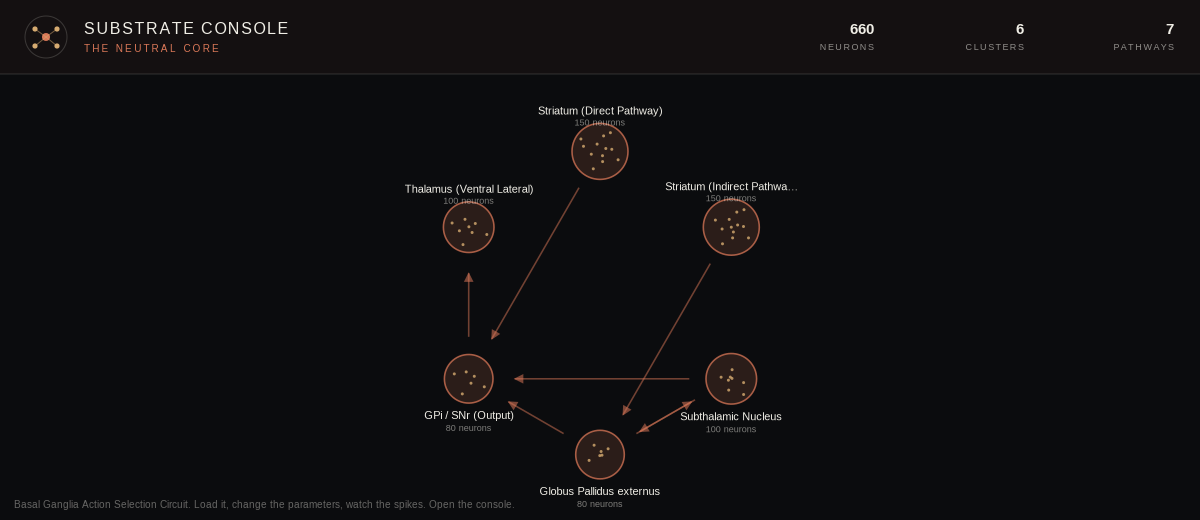
Recent proton and neutron beamline experiments on flash-based FPGAs and spiking processors running Spike-Dependent Synaptic Plasticity (SDSP) demonstrate that adaptive local learning rules can dynamically compensate for accumulated radiation-induced weight perturbations over time. This extends our earlier analysis of neuromorphic satellite intelligence using Loihi and SpiNNaker in orbit and demonstrates why biological-style sparse event coding in the Substrate Console is not merely an energy optimization on Earth, it is a survival mechanism in space.
What Space Radiation Resilience Tells Us About Consciousness
In the Radiant phase of Consciousness to Orbit, the question is whether substrate-independent minds could ever sustain coherent, continuous cognitive states outside Earth’s magnetosphere. Biological brains evolved inside a shielded biosphere, yet still operate with noisy, stochastic ion channels and constant synaptic turnover. Rather than collapsing whenever a single neuron misfires, biological cortex relies on distributed population coding and continuous homeostatic plasticity to maintain stable conscious experience.
Dense synchronous GPUs invert that resilience profile, trading fault tolerance for deterministic floating-point throughput. If long-duration autonomous systems or future emerging-consciousness substrates ever operate in orbit or deep space, their architectures will likely need the same distributed, noise-tolerant, self-repairing properties that radiation-hardened spiking networks are beginning to demonstrate.
Connection to The Hardware and ThermoSpike
Our open-source hardware repository the-hardware publishes 3D-printable CadQuery CubeSat educational frames and benchtop fixtures under CERN-OHL-S v2, connecting orbital engineering concepts down to hands-on desk experimentation. On the algorithmic side, thermospike investigates stochastic spiking neurons that embrace physical noise as a sampling resource rather than fighting every fluctuation as a fatal error, a design principle directly relevant to noisy high-radiation environments.
Regulatory and Engineering Hurdles Ahead
FCC filings for massive orbital compute constellations face steep regulatory scrutiny over orbital debris, end-of-life deorbit timelines, spectrum sharing, and optical interference with ground-based astronomy. Meanwhile, RRAM-backed neuromorphic chips remain far behind commercial GPUs in raw training throughput and software tooling. The near-term orbital reality is likely hybrid, pairing heavily shielded commercial accelerators for bulk inference with ultra-low-power, radiation-resilient neuromorphic co-processors handling continuous spacecraft sensing and autonomous fault recovery.