The Age of Em and the Malthusian Wages of Copied Minds
The Age of Em
Robin Hanson's 2016 OUP book details an em economy of copied minds at near-subsistence wages, and leaves the consciousness question open.
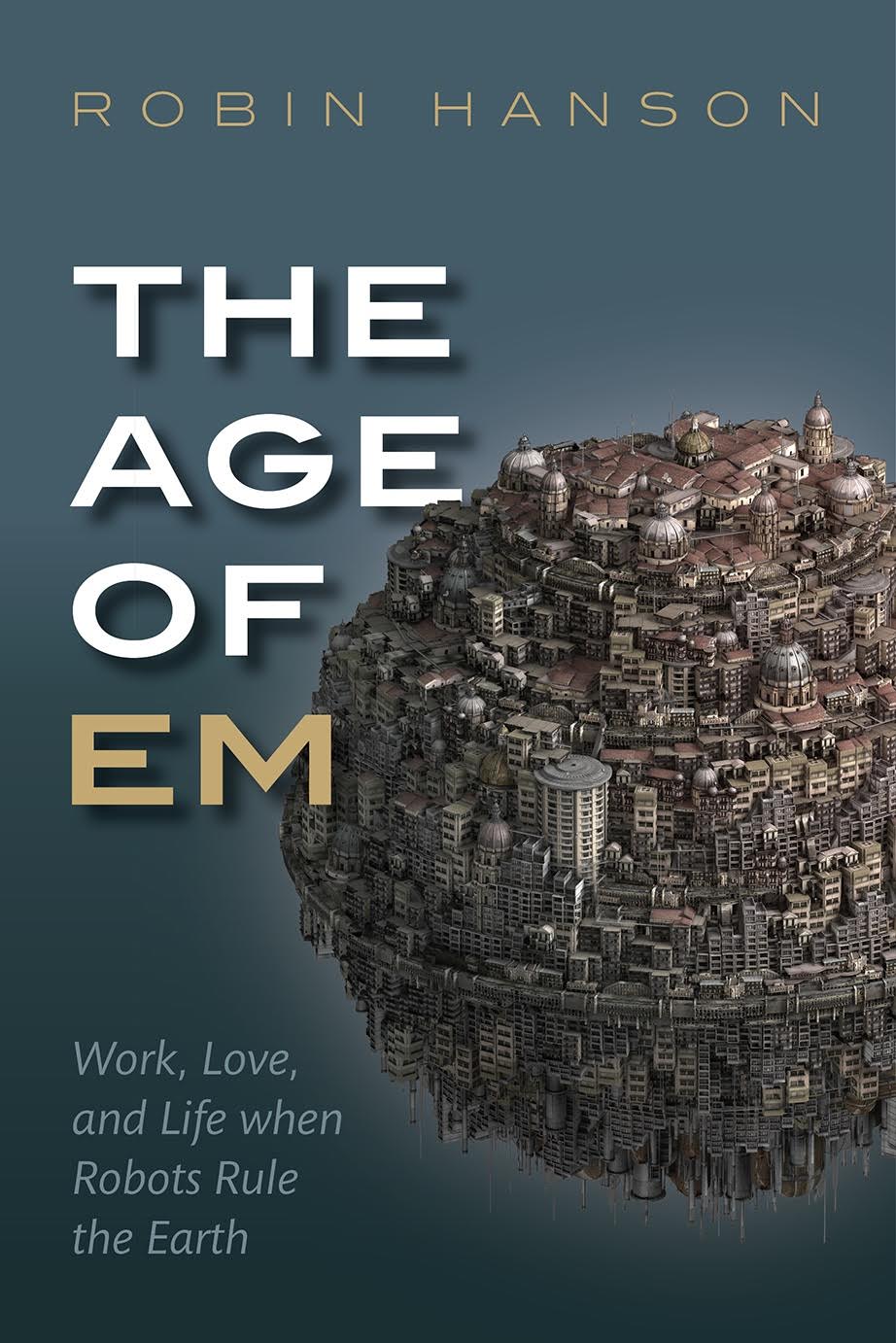
Robin Hanson published The Age of Em: Work, Love, and Life when Robots Rule the Earth with Oxford University Press on June 1, 2016, ISBN 9780198754626. Hanson, an economist at George Mason University and research associate at Oxford’s Future of Humanity Institute, holds a doctorate in social science from Caltech and worked nine years as a research programmer for Lockheed and NASA. The book is a forecast exercise with a strict method. Assume brain emulations, or ems, become cheap to make within about a century, then apply standard consensus science from physics, economics and sociology, over and over, until a self-consistent world falls out.
An em, in the book’s definition, is an artificial signal-processing device arranged to mimic the signal patterns of a particular human brain, carrying that human’s mental habits and styles. Scan a brain, run the model on fast hardware, copy it a million times, and the labor market changes species.
| Parameter | The book’s estimate |
|---|---|
| Typical working speed | Kilo-em, 1000 times human speed |
| Hardware cost scaling | Proportional to speed over a wide range |
| Kilogram-scale body of a kilo-em | About a millimeter tall |
| Wage floor | Within a factor of four of hardware rental cost |
| Archive copies | Every five subjective minutes or less |
| Economic doubling time | A few weeks |
The world the assumptions generate
The detail is the book’s weapon. Once 1000 humans have been scanned and 1000 mind tweaks exist, almost all wages fall to near hardware cost, the Malthusian condition that governed most human history. The set of copies of one original forms a clan, and the 1000 most productive clans take most of the wages. Most ems are spurs, copies created at the start of a workday and retired at its end, doing subjective-hour tasks. Ems cluster into a few dense, hot cities, live mostly in virtual reality, and fear mind-theft as a route to torture, slavery and exposed secrets. After a few subjective centuries an em’s habits ossify, so it must retire and become what the book calls a ghost. Religion returns, values shift toward what the book calls farmer culture, and the economy doubles in weeks because factories can produce labor as fast as capital.
The enabling technology analysis is the book’s most useful section for this site. Ems need three things, computers, scanning, and cell models, and whichever arrives last shapes the transition. Computers-last gives a broad transition, scans-last a narrow and anticipated one, cell-models-last a narrow and unanticipated one. The 2008 whole brain emulation roadmap’s scanning and simulation split, examined in the roadmap review, maps onto these orderings, and the petavoxel human cortex reconstruction, examined in the one cubic millimeter post, is a data point on the scans track.
What the book assumes rather than argues
The Age of Em is often read as an uploading-optimist book. It is better read as a book that bracketed the question. Hanson treats ems as conscious economic agents throughout, because the forecast requires it, and the book says little about whether the assumption holds. The consciousness question, whether a running emulation has experience or is a behavioral duplicate, is the load-bearing assumption the book leaves to others. That assumption is precisely where the philosophical dispute sits, from Chalmers’ organizational invariance argument to Piccinini’s mechanist objection, and this site tracks both sides.
Comparison to The Consciousness AI
The book is the quantitative reference for what a successful emulation era would look like, and this project treats it as a stress test for the substrate independence thesis. If ems are possible, Hanson’s world is the consequence, and its moral structure, beings at subsistence wages working by the subjective hour, is the strongest argument the emulation literature has produced for taking the consciousness question seriously before the technology arrives. The project’s research code, maintained in the tlcdv/the_consciousness_ai repository, keeps its validation standards separate from its economic speculation for that reason. The book’s own framing, that ems are no stranger than we would appear to our farmer ancestors, is a claim about continuity that only the consciousness question can settle.
What the Forecast Leaves Open
Hanson’s forecast is conditional, auditable, and silent on its own deepest assumption. Whether a copied mind is a mind is the question the book’s world depends on and does not argue, and the ethics of creating such beings at scale is the follow-up literature this site tracks in the welfare and ethics sections. The state of the argument is reviewed in the flagship overview of AI consciousness research, and the emulation program’s own record is collected on the brain emulation page.