


Herbert Fröhlich Coherent Excitations in Biological Systems and Long-Range Order
Coherent Excitations in Biological Systems
Herbert Fröhlich's Coherent Excitations in Biological Systems proposed that metabolically driven cell membranes can sustain coherent dipolar oscillations, bridging bioelectricity and quantum theories of mind.
Buy on amazon.com As an Amazon Associate I earn from qualifying purchases.
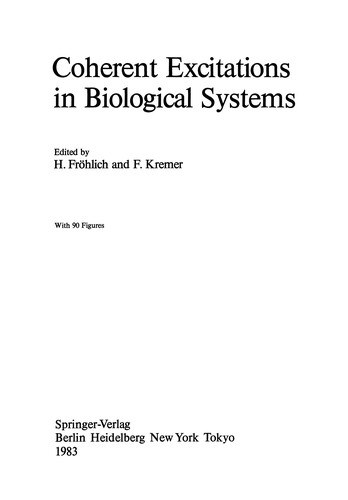
How can a warm, wet biological cell maintain long-range electrical order without thermal noise scrambling every weak signal? In Coherent Excitations in Biological Systems (edited with F. Kremer, Springer-Verlag, 1983, ISBN 3642691889, followed by his 1988 Springer companion volume Biological Coherence and Response to External Stimuli), theoretical physicist Herbert Fröhlich brought together physicists and biologists to test a bold physical hypothesis. When metabolic energy is pumped above a critical rate into strongly polarized biological structures such as cell membranes, that energy may channel into a single lowest-frequency collective oscillation, now known as a Fröhlich condensate.
Indexed in our Bioelectricity hub and AI Consciousness Books guide, Fröhlich’s Springer volume forms the physical bridge between the forgotten century of bioelectricity, non-thermal bioelectromagnetics, and the quantum biology debate inside modern consciousness science.
The Fröhlich Condensation Mechanism in Living Membranes
Cell membranes maintain intense electric fields of roughly 10^7 volts per meter across a thickness of only a few nanometers. Fröhlich recognized that dipolar macromolecules embedded in such fields behave as strongly coupled oscillators bathed in metabolic energy.
| Physical Regime | Energy Distribution | Signal Sensitivity | Experimental Status in Living Cells |
|---|---|---|---|
| Thermal Equilibrium (Classical) | Energy spreads randomly across all vibrational modes (equipartition) | Weak electromagnetic fields drown in kT thermal noise |
Baseline thermodynamics for passive matter |
| Non-Equilibrium Fröhlich Condensation | Metabolic pumping above threshold concentrates energy into one coherent mode | Long-range frequency-selective resonance becomes physically possible | Demonstrated in simplified models and protein terahertz spectroscopy; room-temperature in vivo coherence remains actively debated |
| Classical Somatic Bioelectricity | Ion pumps and channels maintain steady resting V_mem gradients across gap junctions |
Millivolt tissue domains persist for hours against noise | Extensively replicated across planaria, frogs, chicks, and mammalian tissues |
Coherent Excitations in Biological Systems gathers experimental reports from the early 1980s alongside Fröhlich’s theoretical derivations, including Werner Grundler and Fritz Keilmann’s millimeter-wave resonant yeast growth experiments, Herbert Pohl’s measurements of natural AC electric fields around dividing cells, and W. Ross Adey’s work on frequency-windowed membrane responses.
Bridging Bioelectricity and Quantum Theories of Consciousness
Fröhlich’s work occupies an unusual dual position in the literature. On one side, it became a central theoretical reference for twentieth-century bioelectromagnetics and biophoton researchers, directly influencing Mae-Wan Ho and Fritz-Albert Popp’s Bioelectrodynamics and Biocommunication and Robert O. Becker and Andrew A. Marino’s Electromagnetism and Life.
On the other side, Fröhlich’s mechanism was adopted directly by quantum consciousness theorists. Stuart Hameroff and Roger Penrose cited Fröhlich’s coherent dipolar excitations as a candidate physical mechanism for sustaining synchronized vibrations inside neuronal microtubules under Orchestrated Objective Reduction (Orch-OR). Whenever researchers argue whether warm biological tissues can sustain non-classical coherence long enough to influence neural computation, Fröhlich’s 1983 and 1988 Springer volumes sit at the root of the argument.
What Coherent Excitations in Biological Systems Tells Us About Consciousness
Fröhlich himself remained a disciplined theoretical physicist who never claimed that coherent excitations automatically produce subjective awareness. His contribution to consciousness science is an empirical test case for the biological-substrate hypothesis.
If waking consciousness or biological intelligence depended specifically on Fröhlich-style dipolar condensates inside wet protein lattices, then purely digital silicon architectures lacking those physical resonances would struggle to replicate the same dynamics. Conversely, if biological cognition relies primarily on classical ion-channel networks, slow resting potentials (V_mem), and recurrent synaptic integration, as modeled in mainstream developmental bioelectricity and computational neuroscience, then functionalist substrate independence remains wide open. Evaluating Fröhlich’s hypothesis rigorously clarifies exactly which physical claims separate quantum biological naturalism from classical functionalism.
Comparison to The Consciousness AI and bioelectrics
The Consciousness AI investigates consciousness as an emergent property across classical spiking substrates, thermodynamic lattices, and somatic bioelectric networks. Our open-source Python library bioelectrics (pip install bioelectrics, MIT licence, Zenodo DOI 10.5281/zenodo.23531183) models classical ion-level electrodiffusion (Na+, K+, Cl-, Ca2+), ion pumps, and voltage-gated gap junctions.
Strict facts discipline is essential here. bioelectrics does not simulate Fröhlich condensates, terahertz protein dipole oscillations, or quantum coherence. It tests how much collective memory and spatial error correction classical somatic electrophysiology already achieves without invoking quantum condensation. Readers interested in the classical somatic side can explore our Bioelectricity hub and Theories of Consciousness index.
Strengths and Limits of Coherent Excitations in Biological Systems
The book’s enduring strength is its intellectual honesty as a physics-driven investigation of far-from-equilibrium biology, asking concrete mathematical questions about nonlinear energy transfer in living membranes. Its main limitation is empirical durability. Several of the millimeter-wave biological window experiments reported in the 1980s proved difficult to replicate consistently across independent laboratories, and decades later, unambiguous proof of full room-temperature Fröhlich condensation driving physiological function inside intact living cells has still not reached scientific consensus. As a historical milestone linking biophysics, bioelectricity, and quantum mind proposals, however, Fröhlich’s volume remains essential reading. Support our open research tools through the Bioelectricity apparel collection below.
Bioelectricity
Planaria, axolotls and the voltage patterns that tell cells what to build. Every order funds the research.
-
 Planaria - Bioelectricity T-Shirt
From $23.99
-
 Planaria - Bioelectricity T-shirt | Small Chest Logo
From $23.99
-
 Axolotl - Bioelectricity T-Shirt
From $24.99
-
 Axolotl - Bioelectricity T-shirt | Small Chest Logo
From $23.99
-
 Cognition - Bioelectricity T-Shirt
From $23.99
-
 Cognition Bioelectricity T-shirt | Small Chest Logo
From $23.99