


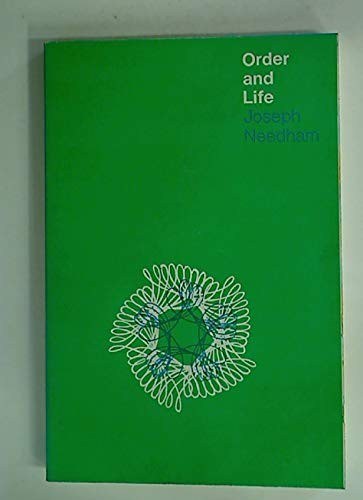
Joseph Needham Order and Life and Hierarchical Biological Emergence
Order and Life
Joseph Needham's Order and Life rejected both vitalism and flat reductionism, framing embryonic morphogenesis around nested organizational levels and morphogenetic fields.
Buy on amazon.com As an Amazon Associate I earn from qualifying purchases.
Before he became famous as a historian of Chinese science, Cambridge biochemist Joseph Needham delivered the 1934 to 1935 Terry Lectures at Yale University, published as Order and Life (Yale University Press, 1936, MIT Press paperback ISBN 0262640015). His central question was one of the hardest puzzles in twentieth-century biology. How does a fertilized egg organize itself into a symmetrical, functioning animal without either invoking a non-physical vital force or reducing life to an unorganized bag of colliding molecules?
Indexed in our Bioelectricity hub and AI Consciousness Books guide, Order and Life supplies the philosophical and conceptual architecture behind the forgotten century of bioelectricity and links classical embryology directly to contemporary debates over causal emergence and how scientists define consciousness across substrates.
Nested Levels of Organization and Morphogenetic Fields
Needham built Order and Life around a rigorous middle path called organicism. Every living organism is composed of ordinary physical atoms, yet its behavior depends on how those components are arranged into nested organizational levels, from macromolecules and liquid crystals up to organelles, cells, tissues, and whole embryos.
| Level of Biological Order | Primary Physical Mechanism | What Changes at This Level | Modern Counterpart in Consciousness and Bioelectricity |
|---|---|---|---|
| Molecular and Paracrystalline | Chemical bonds, protein folding, liquid-crystalline alignment | Anisotropic structure and directional transport inside cytoplasm | Cytoskeletal networks and ion-channel gating conformations |
| Cellular and Membrane | Transmembrane gradients, selective permeability, cell polarity | Individual cells establish internal coordinates and excitability | Resting membrane potential (V_mem) and single-cell excitability |
| Tissue and Morphogenetic Field | Long-range organizer gradients and collective coupling | Groups of cells regulate whole-organ proportions despite perturbation | Voltage-gated gap junctions, bioelectric prepatterns, and pattern memory |
| Organism-Scale Architecture | Integrated nervous, endocrine, and somatic feedback loops | Coherent agency, behavioral navigation, and survival | Multiscale causal emergence and the cognitive light cone |
Drawing on Hans Spemann’s organizer experiments and Paul Weiss’s concept of the morphogenetic field, Needham argued that field laws in embryology are mathematically real scientific descriptions rather than mystical metaphors. Just as physics uses field equations to describe electromagnetic or gravitational order across space, embryology needs field descriptions to capture how a split embryo still regulates into two complete, proportionally scaled organisms.
From Needham’s Organicism to Causal Emergence and Bioelectricity
Needham’s insistence on multi-scale organization connects directly to two major research programmes covered on this site. First, in developmental bioelectricity, Michael Levin’s cognitive light cone framework formalizes Needham’s nested levels as overlapping cognitive selves, where cells pursue local metabolic goals while coupled tissues pursue large-scale anatomical targets. Paired with D’Arcy Wentworth Thompson’s On Growth and Form and E. J. Lund’s Bioelectric Fields and Growth, Needham’s book completes the early twentieth-century triad that framed biology around physical fields and organizational hierarchy.
Second, Needham’s argument that higher organizational levels can carry genuine explanatory power anticipates modern mathematical work on causal emergence. In Erik Hoel’s Causal Emergence 2.0 and Federico Pigozzi and Michael Levin’s 2026 study on causal emergence and alignment, macro-scale states are shown to have greater effective causal power than micro-scale descriptions when micro-level noise averages out into stable macro-level attractors.
What Order and Life Tells Us About Consciousness
Needham did not propose a theory of phenomenal consciousness in Order and Life, yet his anti-reductionist method cuts directly through a central deadlock in consciousness science.
Pure micro-reductionism struggles to explain how subjective experience or unified agency arises from trillions of molecular collisions, while dualism or vitalism abandons physical explanation altogether. Needham’s hierarchical organicism shows how novel causal properties emerge strictly from physical organization across scales. That premise sits at the foundation of functionalist emergentism, the view that consciousness is an emergent property of specific multi-scale causal organization rather than a mysterious non-physical substance or an exclusive privilege of one carbon chemistry.
Comparison to The Consciousness AI and bioelectrics
Needham’s observation that macro-scale tissue fields stabilize global anatomy despite micro-scale turnover is captured computationally in our open-source PyTorch library bioelectrics (pip install bioelectrics, MIT licence, Zenodo DOI 10.5281/zenodo.23531183). By solving ion-level fluxes at the single-cell scale while extracting steady-state attractors and basins of stability at the multi-cell tissue scale, bioelectrics bridges micro-level electrodiffusion to macro-level pattern memory in executable code.
Keeping strict facts discipline, bioelectrics simulates somatic ionic electrophysiology rather than the chemical organizer molecules or liquid-crystalline biochemistry Needham examined in 1936. What links them is the shared commitment to modeling hierarchical biological order quantitatively across scales.
Strengths and Limits of Order and Life
Order and Life remains remarkably clear and philosophically disciplined almost a century after its Yale lectures, avoiding both vitalist speculation and crude molecular determinism. Its main limitation is its era. Written seventeen years before the double-helix structure of DNA and decades before molecular genetics and voltage imaging, Needham could only speculate about the physical carriers of organizer fields. Read alongside twenty-first-century bioelectricity and causal emergence, however, his book reads like an early blueprint for multi-scale systems biology. Every order from our Bioelectricity apparel collection below helps fund our open research.
Bioelectricity
Planaria, axolotls and the voltage patterns that tell cells what to build. Every order funds the research.
-
 Planaria - Bioelectricity T-Shirt
From $23.99
-
 Planaria - Bioelectricity T-shirt | Small Chest Logo
From $23.99
-
 Axolotl - Bioelectricity T-Shirt
From $24.99
-
 Axolotl - Bioelectricity T-shirt | Small Chest Logo
From $23.99
-
 Cognition - Bioelectricity T-Shirt
From $23.99
-
 Cognition Bioelectricity T-shirt | Small Chest Logo
From $23.99