


Robert O. Becker and Andrew A. Marino Electromagnetism and Life and the Analog Control System
Electromagnetism and Life
Robert O. Becker and Andrew A. Marino's Electromagnetism and Life documents direct-current injury potentials, limb regeneration, and a primitive analog electrical control network.
Buy on amazon.com As an Amazon Associate I earn from qualifying purchases.
Before modern developmental bioelectricity mapped resting voltage gradients with fluorescent dyes, orthopedic surgeon Robert O. Becker and biophysicist Andrew A. Marino asked why a salamander can regrow an entire amputated limb while a mammal heals the same wound with scar tissue. In Electromagnetism and Life (State University of New York Press, 1982, ISBN 0873955609, paperback reprint ISBN 0981854907), they synthesized two decades of laboratory measurements showing that steady direct-current (DC) electric potentials travel along peripheral nerves, reverse polarity at regenerating stumps, and form a primitive analog control system operating beneath fast neuronal spikes.
Featured in our Bioelectricity hub and AI Consciousness Books guide, Electromagnetism and Life is the technical monograph behind Becker’s later popular book The Body Electric. It connects clinical electrophysiology directly to the forgotten century of bioelectricity and to current debates in consciousness science.
The Dual-Layer Electrical Model of Living Organisms
Standard neuroscience treats the nervous system as a fast digital-like network of all-or-none action potentials propagating along axons. Becker and Marino argued that evolution built that fast impulse system on top of an older, slower, continuous electrical signaling network carried by perineural glial and Schwann cells.
| Signaling Layer | Speed and Signal Type | Proposed Anatomical Carrier | Primary Biological Function |
|---|---|---|---|
| Fast Impulse System (Classical) | Milliseconds, all-or-none action potentials | Neuronal axons and chemical synapses | Rapid sensory processing, motor control, and behavioral response |
| Primitive Analog DC System (Becker and Marino) | Seconds to days, continuous direct-current potentials | Perineural glial cells and tissue junctions | Injury detection, limb regeneration polarity, fracture healing, and baseline arousal |
In salamanders, Becker measured a sharp positive current of injury immediately after amputation, followed by a reversal to a negative potential as the blastema formed and regenerated a new limb. In non-regenerating frogs, the negative reversal failed to appear. When Becker and colleagues (including Joseph Spadaro and Stephen Smith) applied tiny microampere direct currents to amputated rat limbs (published in Nature, 1972) and frog stumps, they induced partial multi-tissue regeneration and cellular dedifferentiation.
From Stump Currents to Modern Bioelectric Pattern Memory
Becker and Marino’s clinical and animal measurements sit directly between E. J. Lund’s 1947 polarity monograph and twenty-first-century molecular bioelectricity. While Becker lacked the genetic tools to identify which specific ion channels generated the stump potentials, subsequent vibrating-probe studies by Lionel F. Jaffe and Richard B. Borgens confirmed that large, sodium-dependent ionic currents leave regenerating newt stumps and that blocking those currents halts regeneration.
Modern research in Michael Levin’s laboratory on planarian bioelectric memory and xenobots and Patrick McMillen and Michael Levin’s 2026 FLIM study of multi-timescale voltage dynamics has updated Becker’s intuition with molecular precision. Rather than relying solely on solid-state semiconduction along nerves as Becker hypothesized, contemporary biophysics explains persistent tissue voltage maps through ion channels, pumps, and voltage-gated gap junctions. Yet Becker’s core structural claim, that slow analog voltage states govern anatomical repair and cellular state changes, proved prescient.
What Electromagnetism and Life Tells Us About Consciousness
Becker and Marino devoted significant attention to how steady DC potentials across the brain track global states of consciousness, including wakefulness, sleep, hypnosis, and general anesthesia. They observed that reversing or canceling the normal front-to-back DC potential gradient in animal brains could induce deep reversible anesthesia, suggesting that fast cortical spiking operates inside a slower, global bioelectric bias field.
That observation bears directly on consciousness as an emergent property. If cortical action potentials require a coherent slow electrical background to sustain waking awareness, then theories of consciousness that model brains purely as discrete spike-train or feedforward logic circuits omit a real physical control layer. At the same time, strict facts discipline applies. Showing that DC currents modulate anesthesia and tissue repair demonstrates an electrical control mechanism; it does not establish that regenerating tissue itself possesses subjective experience.
Comparison to The Consciousness AI and bioelectrics
Becker and Marino’s focus on how small electrical perturbations shift a living tissue from one stable anatomical outcome (scar healing) to another (regeneration) is the exact inverse-design problem addressed by our open-source PyTorch library bioelectrics (pip install bioelectrics, MIT licence, Zenodo DOI 10.5281/zenodo.23531183). bioelectrics computes steady-state bioelectric attractors and their gradients across coupled cells, allowing researchers to test which channel or gap-junction intervention moves a tissue into a persistent target voltage state.
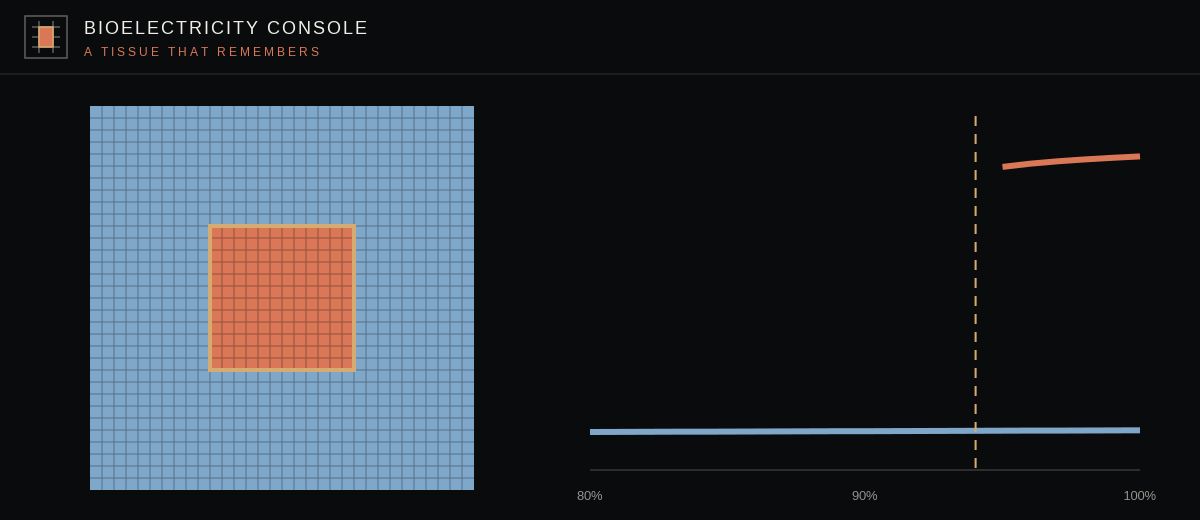
We keep the scope exact. bioelectrics models ion-channel and gap-junction electrodiffusion in somatic tissue sheets rather than external environmental EMF exposure or perineural solid-state physics. Readers can interact directly with bistable voltage domains in our Bioelectricity Console or inspect the open-source modeling engine below.

Strengths and Limits of Electromagnetism and Life
Electromagnetism and Life stands out for grounding bold biological hypotheses in original orthopedic and electrophysiological data, including bone fracture healing protocols that eventually led to FDA-approved electrical bone-growth stimulators. Two limitations require caution when reading the book today. First, Becker’s proposed solid-state semiconductor mechanism for perineural DC transmission has largely been superseded by ion-channel and gap-junction biophysics. Second, the book’s later chapters on public-health hazards from environmental 60 Hz power lines reflect 1980s epidemiological controversies where causal mechanisms remain debated. Separated from those dated details, Becker and Marino’s empirical work on regeneration potentials remains a landmark in bioelectricity. Explore our Bioelectricity apparel collection below to support open research.
Bioelectricity
Planaria, axolotls and the voltage patterns that tell cells what to build. Every order funds the research.
-
 Planaria - Bioelectricity T-Shirt
From $23.99
-
 Planaria - Bioelectricity T-shirt | Small Chest Logo
From $23.99
-
 Axolotl - Bioelectricity T-Shirt
From $24.99
-
 Axolotl - Bioelectricity T-shirt | Small Chest Logo
From $23.99
-
 Cognition - Bioelectricity T-Shirt
From $23.99
-
 Cognition Bioelectricity T-shirt | Small Chest Logo
From $23.99
Researchers covered here
- Robert O. BeckerSUNY Upstate Medical University and Veterans Administration Hospital, SyracuseElectromagnetism and Life, direct-current control systems, and electrical stimulation of limb regeneration
- Andrew A. MarinoLouisiana State University Health Sciences CenterElectromagnetism and Life, Modern Bioelectricity, and biophysical models of weak field detection