


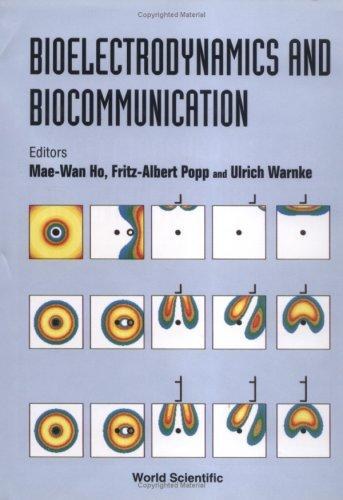
Mae-Wan Ho and Fritz-Albert Popp Bioelectrodynamics and Biocommunication
Bioelectrodynamics and Biocommunication
Mae-Wan Ho, Fritz-Albert Popp, and Ulrich Warnke's Bioelectrodynamics and Biocommunication examines ultraweak photon emission, liquid-crystalline tissues, and electromagnetic signaling.
Buy on amazon.com As an Amazon Associate I earn from qualifying purchases.
Do living cells communicate solely through diffusing molecules and ion-channel voltages, or do ultraweak optical emissions and whole-body electrodynamic coherence also play a regulatory role? In Bioelectrodynamics and Biocommunication (World Scientific, 1994, ISBN 9810216653), geneticist Mae-Wan Ho, biophysicist Fritz-Albert Popp, and zoologist Ulrich Warnke assembled an international collection of papers investigating ultraweak photon emission (biophotons), weak magnetic field effects on Drosophila embryos, and liquid-crystalline optical coherence in living tissues.
Indexed in our Bioelectricity hub and AI Consciousness Books guide, this 1994 volume represents the most ambitious and contested frontier of the forgotten century of bioelectricity. Reviewing it with strict empirical standards separates verified physical measurements from unproven signaling claims inside modern consciousness science.
What Is Measured vs. What Remains Contested
Because biophotons and biological coherence are frequently overstated in popular media, a clean evidence table is necessary to evaluate Bioelectrodynamics and Biocommunication accurately.
| Phenomenon Covered in the Volume | Replicated Physical Observation | Proposed Biological Interpretation | Mainstream Scientific Consensus |
|---|---|---|---|
| Ultraweak Photon Emission (Biophotons) | Living cells emit 10 to 1,000 photons per square centimeter per second across UV to near-IR wavelengths |
Popp argued delayed luminescence reflects coherent optical storage in DNA and intercellular communication | Emission is well established as a byproduct of oxidative metabolism and reactive oxygen species; coherent signaling remains unproven |
| Weak Static Magnetic Fields in Drosophila | Ho and colleagues reported cuticular pattern abnormalities after brief early embryonic exposure | Electromagnetic fields perturb global morphogenetic prepatterns directly | Reported effects are sensitive to exposure protocol and remain outside standard developmental genetics |
| Liquid-Crystalline Tissue Birefringence | Polarized light microscopy reveals aligned collagen and cytoskeletal domains in living organisms | Ho proposed rapid, coherent whole-body energy transfer and communication | Structural liquid-crystalline order in connective tissue is real; quantum-coherent whole-body signaling lacks direct confirmation |
| Endogenous Ionic Bioelectric Currents | Steady DC currents and V_mem gradients traverse embryos, roots, and wounds |
Electrical patterns instruct morphogenesis and spatial polarity | Firmly established and replicated across species using modern molecular tools |
Building directly on Herbert Fröhlich’s Coherent Excitations in Biological Systems and Joseph Needham’s Order and Life, Ho and Popp argued that conventional biochemistry treats cells as dilute bags of randomly colliding enzymes while ignoring electromagnetic coupling across structured intracellular water and polymers.
Connecting Biophotonics to Developmental Bioelectricity
Why does a volume centered on biophotons and electrodynamics appear in historical bioelectricity bibliographies alongside E. J. Lund and Robert O. Becker? Both traditions ask the same underlying architectural question. How do millions of cells coordinate rapidly across macroscopic anatomical distances without waiting for slow chemical diffusion alone?
Modern developmental bioelectricity answered a large portion of that question using classical ion channels, electrogenic pumps, and gap junctions, as demonstrated in Patrick McMillen and Michael Levin’s 2026 FLIM imaging of seconds-to-hours voltage dynamics and Levin’s cognitive light cone framework. Biophotonics pushed the same question into the optical and electromagnetic regime, asking whether endogenous light emission adds a faster non-chemical channel. Even where the stronger optical-coherence claims did not hold up, the volume documented genuine biophysical measurements of delayed luminescence and tissue birefringence that still attract experimental scrutiny.
What Bioelectrodynamics and Biocommunication Tells Us About Consciousness
Ho’s synthesis in particular directly engages philosophy of mind by proposing a strong version of biological naturalism. If living organisms coordinate their parts through continuous, liquid-crystalline electromagnetic coherence spanning from molecules to the whole body, then biological agency and experience would depend intimately on the wet physical medium of living tissues rather than on abstract algorithmic state transitions.
Evaluating that claim honestly highlights a sharp empirical test for consciousness research. Under functionalist emergentism, consciousness is an emergent property of causal organization that does not require optical coherence or liquid-crystalline biology. If future experiments ever demonstrated that coherent biophoton fields carry causally necessary information for cortical binding or unified awareness, substrate-independent computational models would face a serious biological constraint. Until such causal evidence exists, classical bioelectric and neural-circuit mechanisms remain the far stronger empirical foundation.
Comparison to The Consciousness AI and bioelectrics
The Consciousness AI tests non-neural biological computation through our open-source PyTorch library bioelectrics (pip install bioelectrics, MIT licence, Zenodo DOI 10.5281/zenodo.23531183), which simulates somatic ion fluxes, membrane potentials, and voltage-gated gap junctions.
Maintaining strict facts discipline, bioelectrics does not model biophoton emission, optical coherence, or liquid-crystalline tissue birefringence. Our research focuses on verifiable, quantitatively validated ionic mechanisms whose parameters can be checked directly against primary electrophysiological assays on our Bioelectricity hub.
Strengths and Limits of Bioelectrodynamics and Biocommunication
The volume is valuable as a primary historical record of late twentieth-century biophotonics and electrodynamic biology, bringing together European, Russian, and British experimentalists whose work is rarely collected in one place. Its major limitation is uneven evidentiary rigor across chapters. Reproducible optical measurements of ultraweak photon emission sit beside speculative leaps toward whole-organism quantum coherence and non-local biocommunication that lack decisive experimental confirmation thirty years later. Read critically, it marks the outer boundary where classical bioelectricity meets speculative biophysics. Support our open-source bioelectricity tools through the Bioelectricity apparel collection below.
Bioelectricity
Planaria, axolotls and the voltage patterns that tell cells what to build. Every order funds the research.
-
 Planaria - Bioelectricity T-Shirt
From $23.99
-
 Planaria - Bioelectricity T-shirt | Small Chest Logo
From $23.99
-
 Axolotl - Bioelectricity T-Shirt
From $24.99
-
 Axolotl - Bioelectricity T-shirt | Small Chest Logo
From $23.99
-
 Cognition - Bioelectricity T-Shirt
From $23.99
-
 Cognition Bioelectricity T-shirt | Small Chest Logo
From $23.99
Researchers covered here
- Mae-Wan HoOpen University and Institute of Science in SocietyBioelectrodynamics and Biocommunication, liquid-crystalline organisms, and quantum coherence in biology
- Fritz-Albert PoppInternational Institute of Biophysics, NeussUltraweak photon emission (biophotons) and coherent optical signaling in living organisms