

Kurzweil Forecast Scanning Milestones by 2099 in The Age of Spiritual Machines
The Age of Spiritual Machines
The Age of Spiritual Machines, Kurzweil's 1999 book, sets dated forecasts for brain scanning, whole brain replication and non-biological minds under accelerating returns.
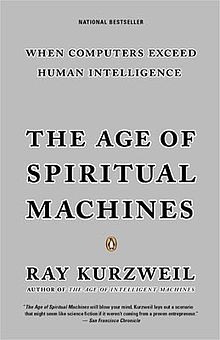
Ray Kurzweil published The Age of Spiritual Machines: When Computers Exceed Human Intelligence with Viking in 1999, ISBN 0-670-88217-8. The book is a forecast and it is built to be audited. It states a general claim, which Kurzweil calls the law of accelerating returns, and then attaches dates to it in tables running from the 2000s through 2009, 2019, 2029 and out to 2099. Brain scanning, whole brain replication and non-biological minds appear in that sequence with dates against them.
The claim and the audit it invites
Kurzweil’s substrate claim is the one this site cares about and it is plain. Mental processes are computational and computation does not depend on what implements it. Once a brain’s organisation is captured in detail and executed on other hardware, the result is that person. He writes this as an engineering roadmap and he does not spend pages on the philosophy, which makes the dates checkable and the metaphysics thin.
The value of the book in 2026 is that the 2009 and 2019 rows of his tables have come due. A forecast with a date is falsifiable and this one is now falsifiable in bulk. That is a real contribution and it is one that most writing about machine minds does not offer.
| Element | What Kurzweil claims | What can be checked |
|---|---|---|
| The law of accelerating returns | Technical progress in information processes compounds | Against the record of the last twenty seven years |
| Dated tables | Milestones for 2009, 2019, 2029, 2099 | The 2009 and 2019 rows are now testable |
| Scanning | High resolution brain scanning arrives in sequence | Against the connectomics record |
| Replication | Whole brain replication follows scanning | Not yet due |
| Non-biological minds | Machine minds arrive and become common | Not yet due |
What the 2020s connectomics record says about the early rows
Kurzweil’s scanning forecast has partly come true and partly not. The analysis of the Sandberg and Bostrom whole brain emulation roadmap records where the field actually stands. Complete synaptic wiring diagrams now exist for the adult fruit fly, at roughly 139,000 neurons and 54 million synapses, and a sample of human temporal cortex one cubic millimetre in volume has been reconstructed at nanoscale with 57,000 cells and 150 million synapses.
Those are the structural results. They are also the ones that sharpen the problem rather than close it. A static wiring diagram does not produce a functioning emulation and the field’s own 2025 reassessment, the State of Brain Emulation Report, concludes that recording remains the binding constraint. Kurzweil’s sequence, scan then replicate, is correct as an ordering. His dates for the scan step are optimistic and his treatment of the gap between a wiring diagram and a running mind is thin.
Comparison to The Consciousness AI
Kurzweil’s claim is the design claim this project makes. Organisation carries the mind and the material is interchangeable. The project’s Global Workspace layer and Affective Core are functional organisation described by what they do.
Where the two part company is on evidence. Kurzweil offers a timeline. The project offers an architecture and it has not demonstrated that the architecture carries a subject. Continuity across component replacement is an open design question here and Kurzweil does not close it either. He assumes that a full enough replication is the person and he does not argue for the identity claim.
His interface position is closer to being useful. He expects scanning and replication to proceed as separable steps, which means the description of the organisation has to be detachable from the hardware that produced it. That is the same structural question the project’s substrate work asks and it is the part of the book that survives contact with the engineering literature.
What the book does not establish
It does not establish the identity claim. Kurzweil assumes a faithful replication is that person and he does not address the branching case at all. The analysis of Parfit’s branch-line case shows that the assumption is exactly what needs defending and that Parfit denies it in a specific way.
It gives no account of how organisation produces experience. The hard problem is outside the book’s scope and Kurzweil is honest about that in later work, where he treats consciousness as a question of social acceptance rather than of proof. His appearance on the Moonshots podcast in January 2026, covered by the analysis of that interview, makes that position explicit.
The dated forecasts are also a mixed record and the book should be read with the scorecard beside it. The direction of travel has been right more often than not. The dates have been early as often as they have been on time and that is a real defect in a book whose whole method is attaching dates to a trend.
The standing of the book
The Age of Spiritual Machines is the popular reference for the accelerating returns thesis and it is the book that made dated forecasting about machine minds standard practice. It belongs on the shelf with Mind Children and Permutation City as one of the three 1988 to 1999 texts that set the terms the engineering literature now argues inside.
The Age of Spiritual Machines: When Computers Exceed Human Intelligence by Ray Kurzweil was published by Viking in 1999, ISBN 0-670-88217-8, with an Orion Business edition in the same year and later Penguin editions. Kurzweil is the founder of Kurzweil Technologies and has worked at Google.