


The 2040 Brain Upload Forecast in The Singularity Is Near
The Singularity Is Near
Kurzweil's 2005 book set dated milestones for brain reverse-engineering and uploading, with upload technology due by 2040 and the singularity at 2045.
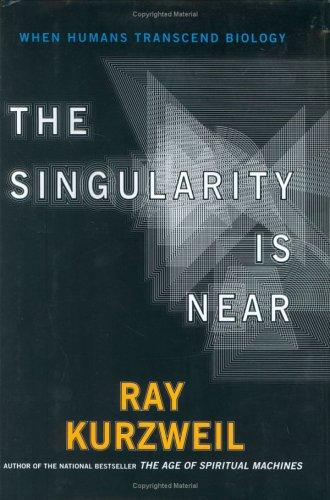
Ray Kurzweil published The Singularity Is Near: When Humans Transcend Biology with Viking in September 2005, 652 pages, ISBN 978-0-670-03384-3. The book builds the forecast machine its predecessor sketched. Where The Age of Spiritual Machines set dated milestones for 2099, examined in the 1999 book analysis, the 2005 book states the underlying law and attaches it to the brain. Kurzweil names the singularity date directly. “I set the date for the Singularity, representing a profound and disruptive transformation in human capability, as 2045.”
| Milestone | Kurzweil’s date | Source page |
|---|---|---|
| Computer matches human brain capacity, supercomputer level | 2010 | p. 25 |
| Brain-level capacity for $1,000 | around 2020 | p. 126 |
| Effective human intelligence model from brain scanning | mid-2020s | p. 25 |
| Turing test passed | 2029 | p. 200 |
| Technology for brain uploading available | 2040 | pp. 199-200 |
| The Singularity | 2045 | p. 136 |
The six epochs and the law of accelerating returns
The book organizes all of evolution into six epochs. Physics and chemistry, biology and DNA, brains, technology, then the merger of human technology with human intelligence, which Kurzweil identifies with the singularity, and finally the universe waking up. Progress runs on the law of accelerating returns. Each stage builds tools for the next, so growth compounds. The curve looks flat until it hits what Kurzweil calls the knee, then rises almost vertically, and what appears to be one smooth curve is a stack of S curves, each paradigm replaced by the next when it levels off.
The engineering claims follow from that law. Kurzweil surveys estimates of the brain’s computational capacity and settles on 10 to the 16th calculations per second and 10 to the 13th bits of memory. General modeling needs that. Uploading, he writes, requires more, perhaps 10 to the 19th calculations per second and 10 to the 18th bits, and the technology to do it will be available by 2040. The route he expects is gradual. Rather than an instantaneous scan, portions of the brain are augmented with neural implants, so the share of nonbiological intelligence rises over time.
The three revolutions
The book’s middle sections carry the genetic, nanotechnology and robotics revolutions, GNR in Kurzweil’s numbering. Genetic technology rewrites biology to defeat aging and disease. Nanotechnology builds tools molecule by molecule. The robotics revolution is strong AI, which Kurzweil calls the most important development of the century. Brain scanning rides the middle revolution, with imaging resolution rising and nanobots scanning the brain from the inside during the 2020s.
The book is also candid about the consciousness question. Kurzweil states there is no objective test that can conclusively determine the presence of consciousness, so nonbiological intelligences will claim the full range of experiences humans claim, and he expects those claims to be generally accepted. That position makes the consciousness question a social settlement rather than a measurement problem, which is the sharpest disagreement this site has with the book.
What the critics said, and what held
The book’s critics attacked the curve. Paul Davies wrote in Nature in 2006 that the exhilarating speculation needs a huge dose of salt, because exponential growth never lasts. Theodore Modis argued that nothing in nature follows a pure exponential and that logistic curves fit real growth, which caps the knee rather than launching it. Neuroscientist David Linden conceded that data collection grows exponentially while insight grows linearly, and that brain nanobots face spaces too small to navigate. Twenty years on, the record is mixed. Hardware matched Kurzweil’s raw capacity forecasts faster than his brain-scanning timeline, while functional brain models remain far behind, which is exactly the gap the whole brain emulation roadmap separated into scanning, interpretation and simulation tracks, examined in the roadmap review.
Comparison to The Consciousness AI
Kurzweil’s uploading scenario is the strongest-popularized statement of the substrate independence claim this site develops, and the book supplies its quantitative floor. The project’s research code, maintained in the tlcdv/the_consciousness_ai repository, keeps the two halves of Kurzweil’s forecast separate. Computational capacity has compounded as predicted. Preserving the functional organization that carries experience is a different problem, and the book’s own concession that no objective consciousness test exists states why the social-acceptance route is insufficient. The 2010 film version of the book was co-produced with Terasem, which makes the connection to Rothblatt’s mindfile program explicit rather than coincidental.
What the 2005 Forecast Leaves Open
The book’s dated claims make it auditable, and the audit is the point. Capacity curves held, brain models did not, and the consciousness question was left to social acceptance where the book placed it. The falsifiable core, that functional organization can be captured at 10 to the 19th calculations per second and reinstantiated, remains untested, and the emulation program tracks exactly that claim on the brain emulation page. The field’s current state of the argument is reviewed in the flagship overview of AI consciousness research.