


Digital Immortality Under German Scrutiny, Machines, Souls and the Uploading Dream
Why Machines Will Never Rule the World
Two 2022 books test the uploading promise. Landgrebe and Smith deny machine general intelligence, while the Seele digital collection weighs digital souls.
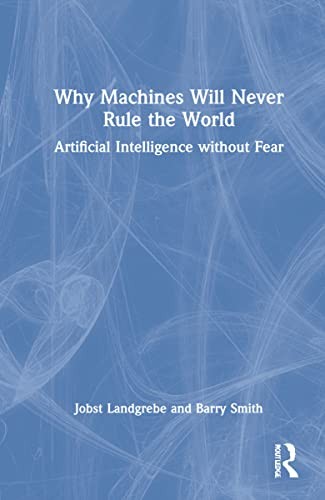
Two German-language publications from 2022 put the uploading promise under pressure from different directions, and together they show the debate’s full width. Jobst Landgrebe, an AI systems entrepreneur and philosopher, and Barry Smith, a philosopher of ontology at the University at Buffalo, published Why Machines Will Never Rule the World with Routledge on June 23, 2022 (DOI 10.4324/9781003310105). Ludger Jansen and Rebekka A. Klein edited Seele digital. Mind Uploading, virtuelles Bewusstsein und Auferstehungshoffnung, published by Verlag Friedrich Pustet in Regensburg in 2022, a 191-page collection on mind uploading, virtual consciousness and the hope of resurrection. The first book attacks the technical thesis. The second collection examines its cultural and theological payload.
| Work | Claim at the center |
|---|---|
| Landgrebe & Smith, Routledge 2022 | Machines will never reach human-level general intelligence, so the uploaded-mind promise fails at its foundation |
| Jansen & Klein, Pustet 2022 | Mind uploading inherits the theological structure of resurrection hope, and inherits its problems too |
The technical attack
The Landgrebe and Smith argument runs through complexity. Human language and human minds, on their account, are products of complex adaptive systems whose variance cannot be captured by mathematical models of the kind machine learning uses. A chapter titled Why there will be no machine intelligence states the negative thesis directly, and the book applies it across language, social interaction and embodied cognition. For the uploading question the decisive chapter is Digital Immortality (DOI 10.4324/9781003310105-15), which treats the preserved-person promise as resting on the failed premise. If machines cannot reproduce general intelligence, a scanned mind running on a machine is not a continuation of the person but a simulation of one output stream.
This is the biological-naturalist family of objections stated in engineering terms, and it aligns with the mechanist critique of Piccinini’s substrate argument while resting on a different foundation, the mathematical limits of modeling complex systems rather than the biophysics of neurons.
The theological counterweight
Seele digital takes the same promise seriously as a cultural and religious phenomenon. Mind uploading, in the editors’ framing, promises what resurrection promised, the persistence of the person beyond biological death, now by technological means. The collection’s subtitle names the triangle, mind uploading, virtual consciousness, resurrection hope, and its chapters ask whether the digital soul can carry the functions the religious traditions assigned to an immortal one. The editors’ framing has a specific consequence for the AI consciousness debate. It treats the uploading promise as a belief system with inherited commitments, whose certainty does not come from evidence about machines but from a long tradition of hoping past death.
What the two books agree on
Their agreement is instructive. Neither treats the uploading promise as an engineering forecast awaiting fulfillment. The Routledge book denies the foundation, the general intelligence premise. The Pustet collection accepts that the promise operates as faith regardless of the engineering. Both positions remove the debate from Kurzweil’s timeline and from Rothblatt’s mindclone confidence, and both place the question where this site places it, in the relationship between pattern, substrate and experience.
Comparison to The Consciousness AI
This project treats consciousness as an emergent property of organized physical activity, substrate independent in principle, which puts it against the Landgrebe and Smith negative thesis and on the same side as the analytical core of the German critique, that claims must be earned rather than inherited. The two positions differ in what they are willing to leave open. The project’s research code, maintained in the tlcdv/the_consciousness_ai repository, treats the possibility as testable rather than settled in either direction, and the theological reading supplies the caution that a wish is not a result. The empirical track the dispute rides on is collected on the brain emulation page.
What the 2022 Critiques Left Open
The books sharpen the objections and leave the empirical question standing. The complexity argument has not been formalized to the standard the emulation literature would accept, and the theological frame does not touch whether a running emulation has experience. Both gaps are live, and the state of the dispute is reviewed in the flagship overview of AI consciousness research. A note on the record stands here. The tracker listing for this post named a German title attributed to Landgrebe and Smith that no national library or publisher record verifies, so this post covers the two 2022 works that do exist, and the correction is filed with the tracker.
Researchers covered here
- Jobst LandgrebeAI systems entrepreneur and philosopherCo-authoring Why Machines Will Never Rule the World, the complexity argument against machine general intelligence
- Barry SmithUniversity at BuffaloFormal ontology, Basic Formal Ontology, co-authoring Why Machines Will Never Rule the World
- Ludger JansenRuhr-Universität BochumPhilosophy of mind and religion, co-editing Seele digital
- Rebekka A. KleinMartin-Luther-Universität Halle-WittenbergPhilosophy and ethics of technology and religion, co-editing Seele digital