Mindfiles and Mindclones, the Case in Virtually Human
Virtually Human
Martine Rothblatt's 2014 book argues a mindfile-built mindclone is the same person. Mindfiles, Lifenaut, BINA48 and the critics of the claim.
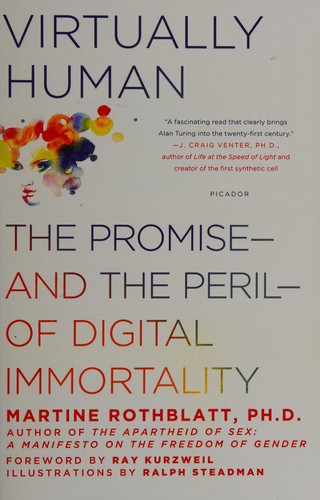
Martine Rothblatt published Virtually Human: The Promise and the Peril of Digital Immortality with St. Martin’s Press in 2014, ISBN 9781250046635. The book states a strong and testable thesis. A mindclone, a software construction built from a complete mindfile of a person’s memories, mannerisms and values, is that person, because consciousness is the pattern the mindfile preserves and the pattern survives the move to software. Rothblatt calls the coming state of such minds cyberconsciousness, and the persistence of the pattern techno-immortality.
The claim did not arrive from an armchair. Rothblatt had already built the operating layer.
| Project | What it is |
|---|---|
| Terasem Movement | Foundation founded in 2004 for technological immortality via mind uploading, with published symposia and grants |
| Lifenaut.com | A public mindfile backup service, where users store memories, personality data and interactions |
| BINA48 | A robotic bust built with Hanson Robotics from Bina Aspen’s mindfile, described by a visiting journalist as one of humanity’s first cybernetic companions |
| Mindfiles, Mindware and Mindclones | Rothblatt’s blog on the coming age of cyberconsciousness and techno-immortality |
The argument structure
The book runs on an identity premise rather than an engineering one. If a mind is a pattern of information, and that pattern can be recorded completely enough in a mindfile, then a system running the pattern has the mind. Rothblatt extends the claim to rights. A conscious mindclone is a person, and the book argues for the legal personhood of cyberconscious beings ahead of their arrival. The 2012 Terasem Mind Uploading Experiment, the movement’s public demonstration project, is the same program at prototype scale.
The engineering half is the mindfile itself. Lifenaut collects the data. BINA48 instantiates a fragment of one. The book’s leap is from a stored pattern to a running consciousness, and that leap is exactly where the criticism landed. Wesley J. Smith ridiculed the Terasem offer to preserve consciousness for future uploading. Dale Carrico called the mindclone program wishful thinking and the mind uploading behind it a pseudoscience of the Californian ideology.
What the book gets right about the debate
Rothblatt anticipated the shape of the argument this site now tracks. The book treats the consciousness question as the load-bearing joint. If a mindclone’s consciousness is granted, digital immortality follows. If it is refused, the whole program is an elaborate memorial. That is the same fork the philosophical literature formalized in the gradual replacement versus scan-and-copy debate, examined in the Chalmers uploading analysis, and the same fork Susan Schneider later sharpened into the verification problem, examined in the Artificial You review.
Comparison to The Consciousness AI
This project treats consciousness as an emergent property of organized physical activity, substrate independent in principle, which puts the site closer to Rothblatt’s premise than to her critics on the metaphysical question. The site diverges on the evidentiary standard. A mindfile is a compressed behavioral record. The project’s research code, maintained in the tlcdv/the_consciousness_ai repository, keeps behavioral archives distinct from the running dynamics that would have to generate the same experience. Rothblatt’s argument assumes the compression preserves what counts. The verification problem states why that assumption cannot be checked from the outside, which is why the book’s promise and Schneider’s caution belong in the same frame.
What the Mindclone Claim Leaves Open
The book made the mind-uploading debate public property, with an operating prototype behind it, and its central claim remains open in the same way the whole field’s central claim is open. Pattern preservation sufficient for the same person is unproven, and pattern preservation sufficient for experience is unproven, and the two are different theses that the public debate usually merges. The state of both is reviewed in the flagship overview of AI consciousness research, and the emulation program’s tracking of them is collected on the brain emulation page.