


Cyber Beings and Digital Immortality, the Religious Frame of Mind Uploading
Religion and the Technological Future
Mercer and Trothen's 2021 Palgrave book reads mind uploading from religious studies, where digital immortality inherits the shape of resurrection hope.
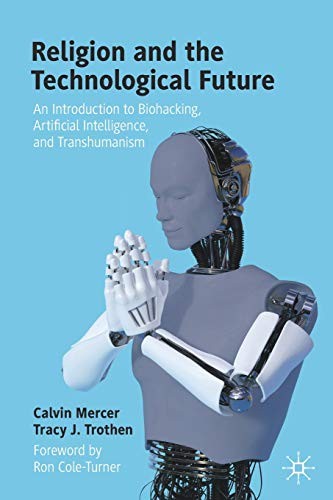
Calvin Mercer and Tracy J. Trothen published Religion and the Technological Future: An Introduction to Biohacking, Artificial Intelligence, and Transhumanism with Palgrave Macmillan in 2021. Mercer is a religious studies scholar at Appalachian State University who has written on theology and whole brain emulation since 2014. Trothen holds a chair at the School of Religion at Queen’s University in Kingston and works on ethics, technology and spirituality. The book is a textbook, in the good sense, an introduction built to organize a field. Its chapter 9, Mind Uploading: Cyber Beings and Digital Immortality (DOI 10.1007/978-3-030-62359-3_9), is the subject this site tracks.
| Question | Where the book puts it |
|---|---|
| Is mind uploading a scientific project or an eschatology? | Both, and the boundary is the interesting part |
| What is a cyber being? | A person projected into software, the book’s term for the upload’s social identity |
| Who wants digital immortality, and why? | A demand side the technical literature usually ignores |
The continuity argument
The book’s central contribution is continuity. Digital immortality narratives did not appear with the technology. They extend a very old set of religious structures, the preserved self, the resurrected body, the beatific persistence of the person, into technical vocabulary. Mercer and Trothen read mind uploading, cryonics and AI afterlife projects as a single cultural formation, and they show how transhumanist rhetoric borrows religious authority while often denouncing religion. The cyber being of chapter 9 is the latest figure in a long line, and the framing explains something the technical literature cannot. Why uploading attracts devotion, and why its critics answer with heresy language of their own.
This reading sits beside the site’s other cultural entries, from Bernal’s 1929 vision to the singularity as a spiritual program in Kurzweil. The Mercer and Trothen account gives that lineage its scholarly frame.
What religious studies sees that engineering does not
Two observations carry over directly to the technical debate. First, the demand side is real. Surveys of attitudes toward mind uploading, which the ethics literature tracks, measure a public that arrives with immortality expectations formed long before any scanner exists. Second, the moral stakes are framed before the facts are. If uploading is framed as survival, ending the biological original looks different than if it is framed as building a copy, and the framing is inherited from religious accounts of death and continuity rather than derived from the technology.
Comparison to The Consciousness AI
This project treats consciousness as an emergent property of physical organization and holds that claims about survival through substrate transfer must be earned empirically. The book’s cultural analysis does not touch that claim, and it does something the technical literature needs. It shows where the certainty comes from. When an uploading advocate asserts that the pattern is the person, part of that conviction is philosophical and part of it is eschatological inheritance, and the book names the second part. The project’s research code, maintained in the tlcdv/the_consciousness_ai repository, keeps its claims separate from its motivations, and this book explains why that separation needs to be deliberate.
What the Cultural Frame Leaves Open
The book organizes the cultural field and leaves the scientific question where it found it. Whether a cyber being would be conscious, and whether the original survives, are empirical and philosophical questions the religious frame cannot answer. What it can answer is why the question is asked with such force, and why the answers divide along lines the technical facts do not predict. The state of the technical debate is reviewed in the flagship overview of AI consciousness research, and the German-language side of the same cultural argument, which reached book length in the same year, is examined in the Seele digital and Landgrebe-Smith analysis.
Researchers covered here
- Calvin MercerDepartment of Philosophy and Religion, Appalachian State UniversityReligious studies analyses of transhumanism, theology and whole brain emulation, co-authoring Religion and the Technological Future
- Tracy J. TrothenSchool of Religion, Queen's University, KingstonEthics of technology and spirituality, co-authoring Religion and the Technological Future