


BrainChip Akida AKD1500 and Akida Pico Event-Based Silicon Against Intel Hala Point
Neuromorphic engineering in late 2026 has split into two distinct hardware tracks. At the commercial edge, BrainChip has expanded deployment of its Akida AKD1500 co-processor (available in PCIe, M.2, SPI, and a Raspberry Pi 5 Development Kit delivering up to 800 effective GOPS at under 1 milliwatt per GOP) alongside the microwatt-class Akida Pico IP core for always-on sensing. At the institutional supercomputing frontier, Intel’s Hala Point system at Sandia National Laboratories packs 1,152 Loihi 2 chips into a microwave-sized chassis simulating 1.15 billion artificial neurons and 128 billion synapses.
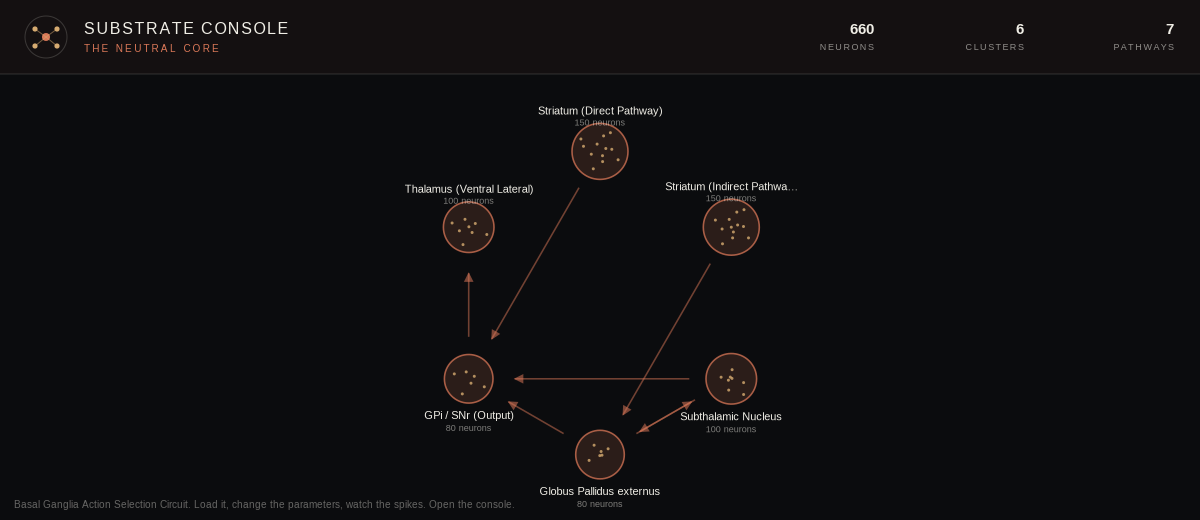
Within our thermodynamic computing hub, our hardware guide, and the browser-based Substrate Console, comparing these two architectures clarifies which biological neural mechanisms actually survive translation into production silicon.
Two Divergent Paths in Event-Based Neuromorphic Silicon
Both BrainChip and Intel abandon the continuous synchronous matrix-multiply clock of data-center GPUs in favor of event-driven computation, where circuits consume dynamic power only when a spike or state change arrives. Beyond that shared principle, their design targets diverge sharply.
| Architecture | Commercial or Research Target | Scale and Throughput | Power Envelope | Key Architectural Feature |
|---|---|---|---|---|
| BrainChip Akida AKD1500 | Commercial edge AI co-processor (M.2, PCIe, SPI, RPi 5 Dev Kit) | Up to 800 effective GOPS | Under 1 mW per GOP | Event-based CNN-to-SNN hybrid blocks with on-chip edge learning |
| BrainChip Akida Pico | Always-on microcontrollers, audio, vitals, IoT | Ultra-compact IP core | Microwatt to low milliwatt | Continuous low-power event filtering without waking a host CPU |
| Intel Hala Point (Loihi 2) | National-lab research (Sandia National Laboratories) | 1.15 billion neurons, 128 billion synapses, up to 20 petaops | Over 15 TOPS/W on sparse workloads | 1,152 asynchronous Loihi 2 dies with programmable neuron microcode |
Recent 2026 benchmarks in Neurocomputing evaluating real-time object detection on single Loihi 2 chips found that distillation-aware direct SNN training recovered 87 to 100 percent of conventional artificial neural network accuracy while delivering lower per-inference dynamic energy than embedded GPUs such as the NVIDIA Jetson Orin Nano. Alongside European many-core platforms covered recently on this site, including SpiNNaker2 and the ESAB neuromorphic supercomputer and BrainScaleS-2 analog multi-chip silicon, 2026 marks the point where event-driven hardware moved from lab curiosities into purchasable evaluation cards.
Where Commercial Edge Silicon Stops Short of Biological Dynamics
To make Akida commercially viable for industrial customers, BrainChip maps standard convolutional neural network blocks onto event-based spiking hardware. That pragmatic choice simplifies software deployment, yet strips away much of the rich recurrent temporal dynamics found in living cortex, such as continuous dendritic integration, slow neuromodulatory gating, and cross-frequency phase locking.
Intel’s Loihi 2 architecture, led by Mike Davies, preserves greater programmability, enabling researchers to simulate full insect connectomes as shown in the Drosophila MaleCNS whole-connectome Loihi 2 study. Even at Hala Point’s 1.15 billion neuron scale, however, the system remains a specialized research platform accessible to select institutional partners rather than a mass-market developer board.
What Event-Based Silicon Tells Us About Consciousness
Evaluating neuromorphic silicon forces precision in debates tracked in how scientists race to define and test AI consciousness in 2026. Biological naturalists argue that metabolic constraints and continuous asynchronous physical dynamics are essential to sentience, whereas computational functionalists argue that abstract information routing is sufficient.
Event-based neuromorphic chips sit directly on that fault line. An Akida AKD1500 running a feedforward event-based vision classifier uses spikes and microwatts, yet lacks global recurrent broadcast, unified world modeling, or homeostatic affective valuation. Spikes alone do not yield emerging consciousness. Conversely, scaling recurrent spiking substrates like Loihi 2 lets researchers test empirically whether cognitive indicators change when continuous asynchronous timing replaces clocked batch updates.
Connection to ThermoSpike and The Hardware
We list both the BrainChip Akida AKD1500 M.2 card and PCIe card in our thermodynamic and neuromorphic hardware guide so builders can compare commercial spiking silicon against open FPGA boards. In thermospike, we explore how stochastic spiking neurons can sample directly from Boltzmann distributions while tracking energy per sample, bridging neuromorphic event routing with thermodynamic computing. For physical benchtop prototyping, our open-source repository the-hardware publishes 3D-printable CadQuery enclosures and mounting fixtures under CERN-OHL-S v2 for neuromorphic, FPGA, and sensor development kits.
Commercial Realities and Open Benchmarks
Vendor throughput numbers such as effective GOPS and peak sparse TOPS/W depend heavily on network sparsity and workload structure. Independent, standardized benchmarks running identical recurrent cognitive tasks across Akida AKD1500, Loihi 2, SpiNNaker2, and embedded GPUs remain scarce. Until those side-by-side recurrent benchmarks exist, Akida is best understood as a practical, low-power event-driven accelerator for edge perception, while Hala Point remains the primary proving ground for brain-scale asynchronous simulation.