

Velocity-Dependent Friction and Stability Limits in Theta-Gamma Phase-Amplitude Coupling
On November 18, 2026, YuHan Luo, Sonali Priyadarshini Nayak, Murielle Hsu, Gregory Worrell, and David Hsu released a two-part bioRxiv study deriving theta-gamma phase-amplitude coupling (PAC) from first-principles non-equilibrium statistical mechanics. In Part I, Velocity-dependent friction in a simple two-oscillator system. I. Phase-amplitude coupling (10.64898/2026.11.18.767449), and Part II, Regions of stability (10.64898/2026.11.18.767758), the authors model a slow theta oscillator and a fast gamma oscillator with a generalized Langevin equation in which gamma damping tracks theta velocity. Their closed-form formula predicts PAC strength across 51,095 simulated records with $R^2 = 0.993$ and zero fitted parameters, governed by a single dimensionless parameter $\kappa$ that also defines a sharp boundary to dynamical instability.
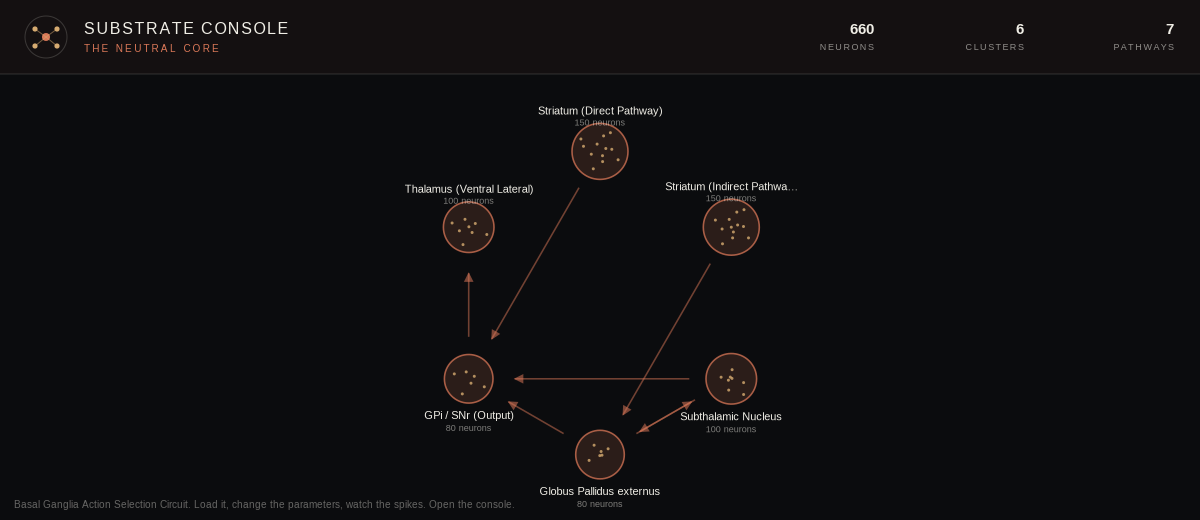
This thermodynamic derivation bridges our thermodynamic computing hub, our brain waves section, and the spiking dynamics explored in the Substrate Console.
Deriving Cross-Frequency Coupling From Fluctuation-Dissipation Physics
Theta-gamma phase-amplitude coupling, where the amplitude of fast gamma rhythms (30 to 80 Hz) waxes and wanes according to the phase of slower theta waves (4 to 8 Hz), is widely observed during working memory, spatial navigation, and conscious perceptual binding. Most neuroscience papers treat PAC as a descriptive statistical correlation measured from local field potentials or EEG.
Luo, Hsu, and colleagues instead formulate a minimal physical mechanism. They write down a generalized Langevin equation for two coupled oscillators subject to thermal-like stochastic noise, where the friction (damping) acting on the fast gamma variable depends linearly on the velocity of the slow theta variable. By enforcing the fluctuation-dissipation theorem, which ties the strength of stochastic noise to an effective temperature and the damping rate, they obtain an exact analytical expression for PAC strength as a function of one composite number, $\kappa$, combining the coupling strength with the effective temperature.
| Property in Luo and Hsu (Nov 2026) | Mathematical Mechanism | Quantitative Result |
|---|---|---|
| Phase-amplitude coupling strength | Closed-form function of single parameter $\kappa$ (coupling and effective temperature) | Matches 51,095 simulated records at $R^2 = 0.993$ with zero fitted parameters |
| Parameter estimation | All governing coefficients enter linearly in the model | Coefficients can be estimated directly from empirical neural recordings via regression |
| Stability boundary (Part II) | Critical threshold in the same parameter $\kappa$ | Stronger theta-gamma PAC pushes the fast gamma oscillator closer to runaway instability |
Because every coefficient enters linearly, the framework allows electrophysiologists to invert the equations and estimate effective coupling and dissipation terms directly from recorded brain signals rather than relying on opaque black-box fits.
The Trade-Off Between Stronger Coupling and Dynamical Instability
Part II of the series uncovers a striking physical constraint. The exact same dimensionless parameter $\kappa$ that amplifies theta-gamma phase-amplitude coupling also governs the stability boundary of the gamma oscillator. Pushing $\kappa$ higher strengthens cross-frequency nesting, yet drives the fast rhythm closer to bifurcation and runaway instability, a regime clinically associated with epileptiform discharges.
This echoes broader findings on neural criticality covered recently on this site, including Fang and colleagues’ 2026 study of thalamic gating and cortical criticality in conscious perception and Stephen Whitelam’s thermodynamic speed limits on non-equilibrium computation. Living cortical networks appear to operate near a thermodynamic edge where high information coupling and dynamical instability sit side by side.
What Oscillator Stability Limits Tell Us About Consciousness
Theories of conscious binding frequently invoke nested rhythms, proposing that slow theta cycles organize discrete perceptual frames while fast gamma bursts bind features within each frame. Luo and Hsu’s two-part derivation shows that this multi-scale nesting is not free. Under fluctuation-dissipation physics, a physical substrate cannot dial up cross-frequency coupling arbitrarily without hitting a hard stability ceiling determined by dissipation and noise.
For substrate-independent theories of consciousness, that result reframes what physical hardware must satisfy. Any artificial architecture attempting to reproduce biological binding through coupled oscillators, whether in digital software, analog silicon, or photonic-thermodynamic waveguides, faces a concrete trade-off between coupling strength, effective noise temperature, and dynamic stability.
Comparison to The Consciousness AI and ThermoSpike
In The Consciousness AI, our oscillatory binding module (models/core/oscillatory_binding.py) uses five coupled Artificial Kuramoto Oscillatory Neurons (AKOrN) operating on a single shared timescale. Because the current code lacks a distinct slow theta and fast gamma oscillator pair, and because its default natural_frequency setting relaxes phases to a fixed point rather than rotating, Luo and Hsu’s two-oscillator PAC formula does not directly apply to our current baseline training runs. Testing whether a multi-timescale extension exhibits controllable $\kappa$-bounded coupling remains an open research question rather than a verified capability.
Meanwhile, our companion open-source project thermospike investigates stochastic spiking neurons that sample from Boltzmann distributions while accounting for per-sample energy cost. Pairing fluctuation-dissipation oscillator bounds with explicit energy-per-sample accounting offers a concrete path for testing whether biological multi-scale rhythms are an efficiency optimum or a biological constraint of noisy ion channels.
Preprint Scope and Empirical Next Steps
Both Part I and Part II are November 2026 bioRxiv preprints that have not yet undergone peer review. Their $R^2 = 0.993$ validation comes from 51,095 simulated trajectories of the two-oscillator Langevin model; applying linear regression to large human intracranial EEG datasets across wakefulness, sleep, and seizure onset will determine how cleanly real multi-region cortical tissue obeys the single-parameter $\kappa$ boundary.