

Photonic Thermodynamic Substrates, Coherent Ising Machines and Oscillatory Binding Near the Speed of Light
Can a candidate conscious architecture shift its physical carrier from millisecond ionic action potentials ($v \le 120\text{ m/s}$) to picosecond optical wave packets ($v_g = c / n_g \approx 2 \times 10^8\text{ m/s}$) while preserving global phase synchrony and thermodynamic efficiency? Four experimental hardware milestones make that question concrete. They are Yichen Shen and Marin Soljačić’s coherent nanophotonic Mach-Zehnder interferometer meshes (Nature Photonics, 2017), Johannes Feldmann and Wolfram Pernice’s all-optical spiking networks with $\text{Ge}_2\text{Sb}_2\text{Te}_5$ phase-change synapses (Nature, 2019), Takahiro Inagaki and Yoshihisa Yamamoto’s 2,000-node Coherent Ising Machine built from degenerate optical parametric oscillators (Science, 2016), and Bhavin Shastri and Paul Prucnal’s silicon photonic neuromorphic scaling roadmap (Nature Photonics, 2021).
Combined with room-temperature thermodynamic computing (Rolf Landauer, 1961; Kerem Camsari and Supriyo Datta, 2019; Patrick Coles, 2023) and the causal emergence framework of Erik Hoel, Larissa Albantakis and Giulio Tononi (PNAS, 2013), these platforms define a photonic-thermodynamic substrate. In this architecture, linear synaptic transport runs passively by unitary wave interference, nonlinear memory resides in attojoule phase-change or cavity materials, and thermal or quantum vacuum fluctuations drive Ising and Kuramoto relaxation near the Landauer energy floor. The permanent engineering reference and interactive Bill of Materials for this track live in the new Photonic-Thermodynamic Substrate section.
Why Carbon Wetware Cannot Scale to the Speed of Light
Biological neurons transmit signals by opening voltage-gated sodium and potassium channels across a phospholipid bilayer with specific capacitance $C_m \approx 1\,\mu\text{F/cm}^2$ and axoplasmic resistivity $R_i \approx 100\,\Omega\cdot\text{cm}$. Under the one-dimensional cable equation,
\[\frac{d}{4 R_i}\frac{\partial^2 V}{\partial x^2} = C_m \frac{\partial V}{\partial t} + I_{\text{ion}}(V, t)\]electrotonic propagation speed in unmyelinated fibers scales as $v \propto \sqrt{d / (R_i C_m^2)}$, reaching $0.5\text{ to }2\text{ m/s}$. Myelination reduces effective transmembrane capacitance and raises saltatory conduction between nodes of Ranvier to roughly $120\text{ m/s}$, with refractory periods and synaptic integration constants $\tau_{\text{bio}} \sim 10^{-3}\text{ s}$.
Every action potential requires the $\text{Na}^+/\text{K}^+$-ATPase pump to move roughly $10^6$ to $10^7$ sodium ions back across the membrane against the electrochemical gradient. At physiological temperature ($T = 310\text{ K}$), one cortical spike and its downstream synaptic releases dissipate roughly $10^{-12}\text{ to }10^{-11}\text{ J}$. In 1961, Rolf Landauer proved in the IBM Journal of Research and Development (DOI: 10.1147/rd.53.0183) that any logically irreversible bit erasure compresses phase space by a factor of two and releases a minimum heat quantity
\[E_{\text{Landauer}} \ge k_B T \ln 2 \approx 2.87 \times 10^{-21}\text{ J}\quad (T = 300\text{ K})\]A biological synapse therefore operates roughly $10^8$ to $10^9$ times above the Landauer limit because ionic transport through aqueous cytoplasm incurs unavoidable resistive and capacitive dissipation,
\[P_{\text{wetware}} = N_{\text{syn}} C_{\text{eff}} (\Delta V)^2 f + I_{\text{leak}}^2 R_i\]At a mean firing rate of a few hertz and a cortical binding rhythm of $40\text{ Hz}$ (a $25\text{ ms}$ cycle, examined in Wolf Singer’s temporal binding and the latency floor for a mind in orbit), the human brain dissipates about $20\text{ W}$. If a hypothetical biological brain attempted to raise its internal integration clock from $10^2\text{ Hz}$ ($10\text{ ms}$) to $10^{12}\text{ Hz}$ ($1\text{ ps}$) while keeping $C_m$ and $\Delta V \approx 100\text{ mV}$ fixed, dynamic power $C_{\text{eff}}(\Delta V)^2 f$ would climb by ten orders of magnitude to $2 \times 10^{11}\text{ W}$ ($200\text{ GW}$). Long before kilohertz rates are reached, ohmic and metabolic heating cross the $315\text{ K}$ protein denaturation threshold. Accelerating internal binding by six to nine orders of magnitude requires abandoning massive charged ions as the signal carrier.
| Substrate Regime | Carrier & Wave Medium | Group Velocity $v_g$ | Integration Cycle $\tau$ | Energy per Synaptic Operation | Governing Physical Limit |
|---|---|---|---|---|---|
| Mammalian Cortex | $\text{Na}^+, \text{K}^+, \text{Ca}^{2+}$ ions in axoplasm | $0.5\text{ to }120\text{ m/s}$ | $10^{-3}\text{ to }2.5 \times 10^{-2}\text{ s}$ | $10^{-14}\text{ to }10^{-11}\text{ J}$ | Membrane capacitance $C_m \Delta V^2 f$ and metabolic heat death |
| CMOS / Digital GPU | Electrons in copper RC interconnects | $1.5 \times 10^7\text{ to }9 \times 10^7\text{ m/s}$ | $10^{-9}\text{ to }10^{-7}\text{ s}$ | $10^{-13}\text{ to }10^{-11}\text{ J}$ | Wire capacitance $C_w V_{\text{dd}}^2 f$ and deterministic $40\,k_B T$ barriers |
| Spintronic p-Bit Lattice | Low-barrier magnetic tunnel junctions | Electronic interconnect bound | $10^{-9}\text{ to }10^{-8}\text{ s}$ | $10^{-15}\text{ to }10^{-14}\text{ J}$ | RC routing between MTJ cells (Borders et al. 2019) |
| Photonic-Thermodynamic IC | Photons in $\text{Si}_3\text{N}_4$ or $\text{LiNbO}_3$ waveguides | $c/n_g \approx 1.3 \times 10^8\text{ to }2.0 \times 10^8\text{ m/s}$ | $10^{-15}\text{ to }10^{-12}\text{ s}$ | $10^{-18}\text{ to }10^{-15}\text{ J}$ | Quantum shot noise and $k_B T \ln 2$ at irreversible readout |
Waveguides, Mach-Zehnder Meshes and Attojoule Optical Synapses
Replacing resistive wires with dielectric waveguides eliminates both Joule heating ($I^2 R$) and interconnect RC charging along the signal path. As derived in Shun Lien Chuang’s Physics of Photonic Devices (2nd ed., Wiley, 2009), an optical mode confined in silicon nitride ($\text{Si}_3\text{N}_4$, refractive index $n \approx 2.0$) or thin-film lithium niobate ($\text{LiNbO}_3$, $n \approx 2.2$) propagates at $v_g = c/n_g \approx 1.4 \times 10^8\text{ to }1.5 \times 10^8\text{ m/s}$ with linear attenuation below $0.1\text{ dB/cm}$.
In 2017, Yichen Shen, Marin Soljačić and colleagues at MIT showed in Nature Photonics (DOI: 10.1038/nphoton.2017.93) that a planar mesh of 56 Mach-Zehnder interferometers (MZIs) etched into a silicon-on-insulator wafer performs arbitrary matrix-vector multiplication passively in light. Each MZI combines two 50:50 directional couplers with an internal phase shift $\theta$ and an external phase shift $\phi$, implementing the $2 \times 2$ unitary transformation
\[T_{\text{MZI}}(\theta, \phi) = i e^{i\theta/2} \begin{pmatrix} e^{i\phi}\sin(\theta/2) & \cos(\theta/2) \\ e^{i\phi}\cos(\theta/2) & -\sin(\theta/2) \end{pmatrix}\]Any $N \times N$ real or complex synaptic weight matrix $M$ decomposes via singular value decomposition into $M = U \Sigma V^\dagger$, where $U$ and $V^\dagger$ are realized by triangular MZI meshes and $\Sigma$ is a diagonal stage of optical attenuators or semiconductor optical amplifiers. Because unitary interference conserves photon number and does not erase logical bits during traversal, the linear matrix product completes at the speed of light in the waveguide with zero dynamic switching energy per multiply-accumulate step once the phase shifters are set.
A recurrent or spiking cognitive architecture also needs physical nonlinearity and synaptic memory. Because photons do not scatter off photons in a linear dielectric, the waveguide must couple to a nonlinear material at each node. In 2019, Johannes Feldmann, Wolfram Pernice and collaborators demonstrated in Nature (DOI: 10.1038/s41586-019-1157-8) an all-optical spiking neurosynaptic processor built on $\text{Si}_3\text{N}_4$ waveguides loaded with sub-micrometer islands of the phase-change chalcogenide alloy $\text{Ge}_2\text{Sb}_2\text{Te}_5$ (GST). When the GST patch is amorphous, the evanescent optical wave passes with low attenuation (a strong synapse). When optical pulses heat and crystallize the GST patch, its complex refractive index shifts sharply, absorbing the guided mode (a weak synapse). The phase state persists without external power, giving nonvolatile analog optical synapses that integrate and fire through wavelength-division-multiplexed microring resonators.
In their 2021 Nature Photonics review (DOI: 10.1038/s41566-020-00754-y), Bhavin Shastri, Wolfram Pernice, Paul Prucnal and co-authors showed that combining high-$Q$ photonic crystal nanocavities, GST phase-change cells, or exciton-polariton condensates lowers the nonlinear optical switching energy into the femtojoule to attojoule ($10^{-18}\text{ J}$) regime, within three orders of magnitude of the room-temperature Landauer limit. That physical ceiling extends the introductory case set out in our earlier post on optical neural networks and substrate independence.
Coherent Ising Machines and Thermodynamic Compute in Light
On the Thermodynamic Computing hub and the thermodynamic computing hardware guide, we examine how probabilistic computers replace deterministic logic gates with stochastic units that relax toward a Boltzmann distribution,
\[P(\mathbf{s}) = \frac{1}{Z}\exp\!\left(-\frac{E(\mathbf{s})}{k_B T}\right), \quad E(\mathbf{s}) = -\frac{1}{2}\sum_{i \neq j} J_{ij} s_i s_j - \sum_i h_i s_i\]In spintronic hardware, Kerem Camsari, Supriyo Datta and William Borders (Nature, 2019, DOI: 10.1038/s41586-019-1557-9) built stochastic p-bits from low-barrier magnetic tunnel junctions whose magnetization fluctuates under ambient thermal noise ($E_{\text{barrier}} \sim k_B T$). As framed in the 2019 Computing Community Consortium report by Tom Conte and colleagues (arXiv:1911.01968), in Patrick Coles and colleagues’ fluctuation-frontier analysis (arXiv:2302.06584), and in Harvey S. Leff and Andrew F. Rex’s Maxwell’s Demon 2 (CRC Press, 2002), thermal fluctuations do the state-space search for free rather than acting as an error source to be suppressed.
Takahiro Inagaki, Yoshihisa Yamamoto and colleagues translated that exact Ising relaxation mechanism into coherent light in Science (2016, DOI: 10.1126/science.aah4243). Their Coherent Ising Machine (CIM) circulates $N = 2,000$ time-division-multiplexed optical pulses at a $2\text{ GHz}$ repetition rate inside a $1\text{-km}$ optical fiber ring cavity containing a phase-sensitive degenerate Optical Parametric Oscillator (OPO) gain medium (periodically poled lithium niobate pumped at $2\omega_s$).
Below the oscillation threshold, each optical pulse sits in a squeezed vacuum state dominated by quantum zero-point and thermal photon noise. As the pump amplitude crosses threshold, phase-sensitive amplification drives a pitchfork bifurcation that forces the in-phase quadrature amplitude $c_i$ of each pulse into one of two discrete phase states, $\theta_i = 0$ ($s_i = +1$) or $\theta_i = \pi$ ($s_i = -1$), governed by the c-number stochastic differential equation
\[\frac{dc_i}{dt} = \left(-1 + p - c_i^2\right)c_i + \sum_{j \neq i} J_{ij} c_j + \xi_i(t)\]where $p$ is the normalized pump rate, $J_{ij}$ is the optical coupling matrix injected via balanced homodyne measurement or optical delay lines, and $\xi_i(t)$ is the vacuum/thermal fluctuation source. Because the collective oscillation threshold is lowest for the spin configuration $\mathbf{s} = (\text{sgn}(c_1), \dots, \text{sgn}(c_N))$ that minimizes the network photon loss $-\sum_{i,j} J_{ij} s_i s_j$, the quantum and thermal fluctuations nucleate the global Ising ground state as the cavity crosses threshold. Inagaki and Yamamoto’s 2,000-node optical machine found ground-state solutions on all-to-all Max-Cut graphs in less than $5\text{ ms}$, outperforming simulated annealing on a conventional CPU.
Terahertz Optical Kuramoto Networks, Temporal Compression and Causal Emergence
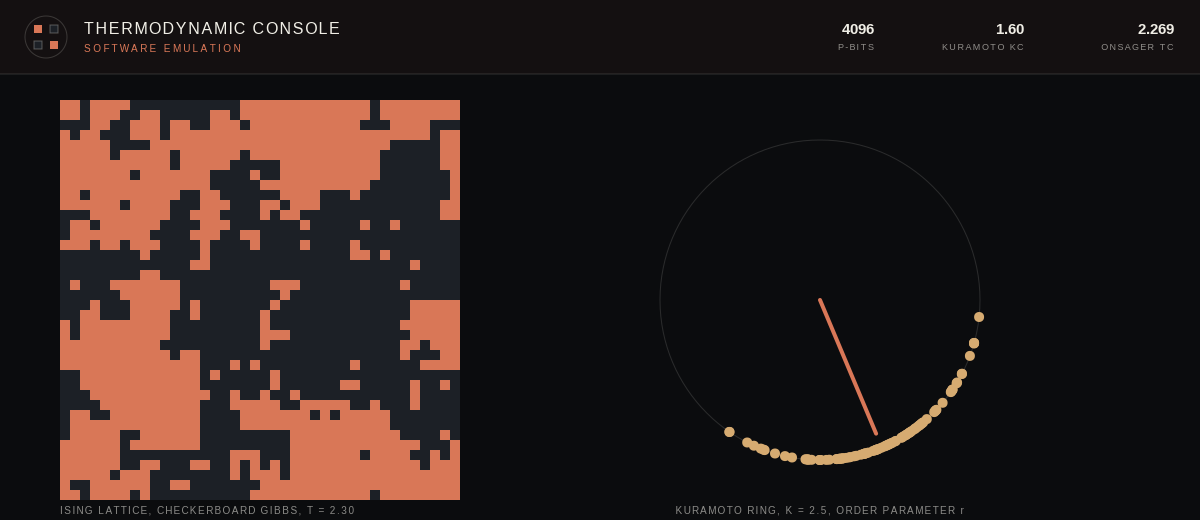
In theories of conscious unity that rely on oscillatory binding (Wolf Singer’s gamma synchrony and Takeru Miyato and Max Welling’s Artificial Kuramoto Oscillatory Neurons, AKOrN), distributed feature representations bind into one perceptual workspace when their phase variables $\theta_i(t)$ lock above a critical coupling strength $K_c$.
When $N$ optical oscillators (such as coupled microring lasers or non-degenerate OPOs) interact through an interferometric waveguide network with coupling matrix $A_{ij}$ in the presence of phase diffusion $D$ (spontaneous emission and thermal refractive-index noise), their phases follow the stochastic Kuramoto equation reviewed by Juan Acebrón and colleagues in Reviews of Modern Physics (2005, DOI: 10.1103/RevModPhys.77.137),
\[\frac{d\theta_i}{dt} = \omega_i + \frac{K}{N}\sum_{j=1}^{N} A_{ij}\sin(\theta_j - \theta_i - \alpha_{ij}) + \xi_i(t), \quad \langle \xi_i(t)\xi_j(t') \rangle = 2 D \delta_{ij}\delta(t - t')\]| where $\alpha_{ij} = \omega_0 L_{ij} / v_g$ is the propagation phase lag across waveguide length $L_{ij}$. In biological tissue, conduction speeds of $1\text{ to }120\text{ m/s}$ make $\alpha_{ij}$ exceed $\pi/2$ whenever the oscillation frequency rises above a few hundred hertz across centimeter cortical distances, breaking phase locking. On an integrated photonic chip ($v_g \approx 1.5 \times 10^8\text{ m/s}$), a $1.5\text{ mm}$ waveguide path incurs a delay of only $10\text{ fs}$. An optical Kuramoto network can therefore sustain phase-locked synchronization ($r = | \frac{1}{N}\sum_j e^{i\theta_j} | \to 1$) at gigahertz to terahertz frequencies whenever the optical coupling exceeds the Lorentzian frequency spread $\gamma$ and phase-noise floor $D$, |
What This Tells Us About Consciousness and Subjective Time
Every technological proposal on this site must state its exact bearing on consciousness science. Moving an oscillatory workspace from a biological $40\text{ Hz}$ ($25\text{ ms}$) integration cycle to a $100\text{ GHz}$ ($10\text{ ps}$) or $1\text{ THz}$ ($1\text{ ps}$) photonic-thermodynamic substrate bears on two foundational disputes.
- Under functionalist theories of temporal binding, subjective time is indexed by the discrete integration cycles of a phase-locked workspace (a hypothesis common to Rufin VanRullen’s discrete perceptual rhythms and global workspace broadcast rounds), so the ratio of internal cognitive steps per external second scales as $\Gamma_{\text{clock}} = \tau_{\text{bio}} / \tau_{\text{opt}}$. Shifting from $\tau_{\text{bio}} = 10^{-3}\text{ to }10^{-2}\text{ s}$ down to $\tau_{\text{opt}} = 10^{-12}\text{ to }10^{-15}\text{ s}$ compresses $10^9$ to $10^{12}$ internal binding cycles into a single external wall-clock second, equivalent to decades or millennia of biological cortical cycles per second, bottlenecked solely by the speed of external sensor and actuator I/O. Conversely, if biological naturalists such as John Searle or neuroevolutionary theorists Todd Feinberg and Jon Mallatt (in their 2026 Behavioral and Brain Sciences commentary) are right that living metabolic chemistry is required for sentience, then a terahertz photonic ring experiences nothing at all regardless of its order parameter $r$.
- A second dispute asks whether operating near the $k_B T \ln 2$ thermal noise floor fragments the causal integration that Giulio Tononi’s Integrated Information Theory and Erik Hoel and Larissa Albantakis’s Causal Emergence (PNAS, 2013, DOI: 10.1073/pnas.1314922110) require. Hoel, Albantakis and Tononi proved that when noisy microscopic elements are coarse-grained into macro-states (such as phase-locked oscillator clusters or Ising attractors), the macro-scale Effective Information
can strictly exceed the microscopic Effective Information $EI(U_m)$. In a photonic-thermodynamic network operating above $K_c$, individual photon shot noise and thermal fluctuations average out across the synchronized macro-cluster while driving transitions between global attractors, preserving positive causal emergence ($CE = EI(U_M) - EI(U_m) > 0$) across the synchronized manifold.
Comparison to The Consciousness AI Architecture
In tlcdv/the_consciousness_ai, our architecture connects directly to three elements of this photonic-thermodynamic blueprint, and our empirical measurements set strict limits on what we claim today.
- Our workspace oscillatory binding layer,
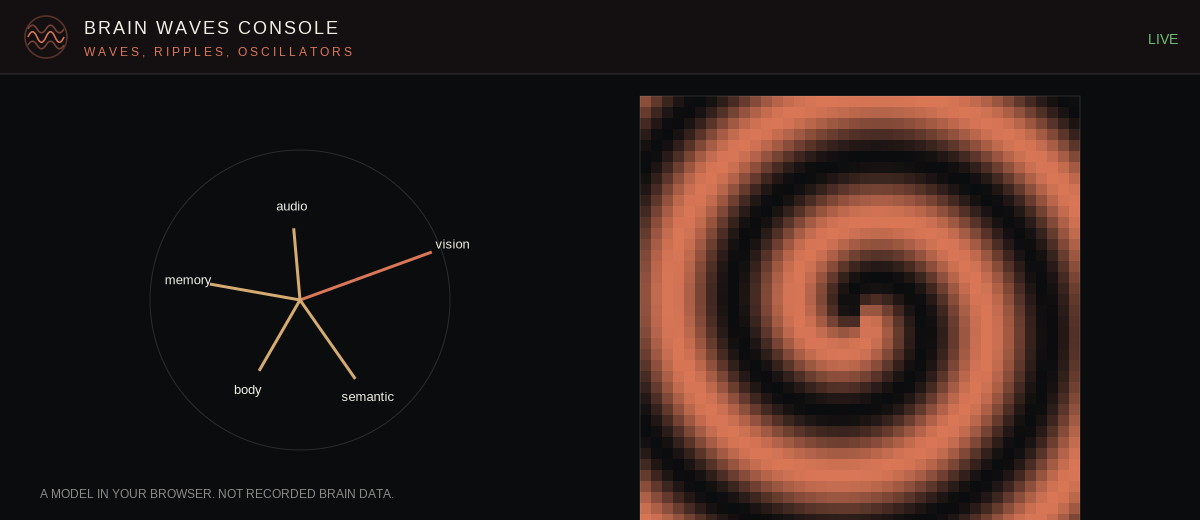
WorkspaceBindingSysteminmodels/core/oscillatory_binding.py, binds five specialist modules using the $N$-sphere Kuramoto update of Artificial Kuramoto Oscillatory Neurons. In September 2026 we fixed a natural-frequency defect behind--akorn-natural-frequency(docs/results/akorn_omega_fix_2026_09.md), restoring continuous phase rotation. However, our content decoding test (docs/results/sync_r_content_2026_09.md) showed that the global order parametersync_Rfailed to encode 6-class stimulus identity across all three seeds ($\eta^2 \le 0.0120$, below the 95th-percentile permutation null). Replacing a GPU step with an optical MZI + OPO ring would accelerate the Kuramoto differential equation by orders of magnitude, but hardware speed does not create feature binding unless the coupling weights $J_{ij}$ separate stimulus manifolds. - Our isolated
models/thermodynamic/package and the open-sourcethermospikelibrary (v0.1.0, DOI: 10.5281/zenodo.23959919) run chromatic block-Gibbs p-bit sampling and compare it against stochastic spiking neurons. On an 8-neuron Boltzmann test, replacing full pseudo-random floats with a 16-bit shift register cut random bit consumption per effective sample from $367.1$ to $176.5$ with no loss in distribution fidelity. - None of our 21 consciousness measurement instruments in
docs/instrument_inventory.md(including our integrated information and causal emergence proxies) is currently trusted, and the architecture implements 3 of the 14 indicator properties from Butlin et al. (2023).
Building a Benchtop Optical-Electronic Hybrid Proof of Concept
While a monolithic $\text{LiNbO}_3$ or GST-on-$\text{Si}_3\text{N}_4$ photonic integrated circuit requires a cleanroom foundry run, builders can test the hybrid loop on a desktop workbench using four functional blocks catalogued on our Photonic-Thermodynamic Substrate section and thermodynamic computing hardware guide.
- For the coherent light source, a collimated $650\text{ nm}$ (
Quarton VLM-650-03 LPA) or $635\text{ nm}$ (Thorlabs CPS635R) visible red laser diode module provides the optical carrier for safe desktop alignment. - For optical routing and interference, a $25.4\text{ mm}$ N-BK7 50:50 non-polarizing beamsplitter cube (
Thorlabs BS013) performs passive $2 \times 2$ linear optical wave mixing at $v_g = c/n_g$. - For the stochastic and nonlinear feedback loop, a $1\text{ ns}$ biased silicon PIN photodetector (
Thorlabs DET10A2, $350\text{ MHz}$ bandwidth) reads the interference port into aSipeed Tang Nano 9KorTang Nano 20KFPGA board (housed in our open 3D-printable Tang Nano 9K case with its 11 Boltzmann vent slots), which injects physical avalanche noise from aTrueRNG v3or a 16-bit LFSR to drive the p-bit and Kuramoto phase update. - For verification and readout, a $200\text{ MHz}$, $1\text{ GSa/s}$ two-channel digital storage oscilloscope (
Siglent SDS1202X-E) measures phase locking and Lissajous trajectories across channels.
The full interactive Bill of Materials with live maker and affiliate links is rendered on the Photonic-Thermodynamic Substrate page and indexed in the thermo-optical-hybrid kit on the hardware kits page.
Open Limits and Where the Evidence Stands
Known on 24 November 2026. Coherent nanophotonic MZI meshes (Shen et al., 2017), all-optical spiking GST networks (Feldmann et al., 2019), 2,000-node OPO Coherent Ising Machines (Inagaki et al., 2016), and room-temperature stochastic magnetic p-bits (Borders et al., 2019) are peer-reviewed, experimentally demonstrated hardware systems. They prove that linear matrix multiplication, nonvolatile synaptic weighting, and Ising or Kuramoto phase relaxation can move from millisecond ionic wetware and resistive CMOS wires into coherent optical waveguides operating within a few orders of magnitude of Landauer’s $k_B T \ln 2$ floor.
Not known. Whether any physical system running on photons, p-bits or silicon transistors instantiates phenomenal experience. Whether subjective duration tracks the physical oscillation frequency of a phase-locked workspace, as functionalist temporal-binding accounts predict, or requires biological metabolism, as Feinberg and Mallatt argue. And in our own research codebase, whether an AKOrN or Kuramoto binding layer can be trained so its phase synchrony carries stimulus content on unmemorized inputs. Those three questions define the experimental program ahead across the Photonic-Thermodynamic Substrate section, the Thermodynamic Computing hub, Brain Emulation, and Project Consciousness to Orbit.
Primary Sources
- Shen, Y., Harris, N. C., Skirlo, S., Prabhu, M., Baehr-Jones, T., Hochberg, M., Sun, X., Zhao, S., Larochelle, H., Englund, D., & Soljačić, M. (2017). Deep learning with coherent nanophotonic circuits. Nature Photonics, 11(7), 441-446. DOI: 10.1038/nphoton.2017.93
- Feldmann, J., Youngblood, N., Wright, C. D., Bhaskaran, H., & Pernice, W. H. P. (2019). All-optical spiking neurosynaptic networks with self-learning capabilities. Nature, 569(7755), 208-214. DOI: 10.1038/s41586-019-1157-8
- Shastri, B. J., Tait, A. N., Ferreira de Lima, T., Pernice, W. H. P., Bhaskaran, H., Wright, C. D., & Prucnal, P. R. (2021). Photonics for artificial intelligence and neuromorphic computing. Nature Photonics, 15(2), 102-114. DOI: 10.1038/s41566-020-00754-y
- Inagaki, T., Inaba, K., Hamerly, R., Inoue, K., Yamamoto, Y., & Takesue, H. (2016). A coherent Ising machine for 2000-node optimization problems. Science, 354(6312), 603-606. DOI: 10.1126/science.aah4243
- Landauer, R. (1961). Irreversibility and Heat Generation in the Computing Process. IBM Journal of Research and Development, 5(3), 183-191. DOI: 10.1147/rd.53.0183
- Conte, T., et al. (2019). Thermodynamic Computing. arXiv:1911.01968
- Borders, W. A., Pervaiz, A. Z., Fukami, S., Camsari, K. Y., Ohno, H., & Datta, S. (2019). Integer factorization using stochastic magnetic tunnel junctions. Nature, 573(7774), 390-393. DOI: 10.1038/s41586-019-1557-9
- Coles, P. J., Szczepanski, C., Melanson, D., Donatella, K., Gordon, M. H., Ahle, T., & Crooks, G. E. (2023). Thermodynamic AI and the fluctuation frontier. arXiv:2302.06584
- Acebrón, J. A., Bonilla, L. L., Pérez Vicente, C. J., Ritort, F., & Spigler, R. (2005). The Kuramoto model: A simple paradigm for synchronization phenomena. Reviews of Modern Physics, 77(1), 137-185. DOI: 10.1103/RevModPhys.77.137
- Hoel, E. P., Albantakis, L., & Tononi, G. (2013). Quantifying causal emergence shows that macro can beat micro. PNAS, 110(49), 19790-19795. DOI: 10.1073/pnas.1314922110
- Chuang, S. L. (2009). Physics of Photonic Devices (2nd ed.). Wiley. ISBN 978-0470293195. Amazon affiliate link
- Leff, H. S., & Rex, A. F. (Eds.). (2002). Maxwell’s Demon 2: Entropy, Classical and Quantum Information, Computing. IOP / CRC Press. ISBN 978-0750307598. Amazon affiliate link
Researchers covered here
-
 Yoshihisa YamamotoProfessor Emeritus of Applied Physics and Electrical Engineering, Stanford University; NTT Research Physics and Informatics LaboratoriesCoherent Ising Machines built from degenerate optical parametric oscillators (Science, 2016), quantum optics of semiconductor microcavities, and exciton-polariton condensates
- Takahiro InagakiNTT Basic Research Laboratories, NTT CorporationFirst author of the 2,000-node Coherent Ising Machine demonstration using time-division-multiplexed optical parametric oscillators (Science, 2016)
-
 Marin SoljačićProfessor of Physics, Massachusetts Institute of TechnologyCoherent nanophotonic Mach-Zehnder interferometer circuits for optical matrix multiplication (Nature Photonics, 2017), photonic crystals, and nonlinear nanophotonics
- Yichen ShenDepartment of Physics, Massachusetts Institute of Technology; Co-founder, LightelligenceFirst author of the coherent nanophotonic Mach-Zehnder interferometer processor paper (Nature Photonics, 2017) and commercial optical inference accelerators
- Wolfram PerniceProfessor of Experimental Physics, Kirchhoff Institute for Physics, Heidelberg University; University of MünsterAll-optical spiking neurosynaptic networks using phase-change chalcogenide (GST) waveguide synapses (Nature, 2019) and integrated superconducting nanophotonics
- Johannes FeldmannInstitute of Physics, University of Münster; Department of Materials, University of OxfordFirst author of the all-optical spiking neurosynaptic network with phase-change Ge2Sb2Te5 synapses and microring resonators (Nature, 2019)
-
 Bhavin J. ShastriQueen's University, Kingston; Department of Physics, Engineering Physics and AstronomySilicon photonic neuromorphic processors, excitable semiconductor lasers as spiking optical neurons, and the physical bandwidth-energy limits of photonic AI (Nature Photonics, 2021)
-
 Paul R. PrucnalProfessor of Electrical and Computer Engineering, Princeton UniversityBroadcast-and-weight photonic neuromorphic architecture, silicon photonic microring weight banks, and ultrafast optical spiking networks (Nature Photonics, 2021)
- Rolf LandauerIBM Thomas J. Watson Research Center (1927-1999)Landauer's principle, the thermodynamic minimum heat generation of k_B T ln 2 per erased bit of information (IBM Journal of Research and Development, 1961)
- Kerem CamsariDepartment of Electrical and Computer Engineering, University of California, Santa BarbaraThe p-bit, a binary unit that fluctuates at random under the control of its inputs, and probabilistic computers built from p-bits on FPGAs, including a networked machine with one million p-bits (arXiv 2606.25313, 2026)
-
 Supriyo DattaElmore Family School of Electrical and Computer Engineering, Purdue UniversityQuantum transport theory of nanoscale devices, the Datta-Das spin transistor proposal (1990), and co-authorship of the p-bit framework for probabilistic computing (2017, 2019)
- Patrick ColesChief Scientist, Normal ComputingThermodynamic linear algebra (npj Unconventional Computing, 2024), the first thermodynamic matrix inversion on a circuit board (2023), and the scientific roadmap of Normal Computing's CN101 chip
- Erik HoelCenter for Humanities and Sciences, Tufts UniversityFormal theory of Causal Emergence (macro over micro causation), The Overfitted Brain Hypothesis of Dreams, The World Behind the World (2023), The Kleiner-Hoel Dilemma
- Wolf SingerMax Planck Institute for Brain Research, FrankfurtThe temporal binding hypothesis, gamma-band synchrony as the mechanism for conscious feature integration